
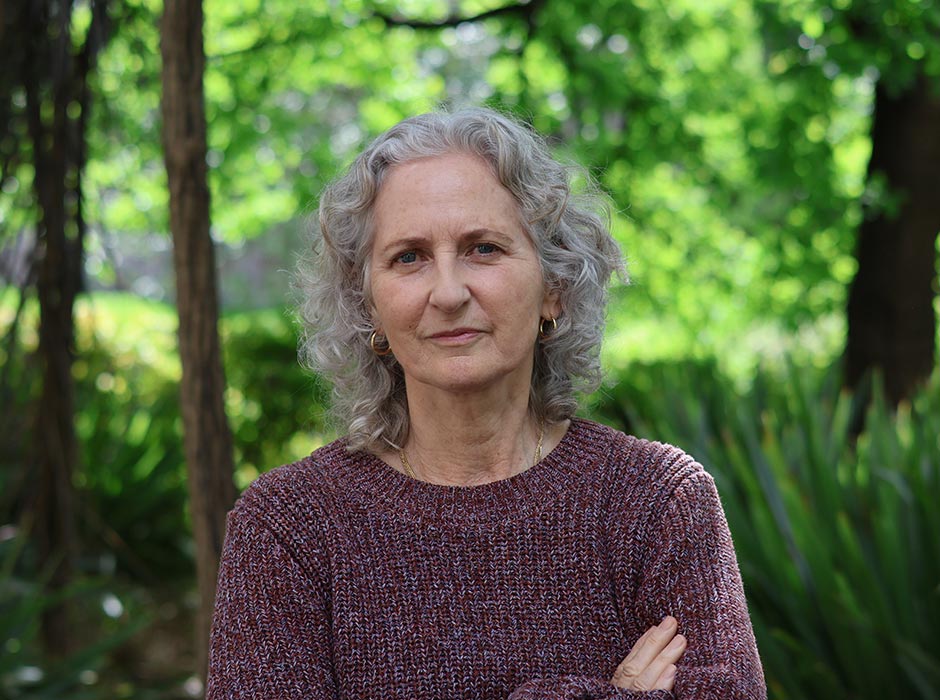
Zoology Professor Yolanda van Heezik welcomes the proposed changes to the Dunedin City Council’s Keeping of Animals Bylaw. “We’ve completely changed our attitudes towards dogs, and we can change our attitudes about cats.”
Due in part to the advocacy of Zoology Professor Yolanda van Heezik, Dunedin City Council is proposing a change to the Keeping of Animals Bylaw that would require cats to be microchipped and de-sexed.
But though Yolanda would welcome stricter control of frisky felines, she’s no cat-hating curmudgeon.
“I grew up with cats, and I watch cat videos on YouTube like everyone else. They are extremely charming animals, there’s no doubt about it,” she says.
“Everyone loves cats, but someone has to stick up for the other animals – and I’m that someone.”
Yolanda began her career advocating for endangered animals in the Kingdom of Saudi Arabia.
“My husband and I met doing our PhDs in Zoology at Otago,” she says.
“Later we were employed at the National Center for Wildlife in Saudi Arabia, contributing to the captive breeding and release of two species: the Houbara Bustard [bird] and the Arabian Oryx – a white, long-horned antelope thought to have inspired the unicorn myth.”
The couple returned to Dunedin with a son in tow, and Yolanda turned her mind to urban ecology.
“Part of that was looking at the predators in urban environments, and that’s how I got onto cats,” she says.
Due to the activities of cats and other introduced predators such as hedgehogs, rats, mice, mustelids – and of course, humans – the populations of many of our native birds and lizards are now greatly reduced.
“Lizards are very much affected by cats as predators,” Yolanda says.
“I’ve got a trail camera in my garden, and there are seven cats that pass through my garden regularly. That’s probably why I don’t have any lizards, even though I’ve created a lizard habitat.
“Grass skinks should be found all across Dunedin, but they’re not. That’s mostly due to cats, which are the most abundant predator in Dunedin. We’ve estimated the abundance of cats to be around 225 per square kilometre in a traditional type of suburb.”
But Yolanda’s not on a mission to eradicate the furry felines.
“Cats are really valuable companions, and I would never deny that,” she says, recalling the beloved pet cats she’s had in the past.
But those of us who love the charismatic creatures are notorious for underestimating their abilities.
“Every part of any urban area is regularly traversed by multiple cats. On average a cat will roam over 16 properties with a home range of about three hectares – and if they live on the edge of town their home range expands hugely. We tracked a domestic cat called Dylan in Leith Valley, and he covered 28 hectares in three days,” Yolanda says.
It’s also easy to underestimate how active a cat is as a predator, on the basis of what prey the cat brings back home.
“Studies using ‘kittycams’ show cats bring back only about a quarter of the animals that they kill, with most prey eaten on site or left behind.”
But why focus on pets? Doesn’t the problem lie with the unowned cats that have to hunt to survive?
Yolanda says the distinctions between owned, stray and feral cats are surprisingly blurry, and that’s why mandatory de-sexing is important.
“One of my post-graduate students showed, through genetics, that the feral population of cats in the Waitaki Basin was being supplemented by the domestic population, probably through the dumping of unwanted cats. Dumped cats also reinforce stray cat populations in urban areas, which are sometimes fed by people who are well-meaning but don’t take on the full responsibility of caring for them. Those cats often have quite poor health, and they’re still breeding and killing wildlife.”
In the end, the problem is less about cats, and more about humans.
“There’s a management strategy called ‘trap neuter return’ where you trap, neuter and vaccinate a stray cat, and then return or rehome it. The idea is that over time the population will slowly decline,” Yolanda says.
Unfortunately, the strategy has limited success.
“You need to rehome at least fifty per cent of the population to have any hope of reducing numbers, and that’s probably because people will abandon their cats close to places where there are lots of strays, so they feel less guilty.”
For all her tough talk, Yolanda wouldn’t rule out getting another pet cat in the future.
“I would have an indoor cat with a ‘catio’ that it could go and sit in, and lots of enrichment.”
Tips for cat owners
- Ensure your cat is microchipped and de-sexed
- Keep your cat indoors. This will also reduce injury and vet bills
- Consider adopting your next cat from an organisation like the SPCA or Cat Rescue rather than buying from a breeder
- If you can no longer care for your cat, rehome it rather than dumping it
– Kōrero by Kathryn van Beek, Communications Advisor | Kaiarataki Pārokoroko
Te Tari Mātai Kararehe
Zoologists study how animals evolved, their behaviour, physiology and ecological interactions, and how to conserve populations in the face of global change.
Study Zoology