
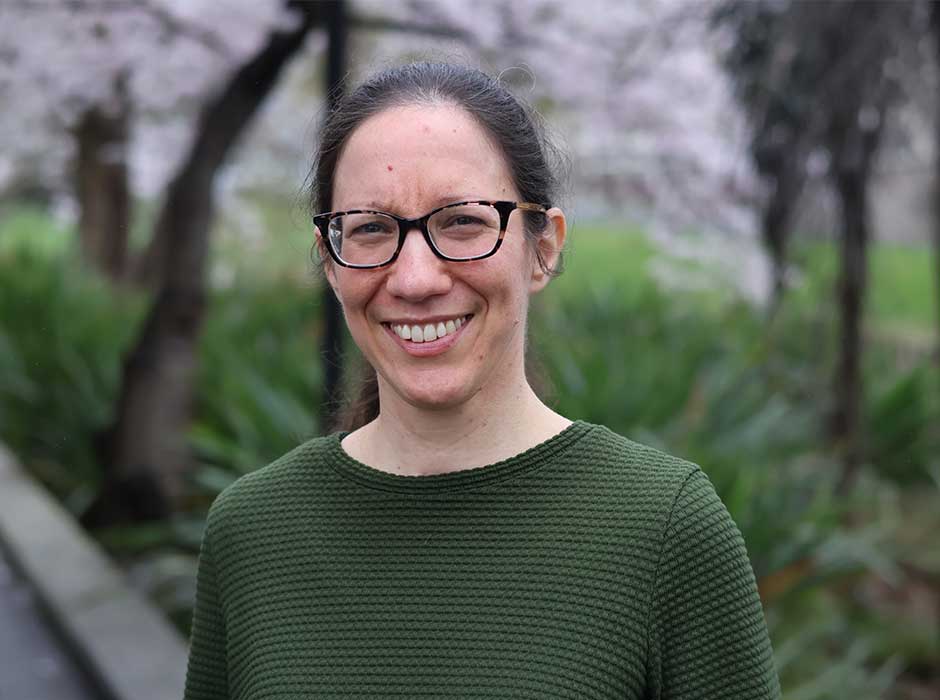
Dr Ana Stojanov, who won an Early Career Award for Distinction in Research for her work on human-AI interaction and conspiracy beliefs, is originally from Macedonia. “We were considering moving to Australia or New Zealand. My husband said there were snakes in Australia, so I said okay, let’s go to New Zealand,” Ana says.
A high school interest in astronomy led Dr Ana Stojanov, now a Senior Lecturer in Science Communication, to become one of the first psychologists in the world to study conspiracy theories.
“You have probably heard the conspiracy that the moon landing was fake?” Ana asks.
“My classmates and I were debating how people can believe that, when all the reasons for the conspiracy have been debunked by science. I became interested in why people would believe conspiracy theories.”
In our post-pandemic era conspiracy theories abound, but scientific knowledge about why some people are more likely to believe them was low when Ana embarked upon her research.
“I was among the first psychologists to study conspiracy theory beliefs,” she says.
“My PhD was focused on whether people would be more likely to believe in conspiracy theories if they feel they lack control in their lives.”
In fact, literature shows that there’s generally more than one issue at play.
“There are factors like anxiety, uncertainty, or being on the losing side of an election or sports match. Social crises like pandemics, wars and natural disasters can trigger conspiracy beliefs because of the uncertainty they cause,” Ana says.
“There’s a theory that people have a need to feel in control and perceive order, and when we don’t, we ascribe power to other entities so we can perceive that order.”
Believing that Elvis lives might seem like harmless fun, but conspiracy theories can have real-world consequences. And the problem with debunking disinformation is that it’s ‘sticky’.
“Myth busting is very tricky, because repeating the misinformation reinforces the memory traces in people’s minds,” Ana says.
“So, instead of saying [potatoes]* don’t cause [people to turn blue], say [potatoes] are safe. Because when you try to debunk the verbatim bit – [people turning blue] – people might still believe the gist that [potatoes] are not safe.”
Ana says that even being exposed to conspiracy theories lowers trust.
“Even hearing a conspiracy you don’t believe – say, that [bookstores] [hide their best books] – will lower your trust in [bookstores]. But if you teach people the strategies that misinformation spreaders use – like polarising opinions, and faking expertise – they’ll be looking for the tactics and on the alert.”
Ana submitted and defended her thesis during the early months of the Covid-19 pandemic and the resulting deluge of disinformation, so her work was particularly timely. But she’s now moved on to another hot button topic – human-AI interaction.
“I became interested in AI’s potential for learning, and how students use it,” Ana says.
“We found that there were very few students who used it dishonestly. Most used it in a way that benefits their learning.”
But like every technology, Ana says AI is a “double-edged sword”.
“People need to be informed and understand the potential and the threat. AI has lots of potential to do good – but so did social media, which was supposed to connect us. AI, in theory, is great – but it has been trained on copyrighted material, and it uses a lot of water to cool the machines.”
Ana’s taking a thoughtful approach to her own use of AI.
“Large Language Models are helpful for writing codes for data analysis, and I’m interested in whether chat bots can imitate people at a group level for studies in social psychology,” she says.
“But when I write, that’s when I think. When I have an idea for a study, I want to write it down so it’s clear and crystalised. Writing is a process – it’s not typing. I use AI less and less for writing because I noticed it took away the process from me.”
Ana works for the Science Communication programme, where from next year she’ll teach a paper called Science Communication in the Post-Truth Era.
“We’re going to cover topics like the science of misinformation, trust in scientists, scientific fraud, and how scientific research is being influenced by people with vested interests. We’ll provide a toolbox for effective science communication.”
The distance-based programme, which offers a postgraduate certificate and diploma, also has a popular internship paper.
“Students are interning at places like Auckland Zoo, the Ocean Media Institute, Forest & Bird, and the World Science Festival.”
In the age of disinformation and AI slop, effective science communication is increasingly important.
“In today’s society where we have science denial, it’s very important for researchers to be able to communicate science to the public. Science is essentially funded by the public, so the public needs to understand what scientists are doing for society,” Ana says.
“For democracy we need a society that can make informed decisions, so as a society we can come up with solutions to the problems we’re facing.”
When she’s not teaching or researching, Ana can be found winning accolades. Her PhD thesis was named an “Exceptional Doctoral Thesis”, her peer reviewed articles have been cited more than 2.5 times the world average, and she recently won an Early Career Award for Distinction in Research.
A psychologist might say her drive can be explained by both nature and nurture.
“My father is very interested in my success. Sometimes when I share that a paper has been accepted for publication, he will be the one to see that is has been published online even before I do,” Ana says, adding that her parents are both Psychology professors.
“I want to make my parents proud.”
*Words redacted and replaced to avoid making disinformation ‘sticky’.
-Kōrero by Kathryn van Beek, Communications Advisor| Kaiarataki Pārokoroko