
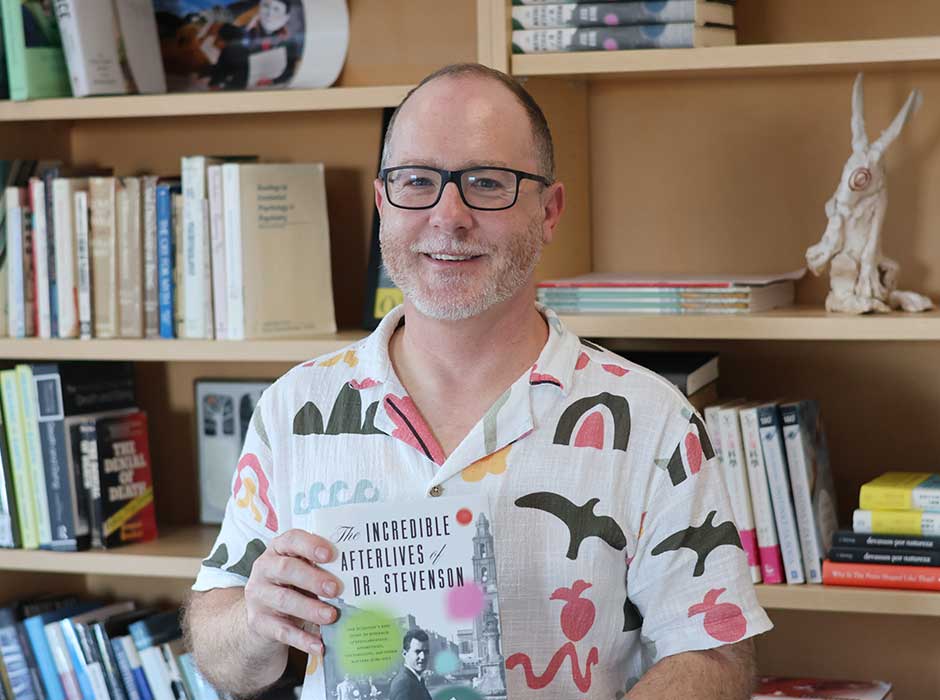
Professor Jesse Bering with his new book, The Incredible Afterlives of Dr Stevenson. The biography tells the tale of a psychiatrist who travelled the globe investigating cases of reincarnation, apparitions, possessions, and near-death experiences.
With book titles including Perv, Suicidal and Why is the Penis Shaped Like That?, Professor Jesse Bering, Head of the Science Communication Programme within the Department of Psychology, has a knack for getting people to engage with his work.
“I look into controversial, taboo topics, because when you address them in a scientific, amoral fashion, you can learn a lot,” Jesse says.
He brings this ethos to his new book, the Incredible Afterlives of Dr Stevenson, the biography of a respected psychiatrist who experimented with psychedelics and mescaline, took a career swerve from psychosomatic medication to the paranormal, and was rejected by many of his peers in the process.
But the story’s not quite as clear-cut as it first appears.
“I took Ian Stevenson seriously and became convinced he was an honest, meticulous scientific figure who was not about self-aggrandisement,” says Jesse, who identifies himself as a “hardcore sceptic” when it comes to matters of the afterlife.
“Stevenson had a non-religious, medicalised view of reincarnation. He presented convincing and eloquent scientific evidence, but he was never taken seriously by the peers he wanted to impress. I think he had some compelling cases … but I’ll leave that to the reader to decide.”
Jesse’s interest in the afterlife was formed in childhood, when he noticed his churchgoing father and Jewish mother had different views on life after death.
“I don’t want to psychoanalyse myself, but I knew they couldn’t both be right,” he says.
The topic became personal when Jesse’s mother later grew unwell, and the pair had “frank and sometimes funny” conversations about what life after death might be like.
“I’m curious about why something that should be so obvious – that when you die, your brain stops working – can feel so counterintuitive.”
After completing a PhD in psychology, Jesse developed twin careers as a researcher and science writer. With five books and many articles to his name, now including a weekly column at the French magazine Le Point, Jesse’s an accomplished science communicator – and he’s sharing the tricks of the trade.
“A lot of people have a science story to tell. In the Science Communication programme, we can help them find that story, bring it to life, and perhaps even put together a book proposal and connect them with key industry insiders.”
Science Communication students come from all walks of life, all over the world, and with a variety of interests from kelp forests to space travel to human decision-making.
“We attract scientifically savvy students who have creative flair. We get people who’ve just come out of undergraduate degrees, and we get working professionals with PhDs from government, conservation groups and universities who are doing it for their professional development. It’s perfect for them because it’s flexible and online.”
With student placements that have included the BBC, Wellington Zoo, Project Jonah and the Ocean Media Institute, and the opportunity to work on projects from museum exhibits to podcasts, the programme imparts practical skills that make for sought-after graduates. It also shares some of Jesse’s taste for the taboo.
“We’ve got a new paper launching next year about science communication in the era of science denialism. Human psychology is easily seduced by misinformation, emotional salience, and other powerful forces. The paper examines challenges in the context of misinformation, AI and other looming threats.”
For all his dark obsessions, articles with titles like Why Do Dogs Rub Up Against Things That Smell Bad? and Scientists Finally Figured Out What Makes Pets Look Like Their Owners – and a screenshot of his border terrier Hanno on his phone – hint at another passion, which is confirmed when Jesse reveals what he would choose to be reincarnated as.
“A well-loved dog. Though I think I’d prefer nirvana.”
-Kōrero by Kathryn van Beek, Communications Advisor | Kaiarataki Pārokoroko
Department of Science Communication
We connect people with science to inspire wonder, nurture greater understanding of the natural world, and empower meaningful action to address society's greatest challenges.
View