
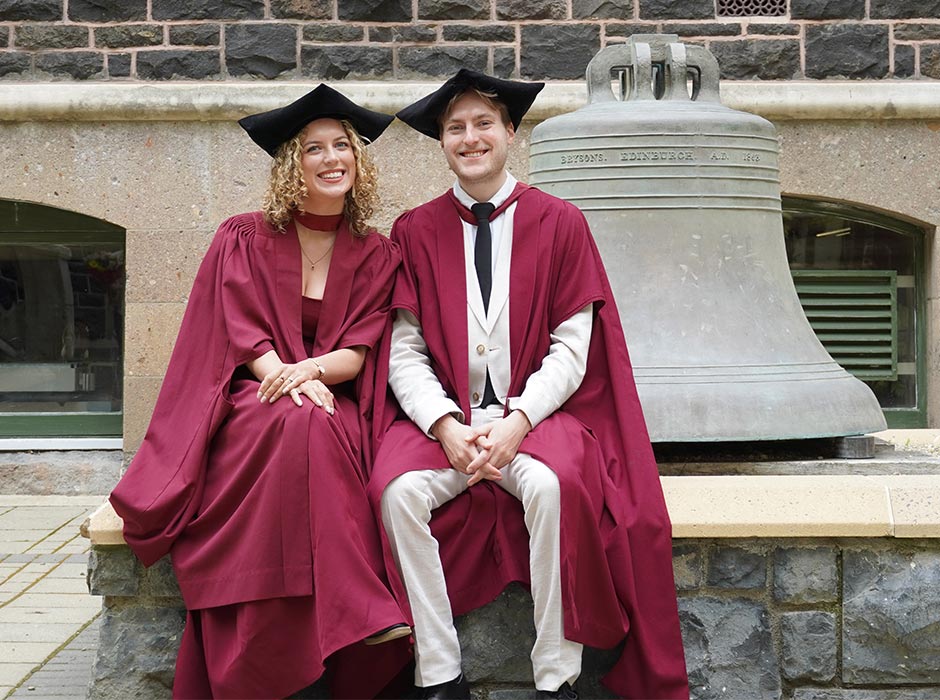
Siblings Drs Emma Anderson and Ben Sutherland graduated on Saturday, the first PhDs in their family. Seen here at the bell in the Quad on the Dunedin Campus, which PhD candidates ceremoniously ring on submitting their thesis.
The next time someone asks if there’s a doctor in the house, not one, but two hands will go up in the Sutherland household.
Sibling Drs Emma Anderson and Ben Sutherland graduated on Saturday, Emma with a PhD in Bioethics and Ben with a PhD in Chemistry. The brother and sister duo are the first PhDs in their family.
Emma says she feels “really proud of us”.
“We have come a long way, and while it was always a distant dream when we were young, I don’t think we thought we would get here.”
Doing a PhD alongside her brother has been the best experience, Emma says.
“A PhD is a really unique experience, so it has been so nice to be able to share it with Ben, sharing the highs and lows over coffee or lunch breaks.
“I tested a lot of ideas with Ben. His brain works differently to mine, so I always found it helpful to have a second opinion.”
Their mum, Felicity Sutherland, who raised them solo, played “a huge part in getting us here”.
“She has always been so supportive of us.
“She taught us to be curious about the world and to do everything with integrity and care. So even though our fields are different, I think Ben and I both reflect that in our work.”
A PhD is not the only thing the siblings have in common. They both started and ended their tertiary education journeys at Otago, and both their theses had a connection to Covid-19.
Emma’s PhD addressed the question of whether New Zealand has ethical obligations to global health that extend beyond its national borders, using the Covid-19 pandemic as a case study.
“With New Zealand’s response to the pandemic as a backdrop, I examined the interplay between two ethical frameworks: Nationalism – which says that primary moral obligations lie within state borders, and Cosmopolitanism – which argues that health justice is grounded in the equal moral worth of all persons, and that there is shared responsibility across borders.
“While the pandemic exposed the limitations of inward-looking, nationalist approaches – such as vaccine nationalism – it also demonstrated the urgent need for a more ethically robust and inclusive cosmopolitan framework.
“I argued that the goal of global health is to move towards mutual interest of all people, both local and global, rather than a global game of self-interest.”
“I still remember her forcing me to play fairies when we were little. And now we have conversations about how annoying publishing papers can be, or the socio-economic implications of Covid-19 vaccines. It’s definitely really cool having a shared achievement, though, and will definitely make the whole graduation day feel that much more special.”
- Ben Sutherland
Ben’s PhD focused on novel ways to design liposomes – nanoparticles made up of phospholipids that can be used as a drug delivery vehicle – so that they can release drugs only in response to exposure from an external stimulus such as ultrasound or laser light.
“When I first started my PhD, I went through quite a few different project ideas, with almost all of them focusing on making liposomes for use in drug delivery.”
A conference in Glasgow introduced the Covid-19 angle into Ben’s research.
“The conference had lots of presentations on the Covid-19 vaccine, which uses a nanoparticle technology similar to liposomes.
“This made me curious if we could use some of the advances made for the Covid-19 vaccine to improve the ability of liposomes to transport other therapeutic agents, with some promising results so far.”
Working through his PhD with his sister was like having a motivator along for the ride, Ben says.
“We definitely had a fair few shared coffee breaks throughout our PhDs. It was always a good time to share ideas, practice ways to articulate what we were writing, or just decompress about the week’s work.
“Being in different fields also helped. In hard science, it’s easy to forget about the wider applications and implications of research, so an outside perspective from Emma was nice.”
Becoming Doctors on the same day is quite surreal, Ben says.
“I still remember her forcing me to play fairies when we were little. And now we have conversations about how annoying publishing papers can be, or the socio-economic implications of Covid-19 vaccines.
“It’s definitely really cool having a shared achievement, though, and will definitely make the whole graduation day feel that much more special.”
So who submitted their thesis first?
“Ben did, and he makes sure I know it,” older sister Emma says with a smile.
“We will graduate on the same day, but I will walk across the stage first. He does hold the title for being the first to complete, so I concede that to him.
“It was actually a good motivator for me to finish on time, so we could both graduate together. Otherwise, I really would never hear the end of it!”
~ Kōrero by Sandra French, Adviser, Internal Communications
Otago PhD programme
Become an expert in your subject area and make a positive impact on society, the economy, and the environment through your research.
Find out more