
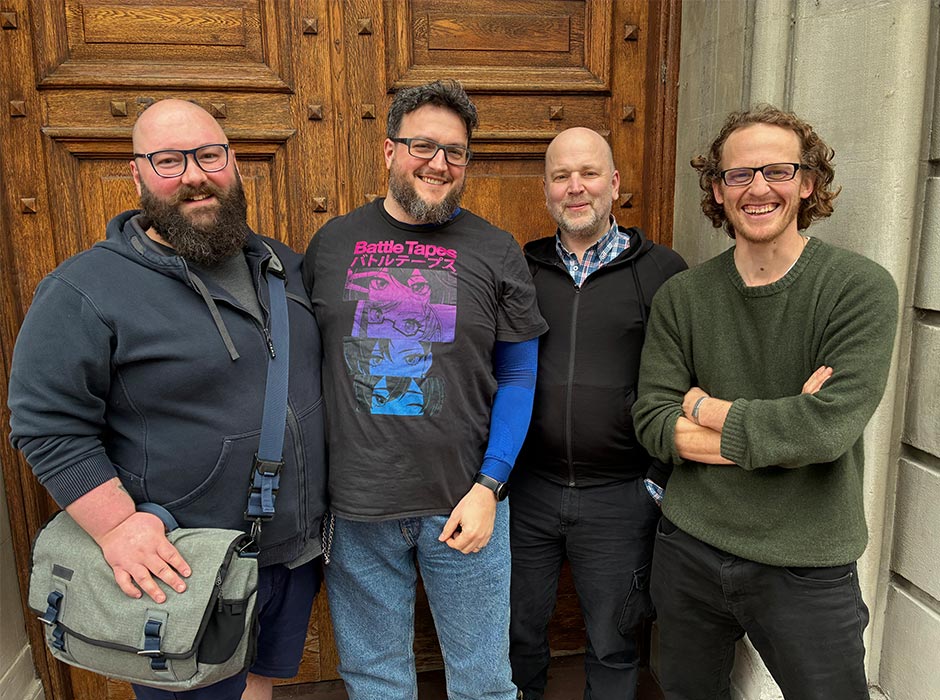
From left: Zoology Teaching Fellow Joseph Cahill-Lane, Senior Lecturer Bart Geurten and Associate Professor Paul Szyszka are joined by Senior Lecturer David Jenkins (Political Theory) for some world building at the entrance to the Department of Zoology, Marples Building.
Forget Dungeons and Dragons, it’s Basements and Aliens in the steampunk surrounds of Zoology's historic Marples Building.
This is where one of the oldest elevators in the Southern Hemisphere conveys state-of-the-art equipment from glass-walled labs to the old stone basement, and students use mind-bending technology to solve problems that are out of this world.
ZOOL412 Neurobiology and Behaviour may be a University paper, but it’s also an immersive, interactive simulation that sends postgraduate students on an extraterrestrial academic quest designed to give them the feeling of making a scientific breakthrough.
“That feeling of discovery – to me, that’s the essence of science. We wanted to capture that feeling in a bottle for students,” says Senior Lecturer Bart Geurten, who developed the paper with Teaching Fellow Joseph Cahill-Lane.
The pair has created a world in which students have been hired by a fictional company to give them information about an alien animal on a distant planet. Students work in groups, taking turns assuming roles such as team leader, reporter and neuroscientist, wrangling imaginary concerns alongside real-world applications.
“We give them made-up but real-looking data, so they’re doing real work but in a fictional context. Because they’re working on an alien animal, they can’t go onto Google Scholar and find an expert who’s already done the research,” says Joseph, whose background in creative writing honed his world-building skills.
“The simulation is filled with different characters. One was a crypto bro, and the students hated him so much they wanted him to get fired. There are also underlying ethical problems. How will the students react if the company orders them to, say, flood the animal’s colony?”
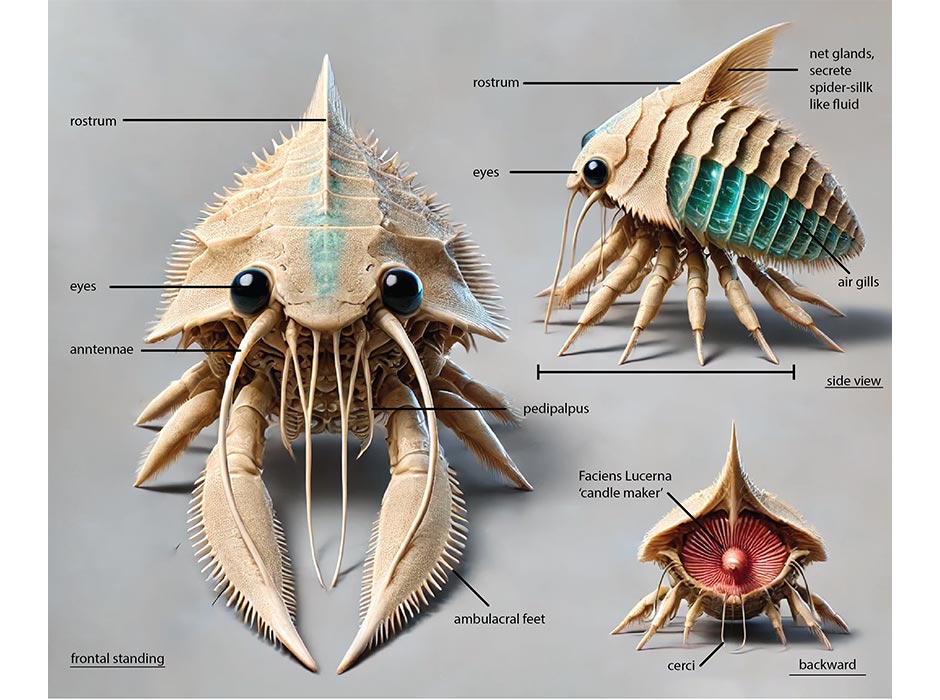
An artist’s impression of an alien animal from the fictional planet “Gliese 9347C”.
Bart says the fictional world, which is filled with hidden ‘Easter eggs’, even has its own economy.
“Students can see if a rival company’s stock is going up, and if the work they’ve done has impacted the stock exchange.”
Each week the students plan an experiment, lay out the variables, generate data and submit their results. And it’s not only the work that’s real – the students are sent off to interview a variety of academics from across the University of Otago and beyond.
“We’ve been surprised that people have been happy to be part of our weird thing, but there’s nothing an academic enjoys more than being asked about their topic,” Bart says.
“We sent a student off to an emeritus colleague of ours, and they spent six hours in the professor’s garage printing 3D robots and discussing science. But the students can’t tell the academics too much, because in the world of the simulation, everything’s commercially sensitive.”
“We’ve been surprised that people have been happy to be part of our weird thing, but there’s nothing an academic enjoys more than being asked about their topic.” – Senior Lecturer Bart Geurten
The fictional research is hampered by other considerations found in the real world.
“They get told they get 12 million yen to run their experiments for a year, but they immediately lose half of it through university overheads,” Bart says, with more than a hint of schadenfreude.
Joseph says the paper, which launched in 2024 and is about to run for the third time, has received “really positive” feedback from students. It’s also had some unexpected benefits.
“There’s a huge social element, and the students have become friends. From the first cohort, three of the students who met in the paper ended up going flatting together.”
Friendship isn’t the only social contagion spreading thanks to Bart and Joseph’s work – there’s an active outbreak of simulations across the University. Business School colleagues are developing a simulation-based course of their own, and Senior Lecturer in Political Theory David Jenkins is poised to run his own interactive paper, POLS399 Political Actors in Action, next year.
“Politics students will experience the different roles – leaders, partisans, revolutionaries, artists and Indigenous political groups – they learn about in the first part of the paper, as they attempt to advance their faction's cause. The simulation’s a great way to experience politics, and struggles for justice, in a heightened but fictional setting,” David says.
But back to Zoology … what will become of the alien animal? Can its habitat be saved? Will it escape the Machiavellian schemes of the crypto bro?
You’ll have to enrol in ZOOL412 to find out.
Zoology at Otago
Zoologists study how animals evolved, their behaviour, physiology and ecological interactions, and how to conserve populations in the face of global change.
More about Zoology