
Monday 14 November 2022 3:24pm
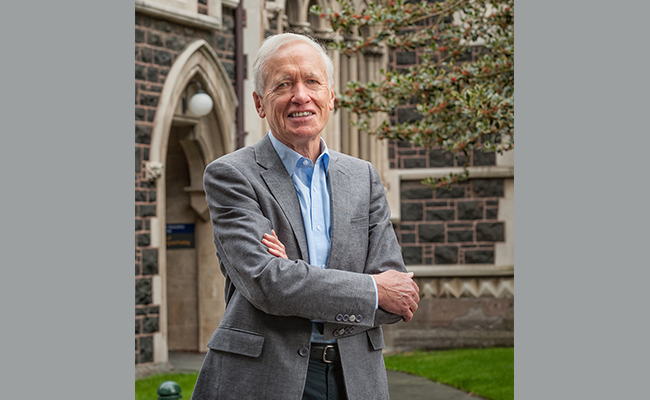
Professor Sir David Skegg KNZM OBE has been celebrated for his leadership in health and epidemiology after being presented with the Blake Medal by BLAKE (formerly the Sir Peter Blake Trust).
Sir David lead the University of Otago as its Vice-Chancellor for seven years from 2004.
He has devoted his life to academic study and public health, contributing his expertise to globally significant issues such as HIV/AIDS, Mad Cow Disease and more recently, New Zealand’s response to COVID-19.
Sir David has also been the chair of numerous health-related groups, councils, commissions, and committees, both in New Zealand and overseas.
His work with the World Health Organisation has helped to improve the reproductive health of countless people in developing countries.
In Aotearoa New Zealand he helped establish our national cervical screening programme and chaired the group that advised government on our response to the Covid-19 pandemic.
University of Otago Vice-Chancellor Professor David Murdoch offered his congratulations to Sir David on the outstanding achievement.
“This award is richly-deserved recognition for Sir David Skegg’s lifetime of service working tirelessly to improve health outcomes for people across the globe, not least providing vital scientific leadership to the New Zealand Government throughout the Covid-19 pandemic.”
BLAKE chief executive, James Gibson, says Sir David’s career is an inspiration to all those who wish to improve the world around them through the study and practice of science.
“Sir David’s extraordinary leadership over multiple decades stems from his consistent dedication to the betterment of human knowledge and public health.”
Sir David tells BLAKE that it is his work on cervical cancer that has given him the greatest satisfaction of his career.
“After I came back to New Zealand, my colleagues and I realised we were facing an approaching epidemic of cervical cancer in young women,” he says.
“It took about 10 years – including all the traumas of the Cartwright Inquiry – before we got a good cervical screening programme, but it is now saving many lives.”
Sir David has garnered many prestigious awards for his health research and leadership, including the Royal Society of New Zealand’s Sir Charles Hercus Medal, the University of Otago’s Distinguished Research Medal, an OBE for services to medicine and, in 2009, a knighthood.
His leadership skills are also recognised in the international arena.
For instance, he was heavily involved with a long-running World Health Organization programme to improve sexual and reproductive health in developing countries.
“Geneva seemed like my second home – I travelled there nearly 50 times,” Sir David says.
“I found it a real privilege to become friends with people from very different cultures, and some of the world’s best scientists in my field were involved.”
Leaders tend to meet other leaders and, over the years, Sir David has worked with many great ones. He’s also worked with some poor ones, and many who are somewhere in-between.
“I think that everyone has got the capacity to be a leader in some sphere of their life, just like we all need to be followers in certain situations,” says Sir David.
He tells BLAKE what qualities he sees great leaders needing.
“Leaders need integrity – people need to be able to trust what they say – energy, and the ability to energise other people and to inspire morale.
“Leaders also need vision, and they also have to be willing to accept criticism. I think that’s very important. And a sense of humour helps as well.”
Three times in Sir David’s career, he has had to drop much of his work to focus on an urgent infectious disease problem.
The first time was during the 1980s for the HIV/AIDS pandemic and the second was in 1996, when it was discovered that ‘mad cow disease’ was linked to a horrible brain disease in young adults.
The third time was in 2020, when Sir David was asked to be a special advisor to Parliament’s Epidemic Response Committee dealing with Covid-19.
He has since become even more heavily involved with the pandemic, chairing the Strategic Covid-19 Public Health Advisory Group that advised the Government on issues such as re-opening borders as New Zealanders got vaccinated.
Sir David says Covid-19 is not going away and will continue to evolve. The biggest challenge for many people will be living with an uncertain future.
“Despite our poor preparation, all New Zealanders can be proud that the response of this country has so far been second to none,” he says.
“We’ll learn more about the vaccines, and hopefully we may get even better anti-viral treatments.
“We’ll need to keep adapting, and to strengthen our health system, and our public health response.”
Looking beyond the pandemic, Sir David says we will need to work hard as a society to ensure that children growing up in New Zealand get the same opportunities most of us have enjoyed.
To achieve this, we must confront the challenges of environmental deterioration, child poverty, and an ailing health system.
Asked by BLAKE about his own future, Sir David is sure there is more to come.
“If you ask my wife, she’d tell you I’ve got a lot of unfinished business – but it’s mostly around my house,” he says.
“I’ve had a fascinating career, and much of it was unplanned, so I won’t be too surprised if some new challenges crop up.”
- Kōrero from blakenz.org