
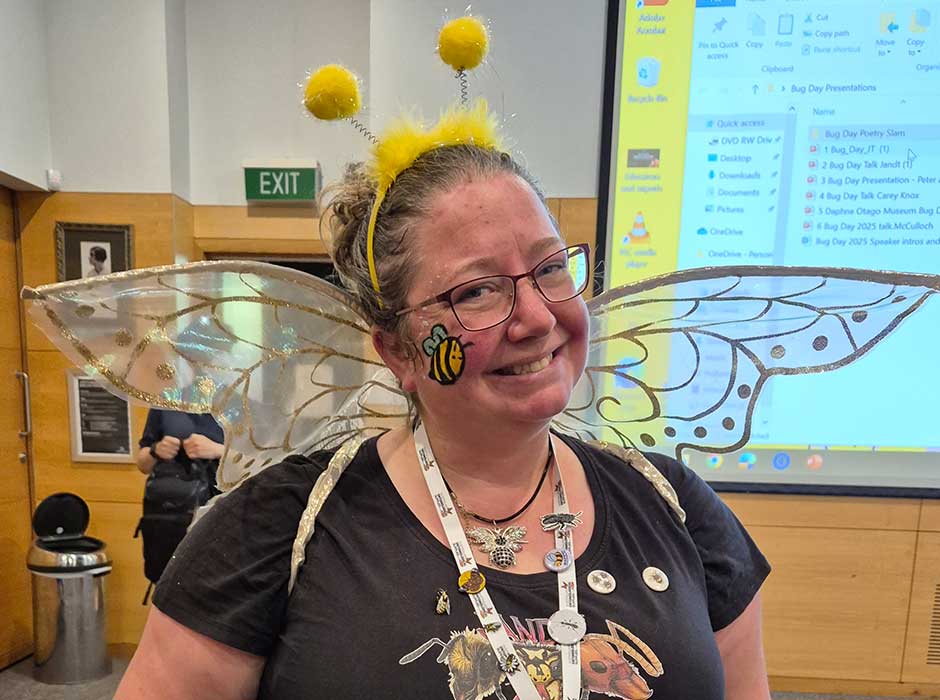
Associate Professor Jenny Jandt moved to Dunedin 11 years ago and became a citizen last year. “I'm originally from the US where Halloween is a big deal,” she says.
US-born Associate Professor Jenny Jandt may be the Department of Zoology’s Halloween Queen, but it was her PhD fieldwork in Arizona that once made her scream.
“I was out looking for ants, and I turned around and this big tarantula was staring at me,” Jenny says.
“I used to be terrified of spiders. I’d take insects to grade schools for outreach, and I’d bring everything except the spiders. Even the cockroaches!”
But when the tarantula didn’t stir, Jenny found herself crouching down and taking photos of it.
“I still wasn’t going to pick it up, but ever since that day I’ve remembered that it’s not about running away and screaming, it’s about taking a closer look.”
Jenny got into Zoology after her interests in animals and the Disney Channel collided.
“I grew up on a farm and I was an only child, so I often found myself interacting with my pets, the frogs and flies I caught outside and the chipmunk babies we raised in the house,” she says.
“I also love cartoons, and one day there was a show with a guy who was an ethologist who studied animal behaviour. I asked – is that real? Is that something I can do?”
Jenny went on to study animal behaviour for her undergraduate degree, doing a double-major in Zoology and Psychology. But of all the challenges she faced along the way, one of the biggest was determining which animal to study.
“If I wanted to study big cats, I would have had to have studied footprints and poop rather than the cats themselves. I tried to study birds, but they kept flying away. I worked in a monkey lab for a time, and I knew I didn’t want to work with animals in a cage.”
And then she discovered insects.
“I fell in love with bees first, and then I fell in love with ground nesting wasps. For my Master’s research in Entomology, we dug up wasp nests and put them in an observation box with a glass floor beneath them, so I could lay underneath a colony with 10,000 wasps above me. I found it really soothing just watching them live their lives.
"Outside, once the foragers got used to me, we developed an understanding. They would patiently wait while I set out their food.”
Perhaps one day Jenny will enlist wasps to help her decorate for Halloween.
“I once had a wasp that built a rainbow nest. I gave her different colours of paper every day, and she built one row of her nest every day."
Jenny earned a PhD in Ecology and Evolutionary Biology – attending plenty of Halloween parties along the way. Over the years her costumes included everything from a bee outfit to a visual depiction of a problem – how social insects evolve worker and soldier castes if those individuals can’t reproduce – that she refers to as “Darwin’s Conundrum”.
This year, Jenny’s going to celebrate Halloween at the Zoology Symposium.
“It’s an opportunity for postgraduates to showcase what they’ve been working on … and we encourage people to dress up for Halloween as something related to their studies.”
The Department of Zoology is stuffed with Halloween-worthy artefacts, with various animals decorating the walls of Benham Building, and everything from cassowary skeletons to bugs preserved in ethanol hidden in drawers and closets.
“Something can seem spooky and gory until you learn about it, and then it becomes absolutely fascinating.”
Jenny says nature can be scary for people who aren’t used to it.
“Peering into the bushes and having some kind of bug jump out at you can be startling, and when we don’t know what we’re seeing we’ll often describe it as bad, or a pest, and think we have to get rid of it. Instead of the automatic terror, take a breath and look at it a little more closely.”
Jenny’s now taking her own advice.
“I have two students working on spiders. One of them has tunnel web spiders upstairs,” she says, without so much as a shiver.
“And I’ve started naming the spiders in my house.”
-Kōrero by Kathryn van Beek, Communications Advisor|Kaiarataki Pārokoroko
Department of Zoology
Zoologists study how animals evolved, their behaviour, physiology and ecological interactions, and how to conserve populations in the face of global change.
View