
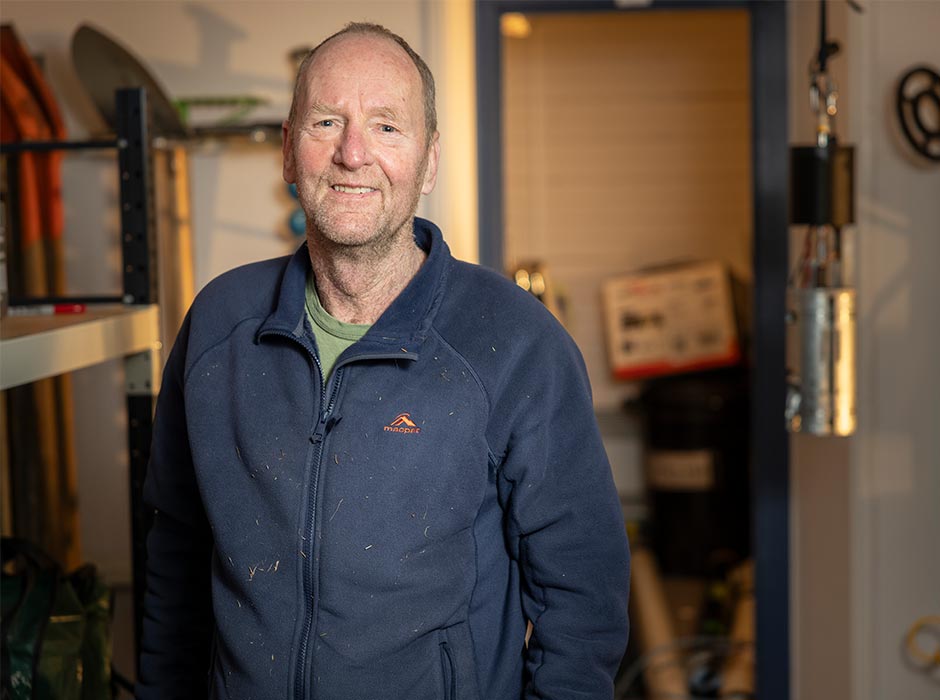
Geology Professor David J Prior has received a Royal Society Te Aparangi Catalyst Fund grant of $80K to enable him and his team to develop stress sensors to measure the driving force for Antarctic ice flow.
Geology Professor David J Prior ended up in Antarctica by accident.
“Technically I’m a structural geologist, looking at rock mechanics related to earthquakes and plate tectonics,” he says.
After moving to Otago from Liverpool fifteen years ago, he “got into ice” as a model material to represent minerals, such as quartz, in the Earth’s mantle.
“And then I started talking to people about Antarctica, and I got sucked into the Antarctic side of things,” he says.
“These days I’m about understanding ice for its own sake.”
That understanding is set to deepen, with Dave and his team having received a Royal Society Te Aparangi Catalyst Fund grant of $80K to test a device they’ve been developing.
“It’s called a ‘stress sensor’,” Dave says.
“You freeze it into a glacier, and it tells you what directions the glacier’s being pushed in, and how hard.”
The device will enable us to understand how Antarctic ice will flow downhill, and what that might mean for sea level rise.
Along with providing data for modelling and prediction, it will also enable monitoring.
“We’re really concerned about the future of ice shelves and the infrastructure of Scott Base, which is on the McMurdo Ice Shelf,” Dave says.
“New Zealand’s planes fly from Christchurch and land on the ice shelf, and people and goods are transported across it. One needs to think about how that ice shelf could change and give us problems with those logistics. The stress sensors will give us some monitoring as to how it’s evolving, and if there are any signals that we need to be worried.”
The device itself isn’t much bigger than a stock cube.
“It needs to be small, because we put it in the ice with a hot water drill which makes a 60mm hole. The sensor gathers the information and transmits it to the surface with radio waves,” Dave says.
The grant will enable Dave’s team to work with their international partners to test the device.
“We’ve spent about three years developing the stress sensor, and now we need to put it together with electronics to make it talk to the surface. The electronics have been developed by a team in Cardiff, Wales. We’ll go there and put the two devices together,” Dave says.
“Our other partnership is with a team in Canada that has field sites in the Yukon, because we need places to test it that are a bit logistically easier, less risky and less expensive than Antarctica.”
“Working in Antarctica kind of fits with the person I am, because it’s all about planning. You plan, plan, replan, and plan again.”
Having now been to Antarctica eight times, Dave seems to have caught the bug.
“Working in Antarctica kind of fits with the person I am, because it’s all about planning. You plan, plan, replan, and plan again,” Dave says.
“We’re helicoptered out to a remote site, just us and our tents, and if the weather is bad no one could possibly come to get us. You have to be very resilient, and everyone’s got to look after each other. It’s not a place for individuals.”
But ask Dave to paint you a picture of Antarctica, and instead of visualising landscapes of ice, you’ll see mountains of … food?
“When you’re working from the base, the difficult thing is avoiding putting on weight,” Dave says.
“There’s fantastic food, five meals a day.”
Dave and his team will be well-fuelled when they return to install the stress sensor.
“Ultimately, we’ll deploy the device in Antarctica in 2028 or 2029.”
– Kōrero by Kathryn van Beek, Communications Advisor | Kaiarataki Pārokoroko
Geology at Otago
Geologists study rocks, minerals, landforms, climates and biota, and the processes that affect them
Study Geology