
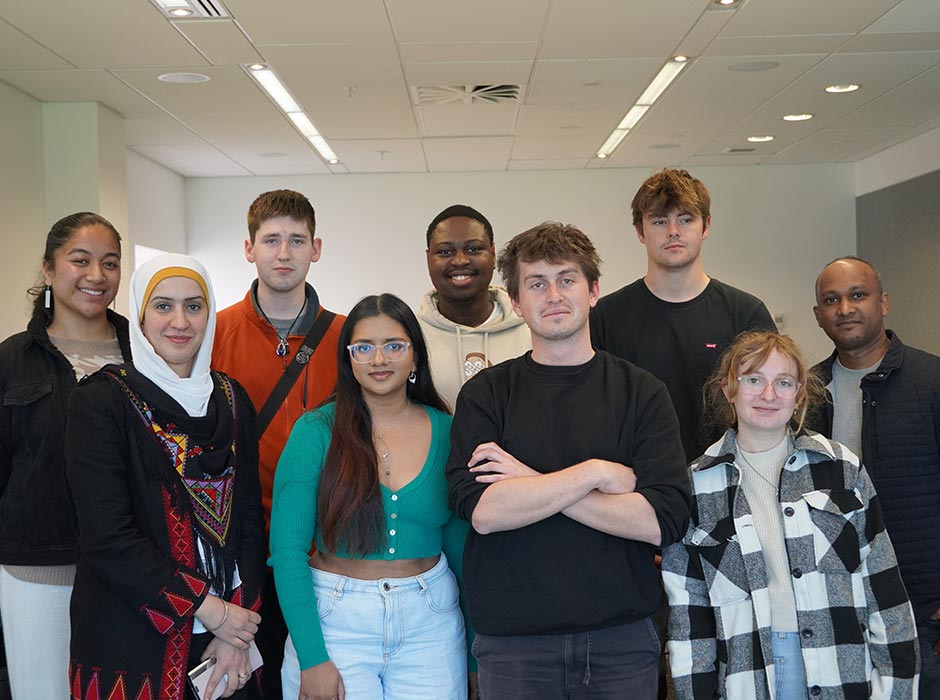
Otago Head of Digital Strategy and Partnering Rasha Abu Safieh (second from left) and group trainer Tana Whineray (centre front), with student interns, from left: Aleisha Funaki, Sam McLeod, Krishna Vallabh, Bakhombisile Olamini, James Oliver, Kylie Bertelsen, Anupriya Dayaratne
A group of University of Otago students have turned studio producers this week in a rare hands-on opportunity to produce the livestream of a major nationwide sports tournament.
The students are working under the experienced guidance of an external producer as they process live footage of the secondary school Winter Tournament Week so that it can be rolled out instantly to about 250,000 supporters tuning in to watch on the MĀORI+ YouTube channel, from across the motu.
The project is led by the New Zealand Sport Collective (NZSC), a collaboration of 35 national sporting organisations and event partners working together to grow funding, boost participation, and deliver social benefits.
The broadcast is being delivered in partnership with Whakaata Māori and is the first time Winter Tournament Week has been comprehensively filmed and livestreamed on this scale.
In a historic first for Indigenous broadcasting, seven major regional and national sporting championship events will be broadcast in te reo Māori, with 26 fluent te reo Māori commentators delivering real-time coverage simultaneously.
A central production hub based at Otago is processing 25-30 tournament livestreams including netball, football, rugby, climbing, golf, wrestling, and basketball, streamed in from competitions in Auckland, Hamilton, ,, Wellington, Palmerston North, New Plymouth, Dunedin and Invercargill.
Otago Head of Digital Strategy and Partnering Rasha Abu Safieh says this is New Zealand’s most ambitious sports broadcasting project and aligns with the University’s commitment to technological innovation and te reo Māori revitalisation.
“Crucially, it creates exceptional internship opportunities for our students - providing hands-on experience in live sports production, digital broadcasting technology, and multicultural content creation.”
Students from Computer Science and related technology programmes were recruited to work for eight days in a fully equipped master control room with 10 dual monitor workstations, high-speed internet, and technical expertise on hand.
The successful applicants possess both the technical competency and resilience needed for this intensive live broadcasting environment, Rasha says.
“They're managing multiple simultaneous video feeds and coordinating complex technical operations under pressure. Key skills include receiving and synchronising live feeds, connecting remote commentators, and adjusting audio levels in real-time.
“They're also inserting digital assets, including advertising and logos, across multiple streams. Each intern manages up to four fields of play simultaneously, developing exceptional multitasking and technical coordination abilities.”
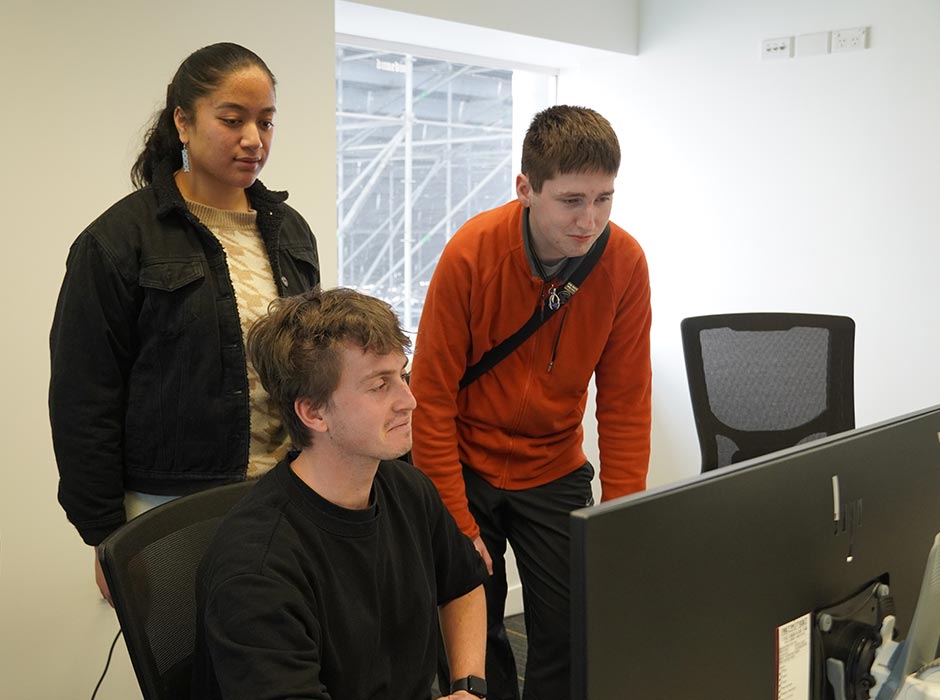
Content Creator Tana Whineray from New Zealand Sport Collective (seated) trains Otago student interns Aleisha Funaki (Computer Science), Sam McLeod (Genetics) on how to use the master control room workstations.
Excitingly for the students, they are working with cutting-edge broadcasting software at the forefront of sports production technology: Singular for graphics insertion - allowing real-time overlay of advertising content, logos, and score bugs - and Spalk for remote commentary integration, which enables te reo Māori commentators to contribute from locations across New Zealand.
Staff from Information Technology Support Services, Property Services and Campus Development have operated like a “highly dynamic sports team” to pull the operation together successfully, Rasha says.
New Zealand Sport Collective Projects Coordinator Caroline Kolver says they turned to Otago to produce the live broadcast so they can air on the MĀORI+ YouTube channel.
“We already knew the University had powerful capability to support a project like this and in talking with key staff it became very apparent there was a strong fit, both in what both parties could do, but in our values and desire to give back and help the wider community,” she says.
Broadcasting secondary school sport has a huge positive impact for communities, and many of the participants also enjoy reviewing the footage for their own analysis, she says.
“For nearly all these events, the schools competing will be a long way from family and friends.
“So, for those who can't afford the time or cost of attending events, this is a free way for them to enjoy supporting and watching their teams.”
The NZSC is grateful to Whakaata Māori and the support from the University of Otago.
Queens High School Sports Director Tessa Nichol says livestreaming has been a “game-changer”.
“Families who can’t travel are still right there supporting their kids, grandkids, and friends, no matter where they are located.
“We are so grateful for the free-to-air broadcast, which has really broken down barriers and kept our school community connected.”
Otago Chief Digital Officer Steven Turnbull says the Tournament Week project demonstrates the potential for longer-term engagement between the University and the NZSC.