
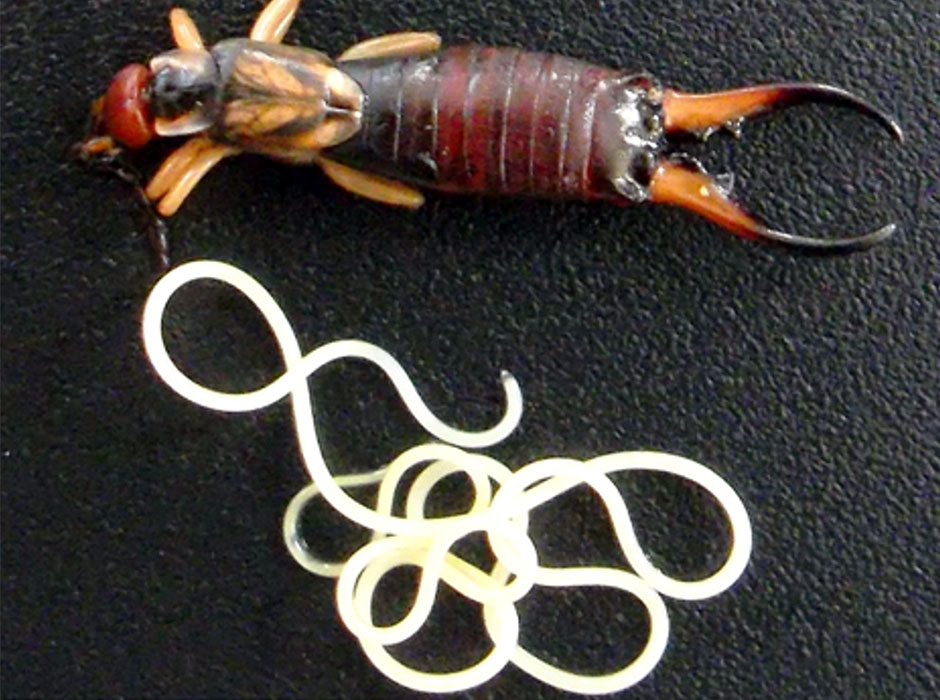
Scientists have uncovered how parasitic worms manipulate their earwig hosts, with dramatic results.
Scientists have long marvelled at a chilling biological phenomenon: parasites that force their terrestrial hosts to march into water and drown themselves, so they can complete their life cycle.
It’s the stuff of science fiction and horror movies, but a groundbreaking study led by the University of Otago – Ōtākou Whakaihu Waka has now uncovered the molecular mechanisms driving this bizarre host manipulation.
Published in Proceedings of the Royal Society B, the study used advanced transcriptomic sequencing to decode the genetic crosstalk between the European earwig (Forficula auricularia) and the parasitic worm, mermithid nematode (Mermis nigrescens).
Senior author Professor Neil Gemmell, of the Department of Anatomy, says once nematodes are fully developed, they force their earwig hosts to seek water for them to reproduce in. Once water is found, the parasite evacuates the host, killing it.
“The behaviour is a classic case of host manipulation, but the underlying mechanisms behind it have, until now, been poorly understood. Our findings reveal how parasites and hosts interact at the genetic level to produce these dramatic behavioural changes,” he says.
The researchers studied gene expression across multiple developmental stages, ranging from uninfected hosts to the moment of behavioural manipulation.
“We found thousands of genes changing their activity in both organisms simultaneously. During manipulation, earwigs showed increased activity in sensory and signalling pathways, while parasites activated genes involved in transport and secretion. Both shared a common regulatory signal, suggesting coordinated molecular changes.”
Lead author Dr Upendra Bhattarai, of Brown University, says uncovering the subtle "under-the-radar" strategy of the parasite was particularly surprising.
“The nematode quietly coexists with its host without triggering massive immune or neurological alarms right until it fully matures and prompts the host's fatal final swim,” he says.
Co-author Jean-François Doherty, of the University of British Columbia, says host manipulation is an example of the "extended phenotype," where a parasite's genes effectively dictate the behaviour of another organism.
“This study provides the first comprehensive genetic framework for understanding how mermithid nematodes hijack insect behaviour.
“Pinpointing exact candidate pathways for this behaviour creates opportunities for future studies into how parasites interface with central nervous systems, including in humans and livestock,” he says.
Co-author Emeritus Professor Robert Poulin, of Otago’s Department of Zoology, says this sort of parasite manipulation is widespread, with multiple examples in New Zealand fauna.
One such example is the native hairworm-wētā system.
Co-author Dr Eddy Dowle, of the New Zealand Institute for Bioeconomy Science, studies the genetic basis of similar water-seeking behaviour in this pair, and says the similarities between the two parasite-host systems provide a unique opportunity to understand how complex traits evolve.
‘’Host manipulation provides a remarkable opportunity to understand how one organism can influence the behaviour of another, and future comparisons of these systems may help us uncover common mechanisms that parasites use to manipulate their hosts,” she says.
The study was funded by a Royal Society Te Apārangi Marsden Fund grant and the University of Otago.
Publication details:
Revealing the genetic mechanisms underpinning the parasite-induced water-seeking behaviour of insects through RNA-seq
Upendra R. Bhattarai, Jean-François Doherty, Robert Poulin, Eddy Dowle and Neil Gemmell
Proceedings of the Royal Society B