
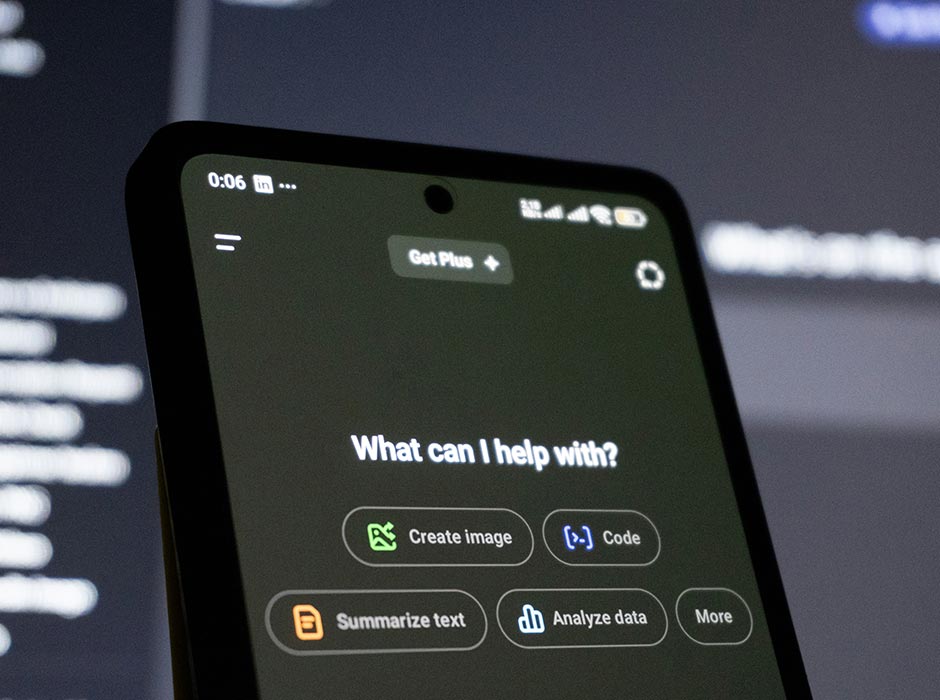
AI is already changing the tertiary learning and teaching environment, Head of Academic Teaching Development Russell Butson says. “It is influencing how students learn, how educators teach and assess, how we support learners, and how academic and professional work is organised.” Photo by Zulfugar Karimov on Unsplash.
With AI use becoming mainstream, the focus for universities has moved from when to use AI to how AI can be used in tertiary learning.
This is what the attendees at the New Zealand AI in Higher Education Symposium will delve into come 2 September.
Hosted by Otago and organised by AI in Higher Education (AIHE) Aotearoa, this practitioner-focused event will bring together tertiary educators, researchers and technologists from across the motu.
Head of Academic Teaching Development at Otago’s Centre for Educational Design and Innovation (CEDI) Russell Butson says the Symposium creates a national space for practitioners to explore the transformative potential of AI in higher education.
“It is an opportunity to share what they are seeing, learn from practical experience, and examine what responsible and educationally valuable use of AI looks like.
“The focus is on applied work – how an idea has been used, what problem it addresses, what happened in practice, and what was learned along the way.”
Attendees will explore the use of AI through three themes – Practice, focusing on what people are doing now, Theory, examining the questions beneath practice, and Future, exploring where these developments might lead.
“Participants will hear honest accounts of implementation, including the challenges, limitations and changes that followed early testing,” Russell says.
“Together, the themes move from current practice through critical examination to the choices ahead, helping participants understand, judge and shape AI-enhanced education.”
The practitioner focus continues with the Immersion Lab, where attendees can gain hands-on experience with AI agents and educational technologies.
“The Immersion Lab will showcase working systems, workflows and experiments, giving people the opportunity to interact with the technology, see what it does and consider where it could be useful in their own setting.”
Complementing the Immersion Lab is the Agentic Innovation Awards, which recognise practical work already being developed and tested.
The submissions to the CEDI-led Agentic Innovation Awards show how quickly AI practice in higher education is moving, Russell says.
“Across teaching, assessment, simulation, student support and institutional work, practitioners are not waiting for a future version of AI. They are building, testing and improving systems now, then making the work available for others to learn from.
“Each submission is showcased on the AIHE website with a video and brief. Together, they show what people are trying, what is working and where practice is heading.”
That same willingness to experiment also shapes the award judging process, Russell says.
“Our panel agent reviews every transcript and brief against an extensive rubric, returning scores and supporting evidence. This gives each entry a consistent first review, even when projects differ in purpose and form.
“It also allows CEDI to test where AI can strengthen a decision-making process. The agent informs discussion, while human judges make the final decisions.”
The emphasis on useful practice makes the Symposium beneficial for people working to embed AI in real courses, programmes and services, Russell says.
“Bringing these perspectives together helps the sector make better-informed choices about the future of higher education.”
AIHE – a collaborative network for AI-enhanced education
Founded by the University of Otago, AIHE Aotearoa connects educators, researchers, and technologists from Aotearoa’s higher education sector to advance responsible AI in learning and teaching.
AIHE Aotearoa held its first symposium in 2024. The Aotearoa Symposium, and the Australia and New Zealand Symposium, series both grew from the same need – a credible venue for practitioner voices.
“Educators and professional staff need a place to share what they are trying with AI, including the challenges, limitations and lessons, in forms that others can understand and use,” Russell says.
Otago leads AIHE Aotearoa and contributes to this wider trans-Tasman network.
“The two communities are separate but connected by a shared commitment to candid, transferable and useful practice.”
~ Kōrero by Sandra French, Adviser, Internal Communications
Centre for Educational Design and Innovation
Otago's Centre for Educational Design and Innovation (CEDI) helps educators design better learning for a changing world.
Explore CEDI