
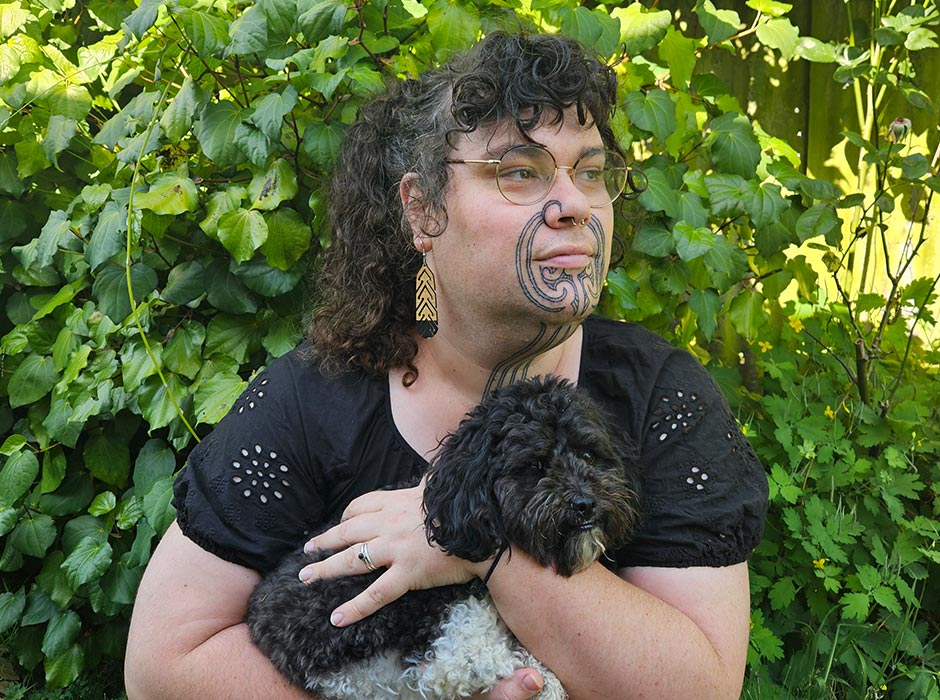
Essa Ranapiri (Ngāti Raukawa, Ngāti Pūkeko, Te Arawa) graduated yesterday with a Doctorate of Philosophy. They are the first Māori PhD graduate from the University’s English programme to have written specifically on Māori literature.
Essa Ranapiri (Ngāti Raukawa, Ngāti Pūkeko, Te Arawa) has become the first Māori PhD graduate from the University’s English programme to have written specifically on Māori literature.
While dubious of "firsts", preferring to acknowledge the long line of thinkers, scholars, and writers who have gone before them, Essa is proud to provide a meaningful source of insight and representation for queer and Māori scholars to draw inspiration from.
“I want all the incredible, aspiring smart kids to take what I've done and build on it in all the ways that matter most. I hope that being here and now will encourage others to believe in their wonderful whakaaro and share it with the world,” they say.
Essa follows in the footsteps of Ōtākou Whakaihu Waka Professor Katharina Ruckstuhl who completed her PhD in 1999 and is believed to be the first Māori PhD graduate in English. Essa will be the first Māori PhD graduate from the English programme to have written specifically on Māori literature.
Born in Kirikiriroa (Hamilton), Essa spent the first two years of their life in Tūranganui-a-Kiwa (Gisborne) before going to live with their nan in Tauranga-Moana.
Currently based in Kirikiriroa they did all of their study online.
Essa and their whānau feel very proud of their accomplishment.
Our queer gods, our queer selves: reading atua in Māori poetry in English by tāngata takatāpui - towards a mana takatāpui future, is the title of Essa’s thesis, which focuses on how atua Māori are written about as queer people.
“I have long been interested in the ways in which we write or talk about atua as queer people. This is what I try to attend to in my work here, but it also operates as an introduction to the landscape of takatāpui (LGBTQIA+) literature.”
Being a well-respected stalwart in the transgender community, and takatāpui iarere (genderqueer) themselves, everything Essa works on has a focus on enabling and empowering transgender and Māori people.
“My thesis operates as a good way to understand the shape and scope of our literature. Everything I write engages with that.
“I also edit an online journal with close friend and writer Midden Rahurahu, called Kupu Toi Takataapui where we aim to share short works of fiction, nonfiction, essay and poetry from within our community.”
While studying Essa also published a book ECHIDNA, a piece they say contends with three strands of tradition; Greek mythology, Christianity and Māori pūrākau (storytelling), and through weaving them together attempts to create a queerer whole.
“What I learnt from writing ECHIDNA is the power of pūrākau to retell a story from our own personal context that can then spark new connections between works and people and places.”
Essa says their work is fuelled by the goal of challenging the colonial forces that attempt to remove takatāpui from history.
“Essentially everything I do is a mark against the colonising forces that would have had us struck from the historical record. I write for those kaituhi takatāpui to come, I write to provide a stepping stone to my own irrelevance.”
Essa acknowledges the support provided by Ōtākou Whakaihu Waka kaimahi during their studies.
“Dr Jacob Edmond from Ōtākou Whakaihu Waka and Dr Alice Te Punga Somerville, who works for the University of British Columbia, were incredible to work with.
“I'm grateful for the University allowing this team to support me through the four years I worked on this mahi. Jacob was always there with the brilliant line notes and always punctual emails, and Alice always asked the big questions which pushed me deeper into my work.”