
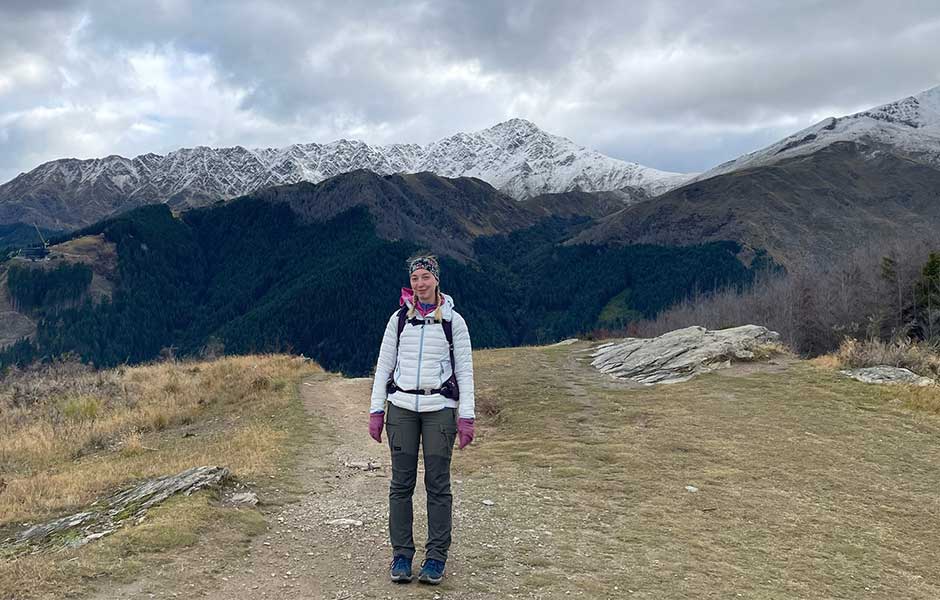
Austrian international student Katharina Pridnig is spending six months at Otago’s Dunedin campus as part of her master’s on how antibiotic stewardship can be implemented in both her homeland and New Zealand.
Austria and New Zealand might seem worlds apart, but an international student’s research into antibiotic equity proves there is more in common than you might think.
From March to September, international student Katharina Pridnig is completing a portion of her master’s at the University of Otago’s School of Pharmacy and Pharmacology.
She made the trip to the Dunedin campus to work under the guidance of Associate Professor Susan Heydon on how antibiotic stewardship can be implemented in both her homeland and Aotearoa so that antibiotics might be used in a way that is fair and inclusive.
In her thesis, stewardship refers to the responsible and equitable management and use of the limited and valuable resource that is antibiotics.
Katharina’s research reflects on ways the two countries might be able to use antibiotics responsibly to preserve their effectiveness and help prevent, or at least slow down, the development of antibiotic-resistant bacteria.
“Health equity is a large part of this research because a stewardship programme can’t be successful without fairly including all groups of people, including vulnerable populations,” Katharina says.
“For this, I’m looking at migrant and refugee groups in Austria, and Māori here in New Zealand to discern things like the degree to which these groups are able to access healthcare services, information and education, what their level of health literacy is, and what barriers they face.”
With antibiotic resistance being a global problem, Katharina says it’s important for policy makers, academics and medical professionals to rethink how antibiotics are used, while prioritising vulnerable populations in this work.
She says raising awareness of the problem of antibiotic resistance is a good place for Governments to start but, at the heart of this messaging, there needs to be the inclusion of all groups so everyone is treated with the same respect and provided the same opportunities.

Katharina, pictured here at Forsyth Barr Stadium, says she really enjoyed her time in Dunedin, and would encourage anyone who has the opportunity to study abroad to take on that unique and rewarding life experience.
Katharina has deeply enjoyed the six months she has spent in New Zealand and would recommend it to anyone who has the opportunity to go abroad during their studies. It has been a unique and rewarding life experience for her, resulting in valuable personal and professional connections.
Social Pharmacy, which is a branch of research looking at the relationship between pharmacy practice and broader societal systems, is not taught in Austria and so reinforced Katharina’s decision to come to Otago and learn from the academics here, as this a large part of her research.
While challenging to get around at the start, she quickly settled into the community and found a fond space in Otago’s Central Library where she spent much time researching and writing.
During her time in the country, Katharina travelled both the North and South Island and will do five more weeks of travel before she returns home. There she will complete her master’s before starting a year of practical pharmacy training and then officially graduating as a pharmacist.
“I’ve honestly really enjoyed my time here in every way. I’ve made so many new friends and really came to appreciate how relaxed and easy-going people are here. It will be particularly hard to leave behind Dunedin’s amazing cafes; I’ve probably gone through several litres of coffee during my time here.”
-Kōrero by Kelsey Swart, Division of Health Sciences Communications Adviser
School of Pharmacy and Pharmacology
The School of Pharmacy and Pharamcology (He Rau Kawakawa) offers a clinically-oriented, patient- and whānau-focused curriculum that includes learning opportunities for contributing to achieving equitable health outcomes.
View