
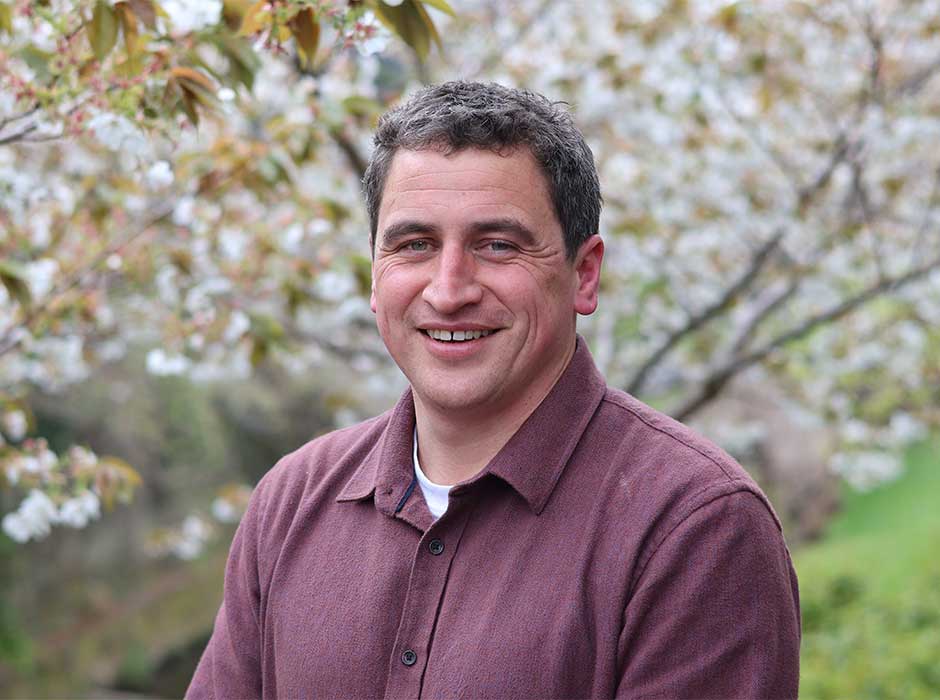
Dr Hitaua Arahanga-Doyle (Ngāi Tahu, Te Ati Haunui-a-Pāpārangi), a lecturer in the Department of Psychology, won this year’s Māori Early Career Award for Distinction in Research.
Dr Hitaua Arahanga-Doyle (Ngāi Tahu, Te Ati Haunui-a-Pāpārangi), who won this year’s Māori Early Career Award for Distinction in Research, says Psychology is often described as an autobiographical discipline.
“So many people work in areas that really strongly link to themselves,” Hitaua says.
“There’s a famous example of a researcher who studied psychopathy and found that his own brain scan resembled that of a psychopath,” he adds, referencing American neuroscientist James H Fallon.
Happily for his colleagues, Hitaua’s less interested in dark triad personality types and more interested in the psychology of belonging.
“Social relationships have always been a strong part of how I’ve moved through the world and thought about the world.”
Belonging and connection have been themes of Hitaua’s life, beginning with childhood visits to Te Taumutu Rūnanga marae Ngāti Moki (Te Pā o Moki).
“The idea of belonging is inbuilt in pillars of Māori values like whanaungatanga and whakapapa,” Hitaua says.
He continued to explore these themes during his school years at Christchurch Boys’ High.
“I gave a high school speech about the movie Stepbrothers. It was tongue in cheek, but it was about how in the movie all their relationships break apart, and then they all resolve and everything works out because they resolve and find a sense of belonging,” he says.
“Those ideas were already swimming in my mind way back then.”
Much of Hitaua’s research is now at the intersection of social psychology and te ao Māori, focusing on cultural concepts relating to identity, belonging, connectedness and mental health.
“Having a sense of belonging is a powerful predictor of positive outcomes,” Hitaua says, explaining that people thrive when they’re connected and supported.
“For example, resilience is often described as an individual trait, but actually it’s more contextualised and social. If you are embedded within an environment that allows you to be resilient – say, a supportive family with money and resources – it’s easier to bounce back than when you have things going against you.”
With a research portfolio that currently spans virtual reality, touch rugby referee abuse and te reo Māori use in schools, it’s no wonder Hitaua has been honoured for his mahi.
Naturally, he puts his success down to his relationships.
“My research is the product of so many groups and collaborations, so when it comes to getting an award for research it really is through the work with others. That’s the only way I can research the breadth of topics I investigate. All those collaborations are the key.”
Hitaua’s networks go beyond research into peer support. As a leader in He Paiaka Tōtara – Māori Psychologist’s Network, Te Poutama Māori – the University of Otago’s Māori Academic Staff Collective, and Ngā Ngaru a Kiwa, an Indigenous research group of psychologists from universities around the Pacific, he helps support other academics.
“I’ve always thought the best way to achieve anything in academia is through collaboration and teamwork.”
He also connects tauira, organising social events and coffee catchups.
“I try to get them out of the lab setting, remove some pressure, and build that sense of belonging.”
Hitaua is grateful to his own past kaiako, who did the same for him.
“My PhD supervisor, the late Professor Damian Scarf, was a massive mentor. Massive in stature – he was a former rugby prop – and in intellect. And Associate Professor Jackie Hunter was my other supervisor. He’s a world expert on social identify and how our sense of self is partly devised from the groups we’re part of. He and Damian set me up to be an academic.”
But Hitaua’s career almost went in a different direction.
He didn’t come to Otago to become an academic – he came to get rich.
“I came originally to study accounting because I have an uncle who I thought was an accountant, and I knew he was quite successful,” Hitaua says.
“It turns out he wasn’t an accountant, he was in something like currency exchange, but I didn’t know better.”
Accounting wasn’t Hitaua’s cup of tī, so he segued into a double degree in Marketing and Psychology, later landing a Marketing Manager role for an engineering firm.
“I learnt a lot about pipes and sewage,” Hitaua says.
“Then I thought – let’s give the psychology thing another go. I came back to do a one-year Honours, and it turned into a PhD.”
The PhD led to a Fulbright Scholarship based at Stanford University, and to his career as an academic.
“It’s been a winding path,” Hitaua says.
“I’m not a ‘ten years in the future’ kind of guy, but it seems to be working for me. Psychologists might describe me as being really ‘present focused’.”
Through all the twists and turns in his career, one thing’s never wavered – Hitaua’s love of Dunedin.
“I whakapapa to Ōtakou, so as a kid I used to come to Dunedin quite a bit,” Hitaua says.
“I loved the city, the whakapapa links, and the vibe of the place. And I love the Highlanders – I had a Highlanders poster in my room as a kid.”
-Kōrero by Kathryn van Beek, Communications Advisor| Kaiarataki Pārokoroko
Psychology: The science of behaviour
In our department, we explore this question and offer some of the most popular and highly-rated undergraduate and postgraduate courses at Otago. We also have an international reputation for excellence in research.
View