
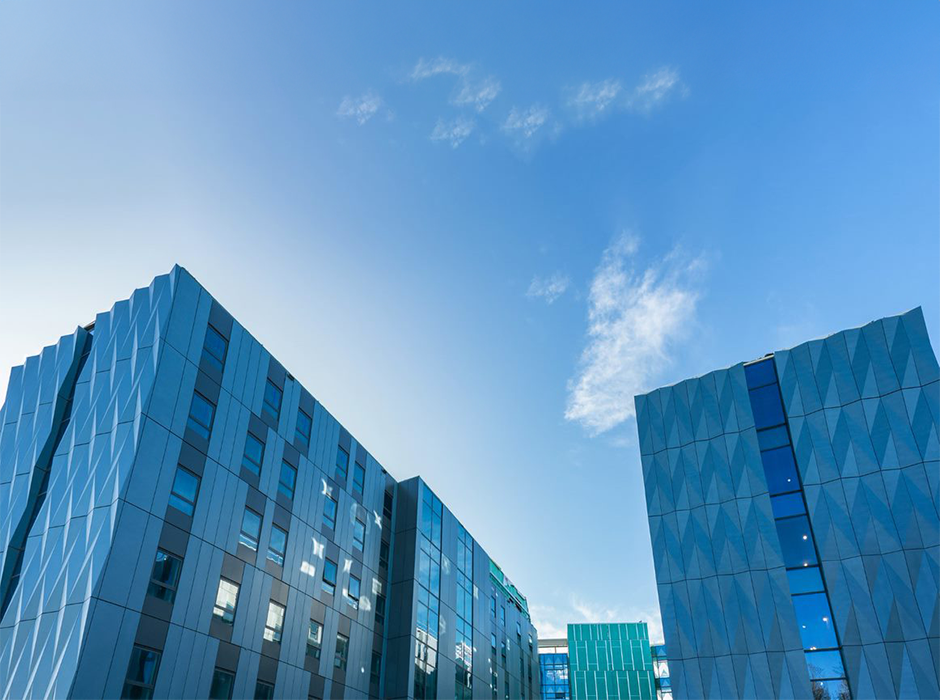
Te Rangihīroa College
Otago will next year welcome 450 students to a new residential college, Te Rangihīroa.
Located on the corner of Albany and Forth Streets, it is the University’s first purpose-built college since UniCol, which was opened more than half a century ago.
As the Otago Magazine discovers – while some student needs have changed since then, many others remain the same.
In May 2023, the University’s newest residential college, Te Rangihīroa College is nearing completion.
Over the past three years it has risen from the ground – and at the time of writing a shipment of 450 bed bases is due, the kitchen is taking shape and landscaping has begun.
Organisational Delivery Project Manager Kirsten Eichstaedt says getting to this stage of the project is a huge step in the right direction.
“When you have furniture, it begins to become a college not a building. Then we just need the people.”
The build includes seven levels (a ground level, five accommodation levels and a plant room) spread over four wings. At the start of 2024 it will be ready to welcome 450 students.
Te Rangihīroa is the University’s first “purpose built” college in more than 50 years, the most recent being University College (UniCol), which opened in 1969 as part of the University’s centenary celebrations. Other colleges have opened in the intervening years, but these have been either adaptions of existing premises, such as the conversion of the Abbey Motel complex into Abbey College in 2005 (now Caroline Freeman College East), or jointly owned projects, such as City College which opened in 2000 under the oversight of the Dunedin City Tertiary Accommodation Trust, and was later taken over by the University and renamed Caroline Freeman College.

The Te Rangihīroa College build in progress in August 2022.
Society has changed a great deal between college builds. 1969 was the year Neil Armstrong took his first, historic, steps on the moon; in New Zealand, it was the year the Auckland Harbour Bridge was widened from four lanes to eight with “Nippon clip-ons”; and it was the year Margaret Mahy first published A Lion in the Meadow, launching her career as a children’s author.
Surely the needs of Otago students have changed out of all recognition since then?
“In some ways, yes,” says Caroline Freeman College Warden Chris Addington. “But I don’t believe what students want, and what they need has changed much.
“The basics are the same; students still need a roof, a bed and food. Now they also need Wi-Fi. But in meaningful ways, when I look around our dining room [at Caroline Freeman College], things are not much different now than they were when I began as a student at Stanford University’s Branner Hall 43 years ago.”
The Te Rangihīroa build began in late 2020 – amid the global COVID-19 pandemic. Therefore, the design of the college has been adjusted to reflect that, with common spaces that are able to be used flexibly and changed at short notice if a need arises.
Other aspects of planning and design have been approached significantly differently than they would have been 50-plus years ago, including a focus on both sustainability and accessibility, and consultation with Māori – including Te Rangihīroa’s Ngāti Mutunga iwi and local Ngāi Tahu throughout the design process. This is particularly visible in the Māori artwork featured inside and out, including 3D façade panels featuring striking kaokao patterns, whakataukī embedded in the Bluestone wall, and Te Rangihīroa’s cursive script.
The University’s Strategic Architect Gordon Roy explains that the build aims to achieve a 5 Green Star sustainability rating from the New Zealand Green Building Council – a first for a residential college in New Zealand. This rating is difficult to attain – and involves meeting requirements from design through to the finished product.
“The design must carefully consider responsible materials, thermal building envelope and thermal comfort, control of construction and demolition waste, and monitor the products specified throughout the project to make sure they are sustainable and viable," Roy says.
It is also the University’s most accessible college. Eichstaedt says it has been designed to accommodate everyone. For example, every room is accessible to someone in a wheelchair. It also has more ensuite bathrooms than any other college and the other bathrooms are ‘all gender’.

The construction team hard at work inside Te Rangihīroa in May 2023. Photo: Trev Hill
This is not the first time the University of Otago has led the way when it comes to gender in accommodation.
The University of Otago was the first in Australasia to house men and women in the same residential college – mostly because of circumstance. At the end of the war in 1945, accommodation for male students was in short supply – so the Stuart Residence Halls Council offered rooms to men in one of two neighbouring houses purchased for women’s college Carrington. As described by Alison Clarke in her book Otago: 150 years of New Zealand’s first university, accommodating men and women in the same residential college was a pragmatic response to needs and opportunities rather than a deliberate scheme, but since it worked it carried on.
Back to 2023, and Te Rangihīroa will be the University’s most state-of-the-art residential college.
But being built during a global pandemic has caused delays. Acting Vice-Chancellor Professor Helen Nicholson says the project was originally scheduled to be completed in May, but will now be ready early next year.
“We had hoped to open for students in semester two this year. However, because of pressure from industry-wide challenges and delays with the façade completion, we are working towards having Te Rangihīroa College completed this year and being open for students from semester one, 2024.”
The impacts of COVID-19 are also being felt in other ways. The University’s financial situation and incoming student numbers have changed significantly between 2020 when the build began and now, prompting questions around the wisdom of the University investing in capital development. Should the University be building student accommodation? Can online learning provide an equivalent experience?
Addington is adamant about the advantages of the first-year college experience.
“Yes, you can get academic learning via books or YouTube or other online platforms,” he says. “But you cannot get the sense of shared community and adventure that you get from leaving home and joining thousands of others who are in the same boat.”
He says that what students do outside of the classroom is just as important as the learning the University offers in its lecture theatres, labs and tutorials.
“At our colleges we have plays, sports, art competitions, volunteering, all sorts of things that help our young people to grow.”
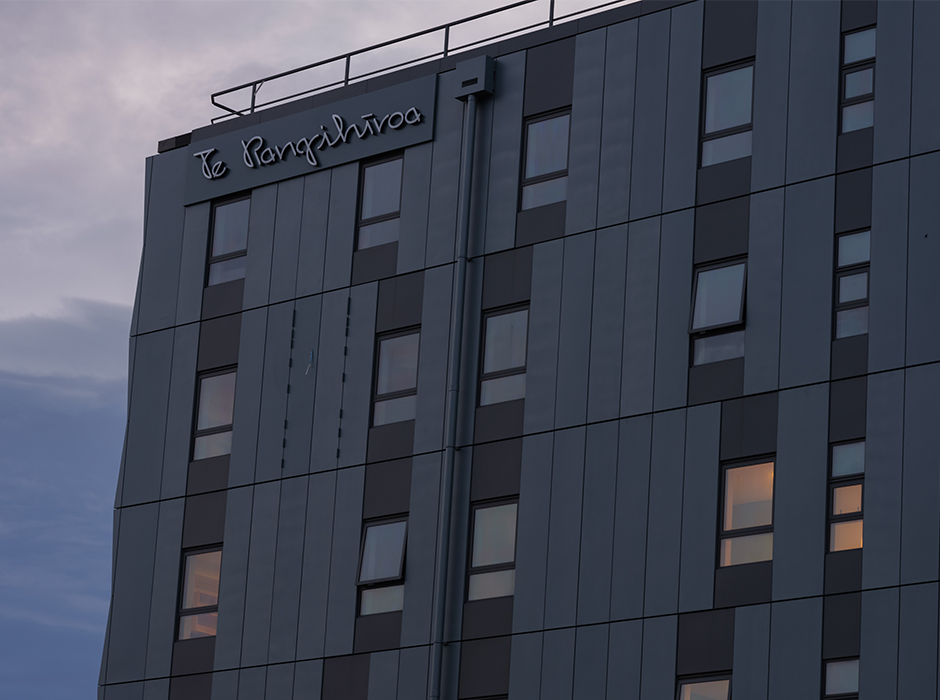
Te Rangihīroa’s distinctive cursive script has been used for the external naming of the new college. Photo: Trev Hill
With more than 85 per cent of Otago’s new students coming from outside Dunedin, it is vitally important to offer accommodation that fulfils their needs – from beds and food to pastoral care, support when homesick or when studies or relationships are challenging.
“Laying aside buildings, grounds and strategic plans, colleges are communities of scholars and staff. They are places for young people to come together with shared goals and shared challenges.”
What makes a college a home is the sense of community, he says. And one way that is achieved is through establishing a shared identity and a collegiate personality and traditions.
“It sounds unlikely, but students spend more time deciding what college they want to live in while they’re here, than what they want to study. It’s so important, that sense of belonging.”
Addington says the first and most important job of whoever leads the new Te Rangihīroa College is that they quickly establish their college identity.
And for Te Rangihīroa there are big shoes to fill.
Otago’s Director of Campus Development Tanya Syddall says the new college is an opportunity to build on the Te Rangihīroa culture.
“It is important that we respect the taonga gifted to the University by creating a facility that can proudly bear the name of Te Rangihīroa.”
Kōrero by Lisa Dick
The man behind the name: Te Rangihīroa
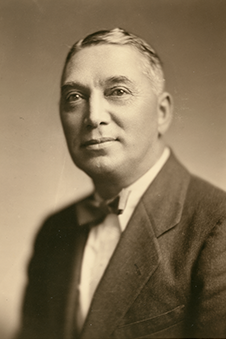
Te Rangihīroa (Sir Peter Henry Buck) c.1941. S.P. Andrew photograph, Box-001-037, Hocken Collections – Uare Taoka o Hākena, University of Otago.
Te Rangihīroa (Sir Peter Buck) was the first Māori medical graduate from a New Zealand university. He graduated in 1904, and later received an MD in 1910, his doctoral thesis being Medicine amongst the Māori, in ancient and modern times.
He is remembered as a great son of Taranaki, and a leader and doctor among his people; a man who used his medical training to stem the tide of profound and serious health problems that almost wiped out the Māori population in the first part of the 20th century. Te Rangihīroa was at the coalface of turning the tide on diseases besetting Māori, including smallpox, tuberculosis and scabies.
Te Rangihīroa later became a Member of Parliament and a distinguished soldier. He was decorated with the DSO for bravery in the field at Gallipoli and in the Somme, with the rank of Lieutenant Colonel. He also later developed a lifelong passion for anthropology with specific reference to the Pacific migrations and the cultures of Pacific peoples. For the last 20 years of his life he was the Director of the Bishop Museum in Hawaii, and was also made a visiting Professor at Yale University. Te Rangihīroa received an honorary Doctorate of Science from the University of Otago in 1937, and was knighted in 1946.
The name was gifted to the University of Otago in 2013 following permission granted from Te Rangihīroa’s iwi and his surviving family members. The original Te Rangi Hiroa College on Castle Street has been renamed 192 Castle College.