
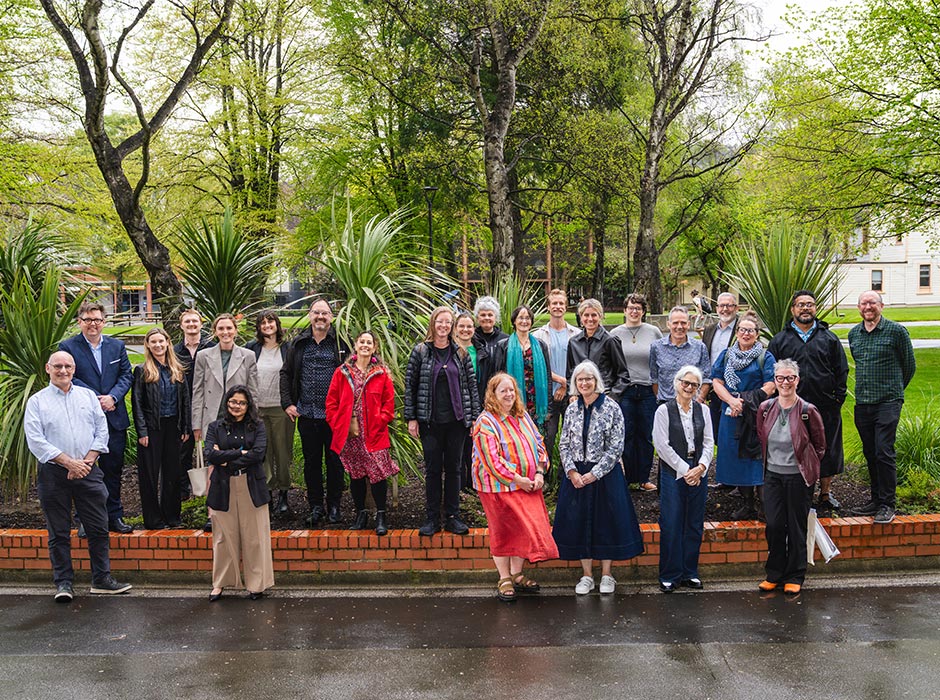
Members of Te Uru Institute for Sustainability are pictured at the launch event in October. There are more than 100 researchers from more than 40 disciplines and 19 sustainability related research groups and networks across the University involved so far.
The door is open and the welcome mat is out. Te Uru Institute for Sustainability at Ōtākou Whakaihu Waka - University of Otago invites new collaborations and research partnerships.
Established on 1 July, Te Uru brings many of the University’s experts together to work on big challenges in sustainability. The Institute comprises more than 100 researchers from more than 40 disciplines and Indigenous knowledge systems, as well as 20 sustainability-focussed research groups.
The Institute’s expertise spans climate change, energy, public health, human behaviour, tourism, education, law, economics, business management, ecology, food, theology, geography, freshwater, marine science, and many other fields.
With Māori and Pacific knowledge central to its approach, Te Uru aims to strengthen connections between researchers, communities, councils, government and industry partners to help develop practical solutions for a more sustainable future.
The Institute celebrated its official launch on 13 October with members and supporters from across the Ōtepoti community and beyond.
Te Uru is co-directed by Professor Janet Stephenson and Associate Professor Katharina Ruckstuhl.
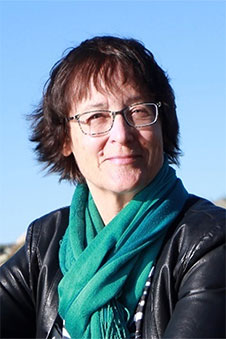
Professor Janet Stephenson
Janet says sustainability leaders across the University had been meeting regularly and exploring ways to work more collaboratively since 2023. This stood the network in good stead when the University issued a call for a Sustainability Research Grand Challenge in 2025.
The challenge called for coordinated interdisciplinary research to address local and global issues and opportunities. Building on the already-established relationships and shared aspirations, the network secured Grand Challenge funding to establish Te Uru in 2026.
“Collaboration and partnerships make us much more effective in responding to the big and complex challenges we are facing,” Janet says.
“Sustainability issues are typically what we call ‘wicked problems’, meaning they are complex and need connections across many areas of expertise, and with the people affected.”
Since July, Janet, Katharina and the wider Te Uru team have focused on establishing the Institute. Well-respected environmental advocate Hoani Langsbury from Te Rūnaka of Ōtākou serves as Chair of the Establishment Advisory Group.

Associate Professor Katharina Ruckstuhl
Katharina says Te Uru’s time has come.
“It’s time to settle down and start digging and plant the sustainability seed. Collectivise the amazing work already going on in the University and to make it visible to those out in our communities so we can start to share that knowledge.”
Te Uru leadership team now includes Māori Caucus members Dr Matiu Ratima, Professor Anna Carr, Professor Craig Bunt, Mawera Karetai, and Andrea Foley. Andrea also serves as Co-Chair of the Indigenous Leadership Working Party alongside Stacey Kokaua. The Chair of the Research Working Party Chair is Professor Ross Thompson, Chair of the Impact Working Party is Dr Ray O’Brien, and the Institute’s Coordinator is Dr Trudie Walters.
Ōtākou Whakaihu Waka kaimahi and tauira working on sustainability-related issues are invited to become Te Uru members.
The Institute is encouraging people to connect with Te Uru on their sustainability issues, opportunities and ideas.
“We are seeking some practical solutions, and meaningful partnerships,” Katharina says.
“We are motivated to communicate, and support action. We welcome people reaching out to us with their sustainability challenges and opportunities.”
- To learn more, visit Te Uru's website where you can sign up for the newsletter and stay up to date on events, research and opportunities to get involved.