
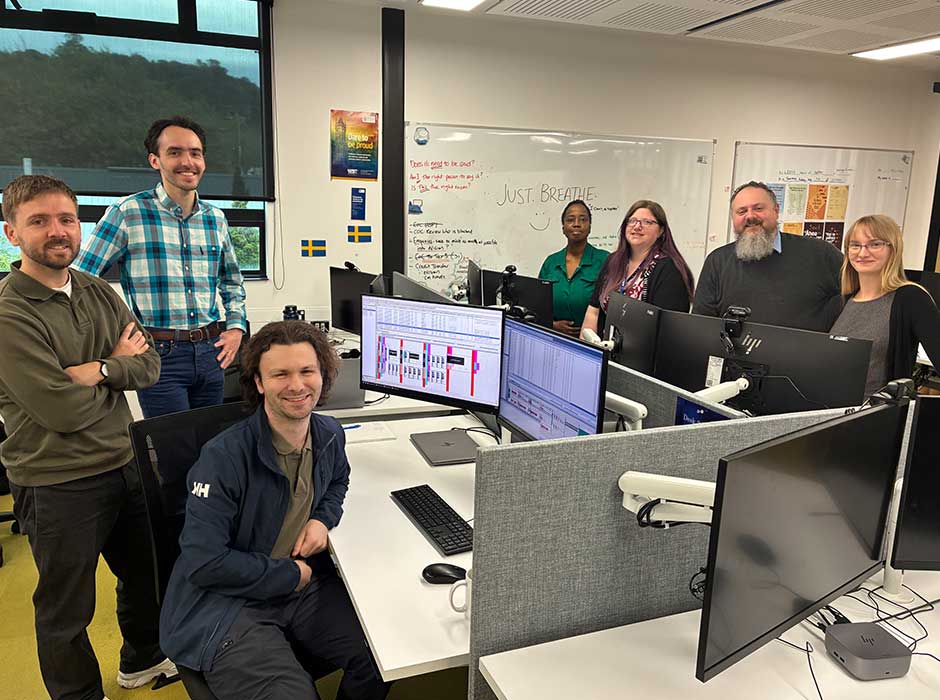
The University of Otago Timetables team, led by Daniel Macshane, second from right, has been hard at work preparing the draft teaching timetable for the 2027 academic year.
The University of Otago’s draft teaching timetable for the 2027 academic year will soon be released to staff for review. Communications Advisory Manager Jamie Shaw talked to the Timetables team to understand the huge effort they put into piecing together one of the largest and most complex puzzles on campus.
For most students, a timetable simply appears.
One day it is not there. The next, it is loaded into their calendar, showing where they need to be and when. Lectures, tutorials, labs and workshops all neatly slotted into place. What many don’t see is the extraordinary effort required to make it all happen.
Long before students begin thinking about the next academic year, the University of Otago’s Timetables team, led by Manager Daniel Macshane, is already hard at work.
Daniel says the team is constantly balancing thousands of teaching activities, room requirements and scheduling constraints to produce a timetable that best serves the needs of the University community.
“The challenge isn’t just finding a room for a class – it’s balancing the needs of students, teaching staff, departments, specialised facilities and teaching spaces, while trying to reduce timetable clashes and create the best possible learning experience,” he says.
Daniel says the process begins months before the timetable is published. In fact, planning for the next timetable begins almost as soon as the current one is released.
Departments provide information about the teaching activities they plan to offer. Teaching requirements are reviewed. Staff teaching availability information is gathered. Room requirements are confirmed. Every piece of information helps build a picture of what the following year’s teaching programme will look like, he says.
The scale is significant. For 2027, the team is scheduling about 1,730 paper offerings and more than 15,000 individual classes across 124 shared teaching spaces and more than 100 departmental rooms.
In the past few years, the University has moved to a constraints-based timetabling model, which uses specialised software to generate timetable options based on the information provided with the aim of reducing clashes for students.
Auto-scheduling implementation manager Jennifer Haugh says the technology is powerful, but it is only one part of the process and it doesn’t replace humans.
“It’s very intricate. There are thousands of rules built to keep classes in the right order, with the right spacing, to avoid clashes, and in the right kind of rooms,” she says.
“But auto-scheduling only works if the people building the timetable understand how to negotiate those intricacies. It’s a real blend of technology and human understanding.”
Jennifer says the complexity can be difficult to appreciate from the outside.
A timetable change that appears simple can have implications across multiple programmes, student pathways and teaching spaces.
“Someone from a particular department reviewing the timetable might spot what looks like an obvious gap and wonder why a class hasn’t been moved into it,” she says.
“But from our perspective it may not actually be available. There could be clashes with core papers from another programme, room limitations or other constraints that aren’t immediately visible.”
Jennifer says that behind every class placement sits an intricate web of assumptions about how students move through their studies.
Because timetables are built before students enrol, the team works with sophisticated “student sets” that represent likely pathways through different combinations of papers.
“Once you take into account all the pathways the system builds for the thousands of paper combinations we’re trying to protect from clashes, finding a place for a class can sometimes feel like walking a very narrow tightrope through a very twisty-turny gorge," Jennifer says.
Despite the complexity, the focus remains firmly on students.
Otago Provost Emeritus Professor James Maclaurin says that, historically, timetable clashes have been a source of frustration for some students, limiting their paper choices and affecting their ability to take the study programme they want.
James says that reducing those clashes is one of the key goals of the University’s ongoing Timetabling Project.
He says the results are encouraging. The 2026 timetable achieved an 18.6 per cent reduction in clash rates for declared students compared with 2024, the last year before auto-scheduling was introduced. Reductions have also been recorded in activity clashes and the number of clashes experienced per student.
Furthermore, the project has helped the University use its teaching space more effectively and efficiently.
Ten rooms have been repurposed for different uses such as temporary office space during seismic work, postgraduate student spaces, and student study spaces.
“The move to an auto-scheduled timetable is a big change and given the scale of the University’s operations, it is also very complex,” James says.
“Our Timetables team have been hard at work behind the scenes and have consistently received excellent feedback in relation to their responsiveness and support, and that’s no small thing.”
For Daniel and his team, seeing the improvements makes all the effort worthwhile.
“The team has a real drive to help wherever they can and find the best possible solutions for any issues that are raised,” Daniel says.
“One of the main goals of the project was to improve the experience for students in terms of the huge number of timetable clashes we were seeing every year. Seeing that working is very rewarding.”