
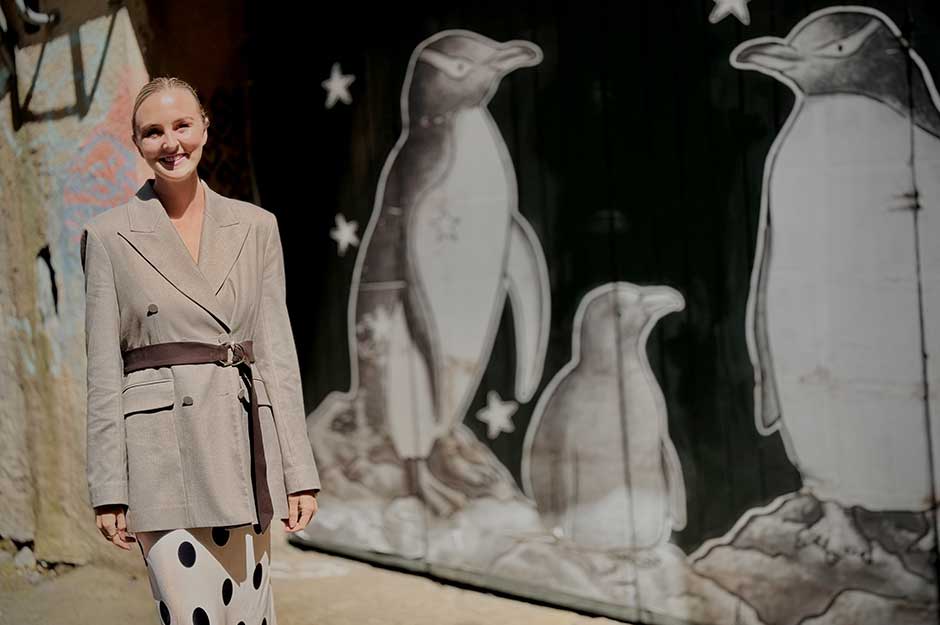
Hoiho champion Anna Campbell says, “From girl power to penguin power, I’ll always back the underdog from down south.” Photo: Nate Lachmann
With voting soon to close in the annual Bird of the Year (BOTY) competition, we thought we’d check in with Commerce doctoral student Anna Campbell and find out why she’ll be waving the flag for the hoiho/yellow-eyed penguin.
We know you’re a big hoiho enthusiast. We also know that you’ve returned to university to find ways of best protecting this imperilled penguin – but via a Doctor of Business Administration thesis rather than a Zoology degree. Can you tell us how and why you’re mixing business and birds?
Because the plight of the hoiho is a big, super-wicked business problem. Ecological stressors endangering hoiho are coming from commercial activities. Local fishing, farming and forestry are having direct impact, and industries are contributing to climate change and nature loss.
Transitioning to a sustainable ocean can give hoiho a shot – and that sits in the field of management studies, particularly in sustainability transitions. My thesis is titled, ‘Call of the hoiho for a sustainable ocean’.
Before returning to study at Otago, you were General Manager of Te Tautiaki Hoiho Yellow-eyed Penguin Trust in Ōtepoti Dunedin. Did that job break your heart a bit?
Absolutely. I remember a time when ten hoiho were found dead over ten days. There have been worse incidents but that one was heartbreaking and personal. It was close to where I live, where I take my kids to the beach, where we collect seafood. Hundreds of penguins and wildlife have been dying around these coasts. It’s a heavy emotion to hold.
When our children are the same age as we are now, their whanau will have lived on these coasts for 200 years. Intergenerational justice is important. Writing something off as a lost cause when we are responsible for it and when there’s more that we can do, gets me pretty fired up. I’m determined that, come 200 years from Te Tiriti, 200 years from women’s suffrage, our generation will have championed sustainability.
You resigned from that role in order to find new ways of getting traction around the plight of the hoiho. What do you hope your research will show?
The role opened my eyes to the social complexity – we call it ‘penguin politics’ – which is a key part of the problem. The social sciences offer multidisciplinary approaches to help navigate through hard issues like this. There’s such incredible cultural, environmental and professional knowledge in this community. That guidance has been essential to both embrace the heartache and analyse issues in order to work through them.
I’m now diving deeper into the literature on sustainability transitions with a multi-level perspective lens. I’ve seen and worked with a number of fascinating niche innovations – across the likes of enterprise, community, education, and arts – that are really exciting. My project will add our local context to an incredible research field as well as demystifying some of the complexity to help with our hoiho mission.
Hoiho are now one of the rarest penguins in the world (there were no more than 115 pairs remaining last season). If nothing is done to reverse current declines, scientists predict hoiho could be extinct on mainland Aotearoa within 10-20 years. A decade is a mere sneeze away. What can we do to stop this madness?
Research by Thor Ruru-Elley, Science Advisor at the Yellow-eyed Penguin Trust, was recently televised on an episode of Paddy Gower Has Issues and shows the incredible lengths these chicks go when they fledge. So, a blue corridor at sea, where hoiho juveniles can roam and forage freely, would give them a good shot.
There’s been some policy intervention in Otago – the marine reserves help maintain hotspots of biodiversity for food and the set-net ban and mortality limit help reduce bycatch. Arguably, this will not save any hoiho, but it could be scaled urgently (even fast-tracked).
There’s a lot of business happening in this blue corridor, so it doesn’t sit right with me to keep calling for tools down. It’s an issue that also impacts our food and livelihoods. So, I’ve been calling for a bycatch buyout scheme, paying out fishers like we pay out farmers for scenic reserves on land, reserving quota at sea. Even a seasonal, voluntary closure is an option. It’s happening on a massive regional scale, and I know we can get Southland, Otago and Canterbury on board. If there’s a philanthropist reading this, we need your help!
The hoiho is one of only two birds to win Bird of the Year twice, taking the crown in 2019 and again in 2024. It’s not greedy to want the crown a third time, is it?
Not greedy at all! Hoiho only roam in Aotearoa’s waters and this means it is our responsibility to protect them. I would love to see first-time voters come out in support of hoiho this year and help us push for a sustainable ocean.
I have to confess, I advocate for this cause not because hoiho are my favourite manu but because of what it has come to represent: an issue that affects communities of people from Akaroa to Awarua, Rakiura to the sub-Antarctic; iwi, hapu and whanau, conservationists, environmentalists, fishers, farmers, vets, bird lovers, Emmerson’s beer drinkers, sports stars, photographers, film makers and politicians.
A vote for hoiho is really a vote for all seabirds. It’s a vote for a southern issue that still needs its day at the Beehive. This competition is like the Olympics for birds - a gold medal brings headlines, endorsements, fans, and much needed attention from political leaders. If you’ve ever wondered what you can do to help, vote!
Vote for the hoiho (or your preferred manu) before 5pm, Sunday 20 September.
-Kōrero by Claire Finlayson, Communications Adviser (Otago Business School)
Doctor of Business Administration
The Doctor of Business Administration (DBA) is designed for business professionals who are looking for a challenge.
View