
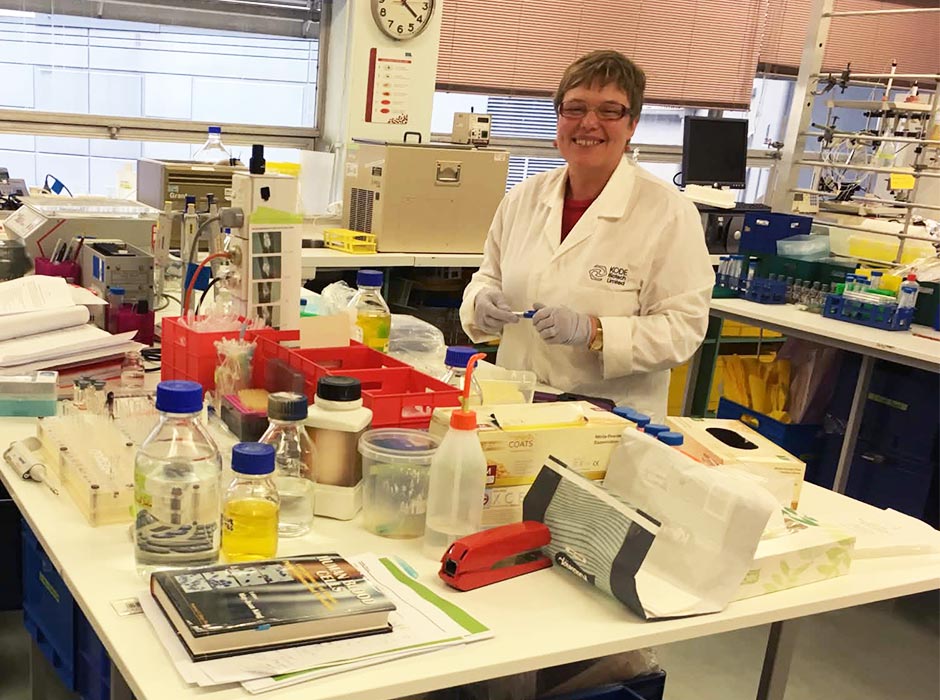
Dr Holly Perry unveils the mystery and reveals the magic behind medical laboratory science.
Ever wonder what happens to blood after it’s been donated? Or how human organs are transplanted?
This Spooktober, the Department of Medical Laboratory Science’s Dr Holly Perry draws back the veil on Transfusion Science, revealing the secrets of a profession that’s often hidden from the public eye.
Once the stuff of science fiction, Holly has helped make blood and organ donation a lifesaving reality over her 45-year-long career.
Holly started her career doing apprenticeship-style training at Palmerston North Hospital in 1981, where she worked and studied simultaneously.
After qualifying, she flew overseas to work in a London blood bank for two years, where she matched blood for patients needing transfusions.
“Immunogenetics is the application of knowledge about blood groups,” Holly says.
“Most people know about the ABO blood group system, with blood groups A, B, O and AB, but did you know there are 49 blood group systems? Within these systems, there are over 400 types, which we call antigens.”
Transfusion Science is a wider field, which encompasses blood and tissue donations which require complex processing and testing to be successful, Holly explains.
Once blood is donated, it gets separated into the liquid part called plasma and the cellular parts, red blood cells and platelets. White blood cells are removed to reduce the risk of some infections and transfusion reactions, and medical laboratory scientists are the ones responsible for this process.
Scientists combine state-of-the-art technology with their expertise to ensure transfusions are successful.
Oftentimes patients can be facing a life-or-death situation where timely help is vital to their survival and so medical laboratory scientists are expected to be both calm and accurate under pressure.
Plasma is considered ‘liquid gold’ by medical laboratory scientists, Holly says.
This pale-yellow, watery part of blood is hugely valuable and can be made into more than 15 different medicines that treat bleeding disorders, a range of immune system disorders and protect from infections like Hepatitis.
“This means a single blood donation can benefit so many people.”
After returning to New Zealand from London, Holly started working for the then Auckland Regional Blood Centre (now part of the New Zealand Blood Service), matching donors and patients for organ transplantation.
“Labs like these receive blood samples from patients needing organ transplants. For example, they might need a kidney if their own kidneys have stopped working, or bone marrow for the treatment of some leukaemias.
“As medical laboratory scientists, we work out the patient’s tissue type by typing the genes that code for antigens on the white blood cells. The closer the type of the donor is to the patient, the more successful the transplant will be, and it’s crucial to have a very close match for a bone marrow transplant.”
Holly wishes more people knew that medical laboratory scientists are a highly skilled workforce that saves people’s lives by playing a vital, hands-on role in many medical diagnoses and treatments.
She moved into academia in the 1990s and has been championing the importance and rewarding nature of the profession ever since.
Holly completed a Master of Science in 2009 at the Auckland University of Technology, before completing her PhD in medical laboratory science in 2019 and starting work at the University of Otago in 2022. Holly teaches Transfusion Science in the Bachelor of Medical Laboratory Science, a qualification that leads to registration as a medical laboratory scientist in New Zealand.
Looking to the future, Holly and her team are investigating whether people with a particular blood group are more susceptible to a transfusion reaction known as haemolysis when they are transfused with blood products that contain antibodies of the ABO system. She hopes this research will go on to inform best-practice patient care once findings have been determined.
-Kōrero by the Division of Health Sciences Communications Adviser, Kelsey Swart.
Study Medical Laboratory Science at Otago
Medical laboratory scientists are part of a highly-skilled team that works to solve the mysteries, put the pieces of the puzzle together and answer the critical questions of medicine.
Explore Medical Laboratory Science