
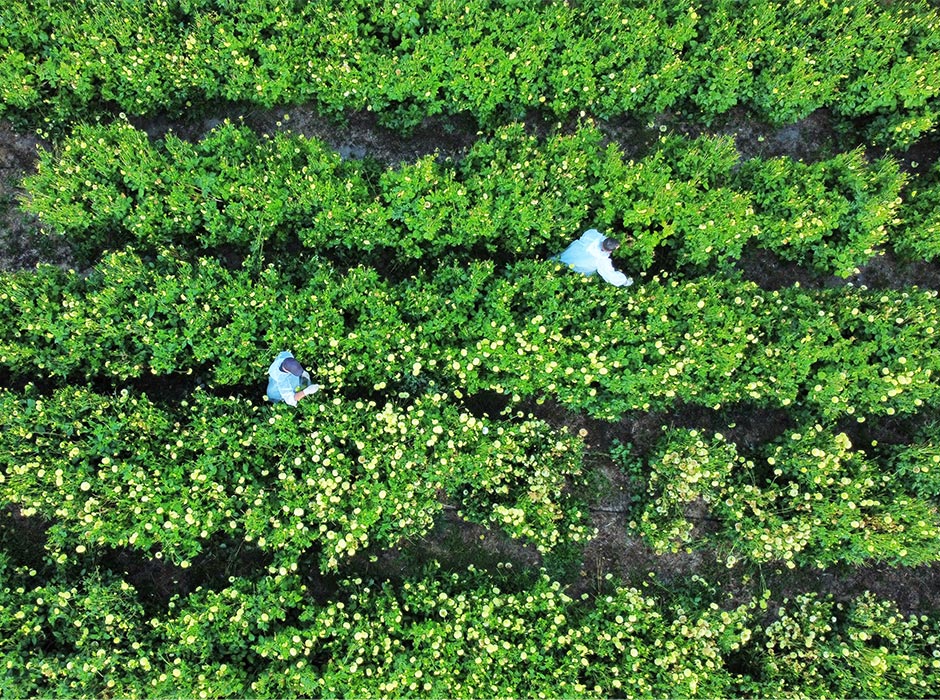
Flower pickers harvest the dahlia plant for a University of Otago study into natural diabetes management.
Associate Professor Alexander Tups has spent his career exploring how certain compounds influence the brain’s delicate control over our bodies. And often, the answers to his questions have been found in the unlikeliest of places.
There’s the wonder-compound with the power to block brain inflammation caused by a fatty diet. Then there’s the dahlia: a garden favourite that blooms in dozens of different hues through late summer and autumn.

Associate Professor Alexander Tups
Alexander could have never conceived that one would be lying hidden within the other. Nor that a fellow scientist’s random piece of knowledge would prove the key to unlocking a secret that’s since led to an award-winning natural health product.
It all began in 2014, when the German-born neuroendocrinologist was sharing a presentation at the University of Otago, shortly before joining its School of Biomedical Sciences.
Alexander was speaking about his group’s findings that a high-fat diet could trigger inflammation in an important region of the brain called the hypothalamus, leading to weight gain and diabetes.
They’d succeeded in blocking the process in mice – effectively preventing these conditions – but had used gene therapy to do it. What Alexander needed was a molecule that could achieve the same result.
He was aware of one such candidate – a type of phenol called butein – but the tree species it came from happened to be toxic, making it unusable for a human health product.
After his talk, University of Otago neurophysiologist Dr Phil Heyward told Alexander where else he could find it: in the dahlia.
“That was exciting, because suddenly, we had something we could look at for commercialisation.”
Alexander has long been interested in understanding how our brains control metabolism – the chemical processes that occur within our bodies to maintain life.
After studying biology in Germany, he went on to complete his PhD in Scotland, where he sought to solve a long-standing mystery about hamsters.
That was how exposure to darkness and daylight, rather than food, causes the rodent to put on weight during summer and slim down over winter.
Alexander and fellow researchers eventually pin-pointed a specific hormone, called leptin, which is secreted by fat tissue and acts in the brain to regulate body weight.
Following a postdoctoral fellowship at the University of Otago, Alexander returned to Germany in 2008 to establish his own group, expanding his research focus to blood sugar.
The team soon made a discovery about insulin, a hormone produced by the pancreas to help cells absorb blood sugar and best known for its use in diabetes management.
Their findings contributed to the growing field researching how insulin acts directly in the brain – a link long neglected by scientific research.
The brain, Alexander explains, appears to be the master regulator of the liver, which itself acts as a “long-term buffer” that stores blood sugar as glycogen. This is released as glucose when the body needs energy.
Alexander’s team was ultimately able to show this entire process is regulated by the brain and that leptin, which he’d studied in hamsters, is essential for the brain to effectively respond to insulin.
When the signalling behind this process was impaired, they found brain inflammation to be the main culprit, leading to the development of metabolic diseases.
To disrupt this process, the team fed mice a high-fat diet, which caused them to gain wait, before using gene therapy to block the inflammation in their brains.
The results were remarkable: not only did these mice not gain body fat, but their blood sugar regulation remained normal.
It was that experiment that ultimately led Alexander to butein and, once he began his role with the University of Otago, the dahlia.
Alexander says one of his first steps was to start collecting dahlias.
“We went to Invercargill to meet very enthusiastic dahlia growers – they have an amazing garden that was featured in a 12-page article in NZ Gardener – and we also got in contact with Dahlia Society of New Zealand,” he says.
“Because we didn’t know which varieties we needed – there are more than 300 available in New Zealand - they supplied us with a range.”
Meanwhile, the University’s commercialisation arm, Otago Innovation, helped to secure a proof-of-concept grant, and an interdisciplinary team including natural product chemist Professor Nigel Perry and food technologist Research Associate Professor Pat Silcock took shape.
After creating an extract from the flowers, Alexander's team began extensive research in mice.
Their analysis confirmed that butein was present in the extract – and that the compound happened to work in concert with two others to produce a powerful effect in regulating blood sugar.
“When we tested these two other compounds in isolation, we found that they only had a marginal effect,” he says.
“But, when we put the three compounds together, the effect was so large that the mice’s blood glucose was no longer different to our control group of the mice: in fact, it was normal.”
The team also compared the effect to that of Metformin - the most prescribed drug for diabetes - to find the dahlia extract was more potent, at a dose 300 times lower.
With the science confirmed, the next challenge was commercialisation.
Seeking to turn their findings into a natural health product that could easily reach people, the team partnered with Christchurch-based Aroma NZ, best known for its green-lipped mussel powder and oil.
While Aroma NZ licensed the technology and acquired one of New Zealand’s largest flower businesses to scale up production, Alexander’s team pin-pointed the best dahlia variety for the extract, then used tissue culture to clone tens of thousands of plants to ensure consistency.
The result was the first product of its kind - Dahlia4 – which is now sold and patented around the world. In June, it earned Aroma NZ the 2025 Cawthron Innovation Award, presented at Natural Health Products NZ Summit in Christchurch.
“It's so important to have the flexibility to do work like this, as it can lead to new ideas – and entirely new pathways.”
Alexander says it’s been incredibly rewarding to see his research come to such fruition: but adds there’s much more waiting to be discovered.
He suspects the same anti-inflammatory properties his team have found to combat metabolic diseases, such as diabetes, may have other important roles.
“For instance, the brain inflammation that we've been looking at happens to be a cause of many other things, like cognitive decline.”
He also points to an intriguing link between insulin resistance and Alzheimer's disease, which the dahlia’s unique anti-inflammatory compounds might shed further light on.
Elsewhere, his team is exploring the potential of the dahlia extract to help with conditions like Long Covid and chronic fatigue, which are also linked to neuroinflammation.
What they’ve discovered so far reflects the value of fundamental “blue sky” research, he says.
“It's so important to have the flexibility to do work like this, as it can lead to new ideas – and entirely new pathways.”
He’s also quick to credit the dedication of his students, postdoctoral researchers, and colleagues, whose insights were critical at every step of the way.
“Without that teamwork, it would not have been possible.”
Study Biomedical Sciences
This interdisciplinary degree provides a deep understanding of how the human body works, how it faces challenges, and how to keep it healthy. You’ll build a strong foundation in biology, from the molecular and cellular level to the structure and function of the body. At the same time, you’ll explore what causes conditions like cancer, diabetes, and heart and infectious diseases, and how they’re diagnosed and treated.
Find out more