
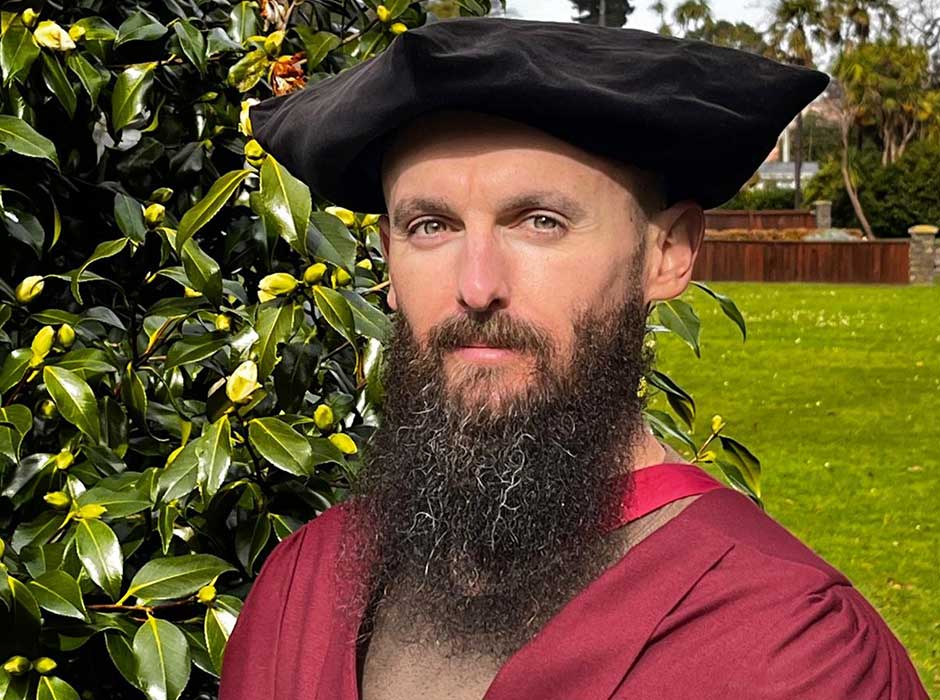
Dr Patrick Mazzocco graduated on Saturday, after having researched the lived experiences of people who took career breaks.
Should you take a career break? Recent Doctoral graduate Patrick Mazzocco has spent the past three years researching the pros and cons of career breaks, and the answer to that question is not just a simple ‘yes’ or ‘no’. During his time at Ōtākou Whakaihu Waka, Patrick experienced a high level of success – something he says would not have been possible without his supervisors Dr Russell Butson and Professor Rachel Sproken-Smith. Koren Allpress talks to Patrick about career breaks and how Russell and Rachel helped Patrick cross the PhD finish line.
Dr Patrick Mazzocco would have a lot of questions for someone considering a career break, starting with ‘what’s prompted you to consider taking a career break, what are you hopes or expectations for what the break will yield?’ and ‘what concerns do you have?’.
Patrick graduated on Saturday with a PhD from the Centre for Educational Design and Innovation at Ōtākou Whakaihu Waka. He spent the previous three years researching the lived experiences of people who had chosen to take career breaks and were without a guaranteed job after the break.
“I wanted to better understand who is pursuing career breaks voluntarily, why they do so, what they perceive to have gotten out of the experience positively or negatively, and how they make sense of their career breaks as they move forward with their careers,” Patrick says.
Having surveyed 120 people from around the world who had taken a career break, and interviewing 24 of them, he found they came from a wide range of backgrounds, and that their pre-career break decisions and plans unfolded in a myriad ways.
“Regardless of where each participant started, what prompted their decision to pursue a career break, and whether their break period was predominantly positive or negative, each of my 24 interview participants was emphatic that their career break completely altered their career ideologies.”
It’s important for anyone considering taking a career break to be intentional and realistic, he says.
“A career break can unearth a lot of mixed emotions, both within the individual and from loved ones. And lots could happen during the break period that might cause additional distress.
“The break also has the potential to transform how one thinks about their career identity and career narrative.”
Patrick says the academic literature on career breaks is both sparse and repetitive in terms of the population being investigated and the view that the experience will harm an individual’s future employment. Conversely, non-academic sources indicated that career breaks have significant value to the individuals pursuing them.
“Given this contradiction, I saw an urgent need for additional research that looked at career breaks as lived experiences instead of simply presenting them as good or bad in relation to a person’s future job prospects,” he says.
Since starting his study, academic and non-academic interest in career breaks has risen significantly, with people around the world reaching out regularly to learn more about his research.
“Because of this, I think the greatest contribution of my research will be the variety of studies it inspires to look at career breaks across different contexts.”
Grateful for the support
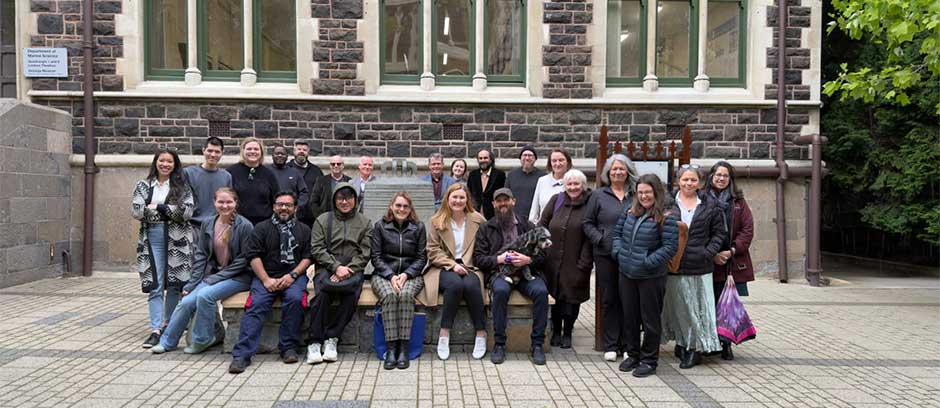
Dr Patrick Mazzocco (front row, seated on the far right, holding a dog) surround by the people who supported him during his PhD journey. Patrick had just handed in his thesis for examination and was able to hit the bell which can be seen behind the seated people.
Patrick emailed Dr Russell Butson in 2020, knowing he wanted to work with him; “not because he was researching a specific topic that aligned with my interests, but because he encourages thoughtful risk-taking and appreciates abstract thinking”.
He chose Ōtākou because he had always wanted to live in Ōtepoti.
“It was so much fun being near both the hills and the ocean during my studies.”
Patrick arrived in Ōtepoti to begin his PhD in 2023 feeling “very confident” he would cross the PhD finish line with Russell’s guidance.
His research journey at Otago was successful in many ways, he says. He was the Ōtākou Whakaihu Waka 3MT® Doctoral winner in 2024, a Falling Walls Lab Honouree in 2025, and has had his research featured in international media.
He credits his supervisors for making it all possible.
“When I started my studies, Russell helped me get settled but wasted no time challenging me to take ownership of the whole research project from start to finish. It was daunting, but he always reminded me we were a team. And the kindness he had extended in the years prior continued throughout my studies.”
Patrick was excited when Russell suggested they add Graduate Research School Deputy Dean Professor Rachel Spronken-Smith as his second supervisor.
“I was initially quite intimidated having Rachel as one of my supervisors because of her prestige and the completely different approach she had than Russell, with whom I'd spent years building a rapport. But Russell and Rachel had successfully co-supervised several times before and she offered a unique perspective neither of us had.”
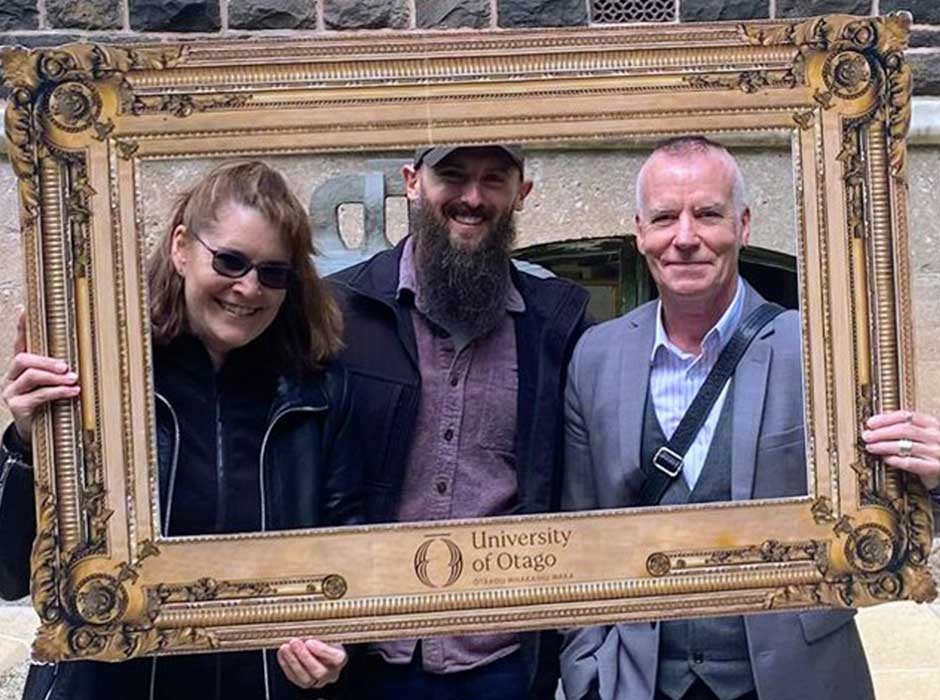
Dr Patrick Mazzocco, centre, with his two supervisors, from left, Graduate Research School Deputy Dean Professor Rachel Spronken-Smith, and Dr Russell Butson.
Patrick says it was “truly incredible” to work alongside the pair.
“I don't know if I would've gotten through it or had as much success or learned as much without this exact combination of boldness and calmness.
“When I wanted to take risks and be less conventional, I knew Russell would be on board and have just the right probing questions to help me rationalise and justify those decisions; when I needed to be more pragmatic and procedural, Rachel gave me enough information to either find the answer on my own or go directly to a resource so I could follow clear steps.
“Ultimately, they both wanted me to constantly dig deeper in my analysis and writing and not settle for the easy-to-reach solutions.”
Even though Russell and Rachel had differing approaches and opinions, they never contradicted each other, he says.
“There were certainly times when the three of us didn't agree on things, but the final decision was always mine to make, with the understanding that any decision needed to be rationalised.
“They probably don't realise how much I benefited from watching them thoughtfully and respectably debate aspects of my research in front of me, seeing them disagree but not argue, to listen and try to understand the other's point of view.”
Russell and Rachel made Patrick feel like a peer from day one, he says.
“It took me until the very end to believe them, but as I reflect on the last six years – particularly the last three-and-a-half – I can see the whole journey so clearly and how much they empowered me. Not just to check the boxes required to complete a PhD, but to produce a novel piece of research I could be truly proud of,” Patrick says.
Graduate Research School senior teaching fellow and researcher Dr Nick Baker was a “relentlessly positive” part of Patrick’s PhD journey.
“He has a true gift for supporting postgraduate students and bringing them together as one community. He has become a great friend and mentor, and I cannot thank him enough for being so generous and encouraging.”
While originally from Illinois, United States, Patrick was in Alaska before he moved to Ōtepoti. After handing in his thesis, Patrick moved to Ōtautahi Christchurch and now works as a career educator at the University of Canterbury’s Centre for Employability and Career Development.
“It’s an incredibly innovative team, and I feel very fortunate to be a part of it,” Patrick says.
Centre for Educational Design and Innovation
Our Centre for Educational Design and Innovation (CEDI), helps educators design better learning for a changing world.
View