
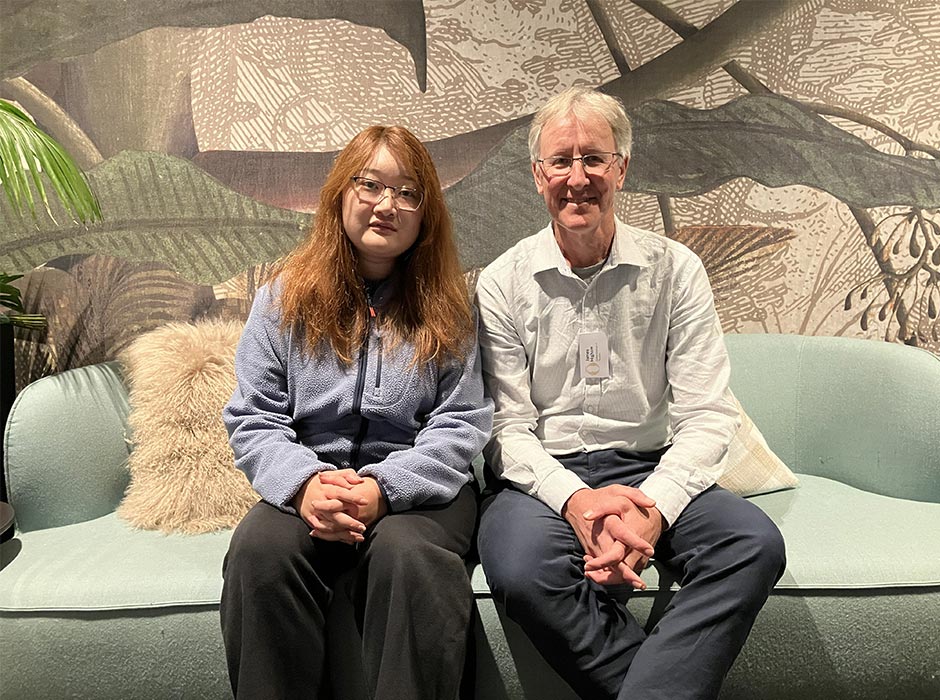
Professor James Higham (right) with Otago alumna Yi Bian in Queenstown after presenting their regenerative tourism research report at the 2026 Otago Tourism Policy School.
You can take the professor out of Otago, but you can’t take Otago out of the professor. Or so it would seem given Professor James Higham’s enduring connection to the University he spent more than three fulfilling decades at.
Now based in Australia at Griffith University in Queensland, James has maintained his deep connection to Otago via his appointment as Honorary Professor in the Department of Tourism – which he was instrumental in establishing – and the Centre for Sustainability Research.
“This appointment makes it easier for me to continue my work with friends and colleagues in Ōtepoti and to support graduate students and colleagues across the University in various ways. The University and Dunedin are important parts of my academic life and I’m very grateful for this continuing affiliation,” James says.
One of the most rewarding and extensive collaborations he’s involved in is a major research project funded by the Ministry of Business, Innovation and Employment (MBIE) Endeavour Programme. Titled ‘He Karapitipitinga Mariko – Immersive Regenerative Tourism Experiences in Aotearoa’, it’s a five-year, multi-institutional, multi-disciplinary collaboration between the fields of tourism, Indigenous studies and computing.
James is one of the project’s four theme leaders alongside Professor Holger Regenbrecht from the School of Computing. Together with a wide team of researchers from Otago, Auckland, Canterbury, Wellington, Denmark and Australia, they are exploring opportunities to apply extended reality technologies to immersive visitor experiences in Aotearoa – ones aligned with the regenerative ambitions of local tourism and community stakeholders.
James recently travelled to Queenstown with Griffith University PhD candidate and Otago alumna Yi Bian to present a Regenerative Tourism Report from ‘He Karapitipitinga Mariko’ at the 2026 Otago Tourism Policy School (TPS).
In his address to TPS audiences, James explained the ways in which extended reality technologies offer the potential for expansive new dimensions of the visitor experience.
“The greatest perceived threat is that the rise of virtual experiences might replace in-person tourist experience." – James Higham
He also acknowledged the wariness, from some corners, around the potential impact of this tech-enabled trajectory to detract from tourism.
“The greatest perceived threat is that the rise of virtual experiences might replace in-person tourist experience,” he says.
“But our focus is on new kinds of interactive and immersive experiences – experiences that can be shared with others, no matter where they are. It’s not about replacing tourism; it’s about complementing and enhancing it – to deliver virtual and augmented experiences that are additional to tourism.”
He cited several tourist markets that might benefit from virtual travel – such as those researching for a future trip, those unable to commit to long haul travel for health or environmental reasons, and those who want to revisit favourite destinations to deepen a connection with them.
The MBIE project was a perfect fit for this year’s TPS theme: ‘What should tourism look like in 2050? Envisioning Aotearoa New Zealand’s future through emerging technologies and the Tourism Growth Roadmap.’
James was a perfect fit too, as he was one of the driving forces behind the inaugural TPS in 2019. Back then, there were 50 attendees across academia, industry and government. Seven years on, the 2026 TPS was a full house with nearly 150 attendees from across the motu.
While heartened by the event’s increased heft and relevance, James says he’s not surprised that it’s become such a must-attend event on the annual tourism calendar.
“It is unique and much needed for a sector that is so diverse and at the same time so important to the New Zealand economy. It was intended from the outset to address timely topics, to be research-informed, and to foster discussion and debate involving government policy makers, industry organisations, business leaders, regional tourism organisations, local communities and mana whenua. Prior to TPS, this opportunity for discussion and debate was rarely available if at all.”
He likes that the event serves a wider, industry-nourishing purpose too.
“It helps to shape the tourism research agenda, it builds visions for the future, it provides insights that help to (re)shape business practices, and it shapes debates that influence the directions and priorities of industry organisations.”
It also, of course, helps beckon a Queensland-based professor with a soft spot for Otago.
“It will always be my tūrangawaewae,” he says.
– Kōrero by Claire Finlayson, Communications Adviser (Otago Business School)
Study Tourism at Otago
When you study tourism you’ll explore how travel, culture and business meet, and how destinations are shaped and reshaped by global change.
Tourism at Otago