
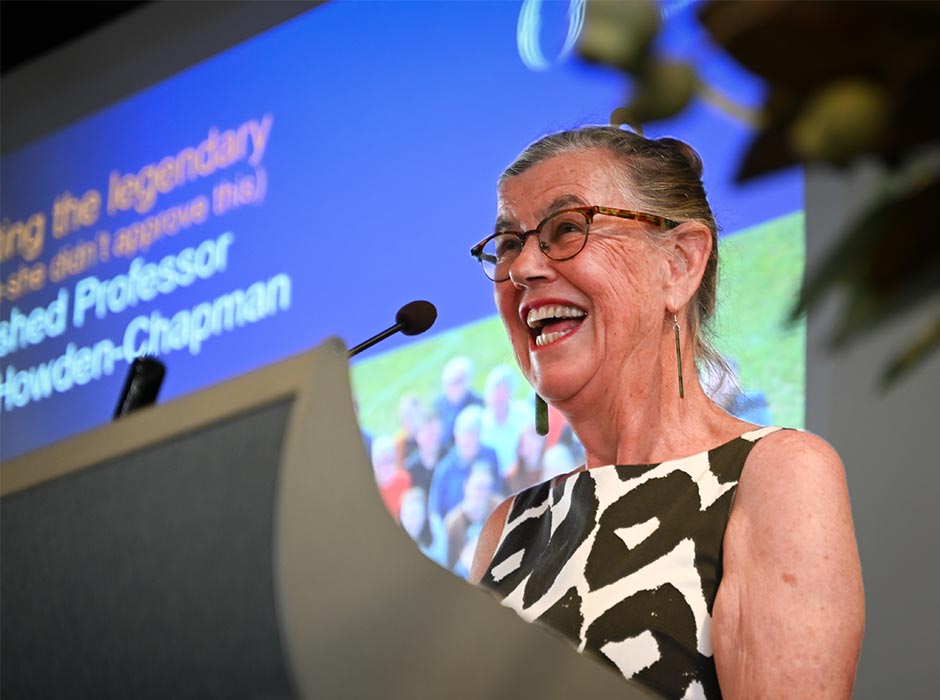
Distinguished Professor Philippa Howden-Chapman speaks to family, friends and colleagues at a gathering at the Royal Society in Wellington, held to celebrate her work on healthy housing research over more than 40 years.
There were anecdotes, tributes, songs and laughter at a gathering to celebrate the more than 40-year career of healthy housing researcher, Sesquicentennial Distinguished Professor Philippa Howden-Chapman (QSO, CNZM, FRSNZ).
Philippa retired from the Department of Public Health (Wellington) at the end of March.
At the farewell event at the Royal Society Te Apārangi on 18 March, colleagues, friends and family came together to share their experiences of working with Philippa, the Co-Director of He Kāinga Oranga – Housing and Health Research Programme and Director of the New Zealand Centre for Sustainable Cities.
The tributes were led by the Head of the Department of Public Health, Associate Professor Ruth Cunningham, who said by any measure Philippa’s achievements had been exceptional.
“Her team’s research has had a profound impact on public policy, both in New Zealand, underpinning the Government’s Warm Up New Zealand programme, and the healthy homes standards, and internationally, where she served as Chair of the World Health Organization Housing and Health Guideline Development Group.
“She has shaped the research and policy landscape in housing and health, both here in Aotearoa and internationally. She has authored more than 600 papers and 70 books and book chapters, led more than 30 research grants, and her work has been cited more than 11,000 times.”
Vice-Chancellor Grant Robertson talked of working alongside Philippa to set up the Centre for Sustainable Cities, when he worked for the University of Otago as a Business Development Manager in the Research and Enterprise Office in Wellington.
"I know of few people in Aotearoa’s history who have had as much influence on public policy from academia as Philippa has." – Grant Robertson
“It was a great joy of my working life to work with Philippa and a much wider team, to put together the Centre, and I learned so much from her during that time.”
He said Philippa was a world-class academic and he wanted everyone in the room to understand just how fortunate and privileged the University, the wider community and New Zealand and the world had been that she went down the pathway she did.
“She is a champion of translational research. I know of few people in Aotearoa’s history who have had as much influence on public policy from academia as Philippa has.
“The fact that we got the healthy housing standards that we did is a tribute to Philippa and the team of people who have worked with her for so long. That is translational research at its very, very best.”
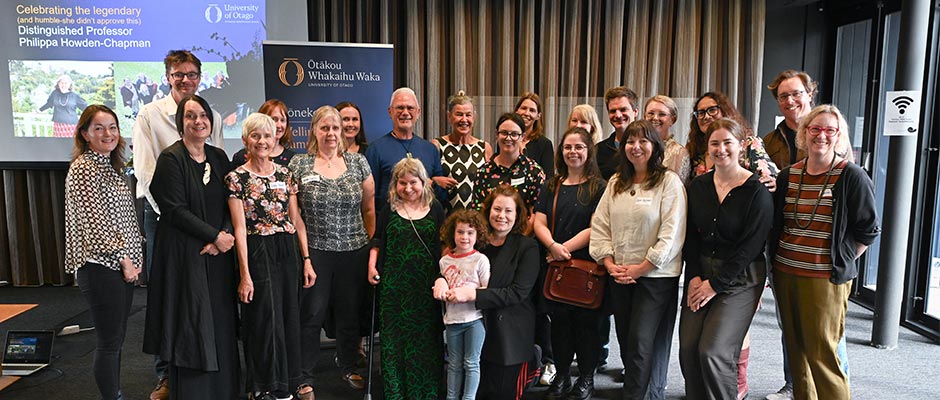
Distinguished Professor Philippa Howden-Chapman with some of the 33 doctoral students she has supervised during her time in the Department of Public Health (Wellington).
The Co-Director of He Kāinga Oranga, Professor Nevil Pierse, spoke of the impact of Philippa’s work on families and communities.
“There are now 600,000 houses that have been insulated because of schemes Philippa has led. That is one-third of the entire housing stock. There are 200,000 people who have had a healthy homes initiative and have had their lives directly improved. There are 40,000 children who haven’t had a hospitalisation in the last five years because of work led by Philippa and her team.
“Those are incredible achievements. And they are just the New Zealand achievements. The work of her team has been cited in policy documents in 72 countries.”
The meaningful impact of Philippa’s research on communities was the focus of a tribute from Cheryl Davies (Ngāti Raukawa, Ngāti Wehiwehi, Ngāti Mutunga ki Te Wharekauri), an Otago public health researcher, and Wainuiōmata Marae Trust Board secretary and manager of Tū Kotahi Māori Asthma Trust at Kōkiri Marae.
Cheryl said it was largely as a result of Philippa’s commitment and support that a papakāinga housing development was being built on the Wainuiōmata Marae.
“In two years’ time, 12 whānau will be living in warm, dry homes as part of our papakāinga and this is largely due to Philippa’s commitment and support over the past 15-20 years in planning and securing funding.
“Wainuiōmata Marae, Tū Kotahi and Kōkiri Marae will forever be grateful for the huge contribution she has made to our communities.”
Among her many honours, Philippa and her team at He Kāinga Oranga were awarded the Rutherford Medal, New Zealand’s top research honour, by the Royal Society Te Apārangi in 2021, and the Prime Minister’s Science Prize in 2014. Philippa was awarded the University of Otago’s top honour, the Distinguished Research Medal in 2023. She is a fellow of the Royal Society of New Zealand and was a director on the board of Crown Agency Kāinga Ora – Homes and Communities for six years.
Philippa said she was grateful to all those who had supported her research over the years, including her colleagues, as well as to the politicians who had backed healthy housing policies.
She and her husband and research partner, Professor Ralph Chapman, an economist from the School of Geography, Environment and Earth Sciences at Victoria University of Wellington – Te Herenga Waka, are looking forward to spending time with their mokopuna in retirement.
Philippa will continue to have a presence on campus, and plans to work on her next book, which focuses on the way forward for housing policy.
But first, she will be having a well-deserved holiday.
– Kōrero by Cheryl Norrie, Wellington Communications Adviser
University of Otago, Wellington
Research and study Health Sciences and Medicine through our Wellington campus.
More news from Wellington