
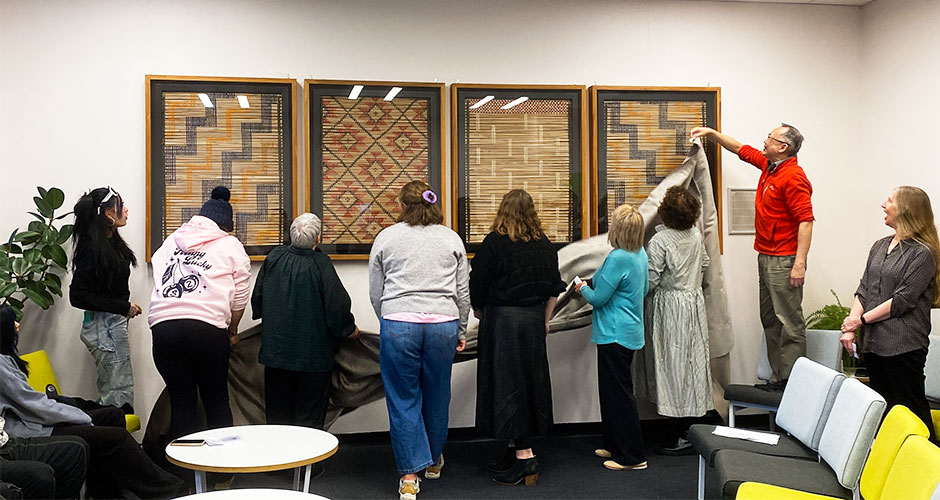
The tukutuku panels in the Human Nutrition staffroom, the result of a months-long team building activity, were unveiled at a special event held on Monday 10 August.
A team building exercise in the Department of Human Nutrition involved wetsuits, stained fingers, and a trip to the emergency room.
It also resulted in the creation of taonga that were installed in the Human Nutrition staffroom this week: four tukutuku panels.
Tukutuku are a traditional Māori art form, with woven wall panels carrying layers of meaning. Made from natural fibres such as toetoe and harakeke, they adorn the interiors of wharenui (meeting houses) across Aotearoa New Zealand.
Professional Practice Fellows and keen weavers Nichola Agnew and Kimberly Ti came up with the idea for the project.
“When I first joined the department, one of the hardest things for me was adjusting to how independently we all work,” Nichola says.
“I really wanted to find something we could do together, something meaningful, but flexible enough that people could contribute to in their own time, even if they only had a spare hour.”
To weave a tukutuku panel, two people need to work together: one at the front of the frame and one at the back, feeding the strips through the kaho (horizontal slats) and kākaho (vertical rods) to form the pattern.
“It’s about more than weaving, it’s about whakawhanaukataka: connecting, chatting and building relationships as you work together.” – Kimberly Ti
“There are quite a few English words that could describe the term ‘tukutuku’ if you look it up, but my personal favourite is ‘giving and receiving’,” Kimberly says.
“It’s about more than weaving, it’s about whakawhanaukataka: connecting, chatting and building relationships as you work together.”
As Tangata Tiriti, the pair sought advice from weaver Marcanui Taura and Associate Dean (Māori) – Sciences Tracy Perry to ensure they upheld tikaka throughout the project.
“Māori values are incorporated into the art, and we learnt about culture in such a fun and meaningful way,” says Kimberly.
But that’s not to say the project was easy – even with Marcanui advising and supporting them every step of the way.
“We didn’t realise how long it would take. We spent weeks harvesting the toetoe, raupō, kiekie and harakeke,” Nichola admits.
The harvesting process involved donning wetsuits and collecting hundreds of stems from wetlands. It was while collecting kiekie that one team member cut their finger badly enough to need stitches – the first of many challenges the team endured and overcame.
“During the whole process my fingers were constantly either coloured or filled with cuts!” Kimberly says.
“After you collect the material, you have to strip, clean, string and dry it. You have to cut the right size whenu (strips), and soften it so it doesn’t crack when it dries.”
Once the materials were dyed, it was time to finalise the design and start weaving.
“It’s a bit like cross stitch – and these have about 12,000 stitches,” Kimberly says.
“Marcanui emphasised that the back should look just as tidy as the front, so there’s a lot of teamwork involved. With one person working on the front and another person working on the back, you just start talking. I got to know more about my workmates during this process than I had over the past five years – and we have a beautiful, meaningful artwork.”
Nichola says the project achieved its aim of deepening connections within the Human Nutrition team.
“I’ve genuinely loved the moments we’ve shared throughout this process,” she says.
“I would also like to personally thank Marcanui for his time, his patience, and all the work that went into preparing the materials. I’m incredibly proud of what we’ve created together.”
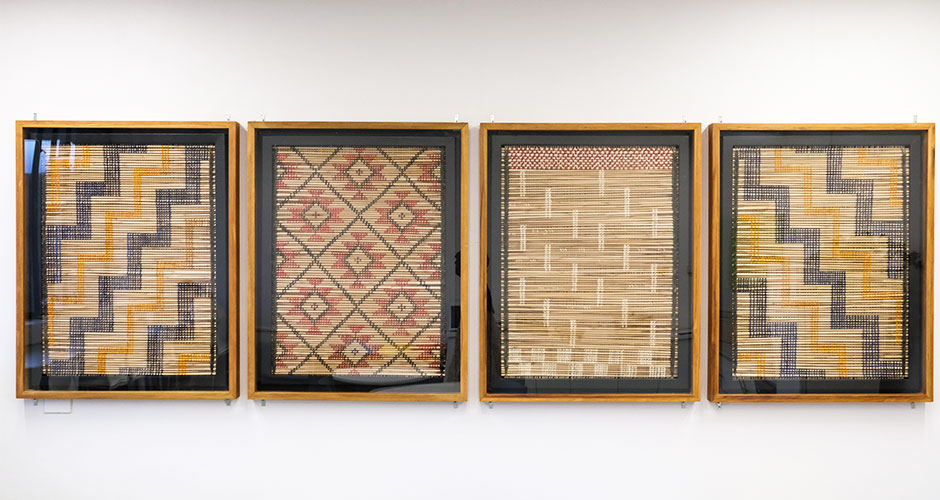
The Poutama, Pātiki, Nihoniho and Roimata Toroa tukutuku patterns are steeped in meaning.
About the tukutuku patterns
The Poutama pattern has been used on two of the four panels. In this stepped design, the horizontal and vertical lines hold their own meanings. The pattern is associated with journeys, ascending taumata (summits), and supporting others to reach those same taumata. Dyed Otago colours, this tukutuku panel represents tauira taking steps on their education.
The third panel uses a combination of Pātiki and Nihoniho patterns. Pātiki is inspired by the flounder, known to inhabit waterways in Ōtepoti Dunedin, and is associated with kai, nourishment, abundance, wellbeing and manaakitaka. Nihoniho represents teeth and symbolises courage, determination, resilience, and the strength required to uphold and protect the community. Together, the patterns represent hospitality.
The fourth pattern is woven in the Roimata Toroa pattern, which references the two sacred albatrosses who accompanied the ancestor Pourangahua when Pourangahua brought kūmara to Aotearoa. This pattern is associated with grief, remembrance, healing, journeys, compassion and endurance. It represents the stars in the sky and the tears of the albatross.
Human Nutrition at Otago
Graduates in Human Nutrition make a real difference in the health and well-being of the communities in which they live and work, at individual, whānau, national and global levels. World-leading experts and practicing nutritionists will help you will learn the science of nutrition, develop professional skills, and learn about yourself while you study.
Human Nutrition