
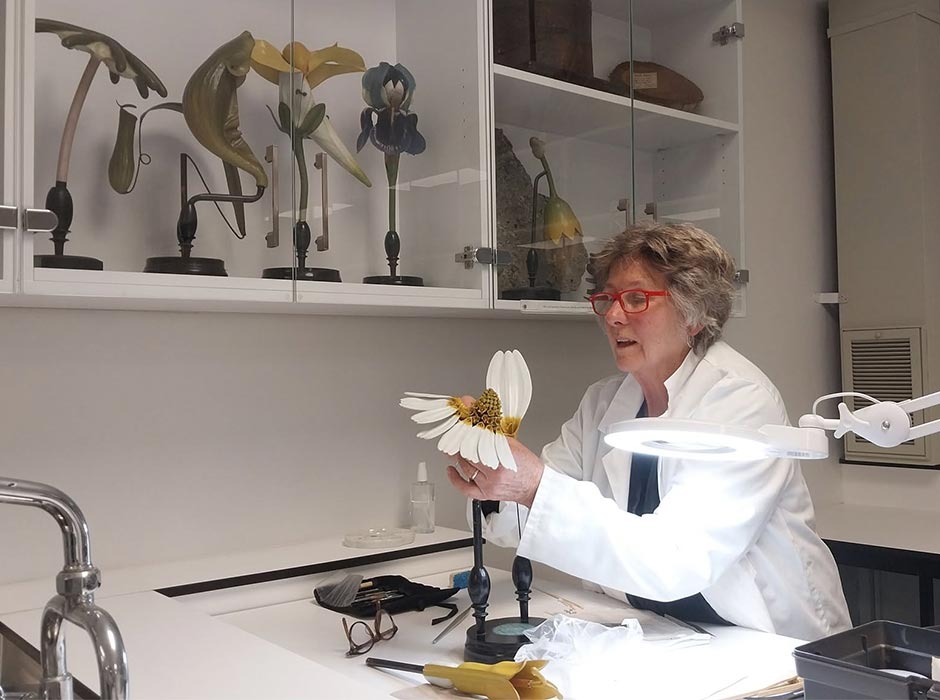
Conservator Marion Mertens restores the Brendel model of an Anthemis cotula, also known as a fetid chamomile, from the daisy family. The Botany Department has a collection of rare Brendel anatomical plant models that date back to 1893.
The unassuming pink building at 464 Great King Street contains a botanical wonderland, complete with climate-controlled herbarium and a collection of rare Brendel anatomical plant models that date back to 1893.
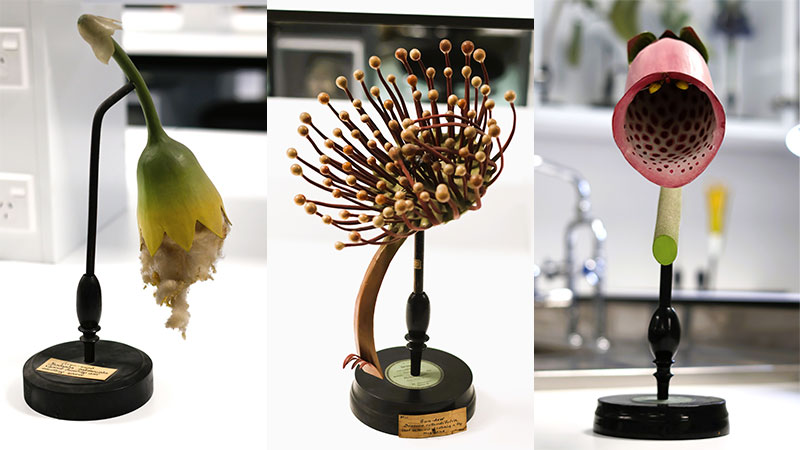
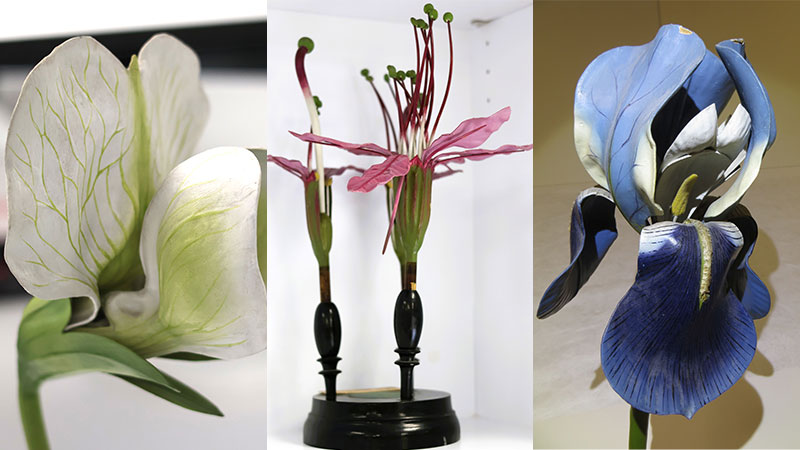
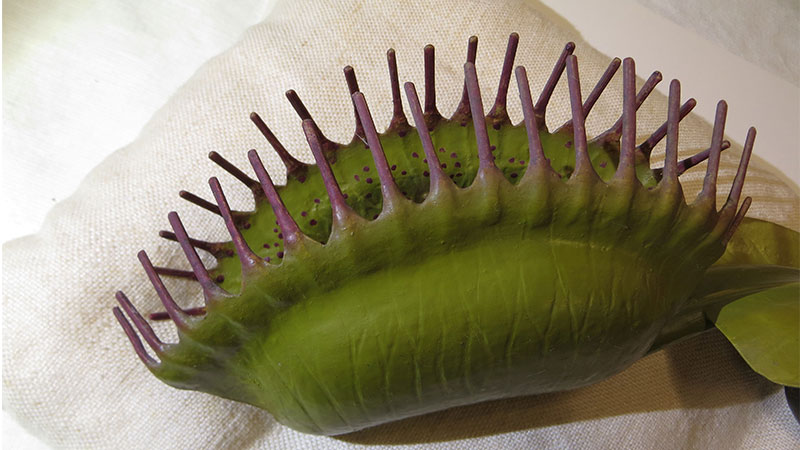
Handmade in Poland from materials such as papier mâché, glass beads, feathers and gelatine, painted with oils and varnished with shellac, the models are still in use 133 years later – thanks in no small part to Conservator Marion Mertens. Marion has examined and cleaned all 36 models, most recently repairing and bringing the shine back to the Anthemis cotula flower.
The exquisite objects are now carefully locked inside custom-made cabinets, but Botany Professor Janice Lord says when she joined the department in 1996, “it took a bit of detective work to piece them together and figure out what they were”.
“Just in the last 20 years there’s been a growing realisation that these models are rare, relatively few people have them, and they need to be preserved. We’re now part of an international group of museums and universities with this collection.”
The Brendel Company was run by a father and son who developed their didactic models with leading botany professors. Their creations, which won medals at several world fairs, were in high demand by the universities of the day.
When University of Otago’s first Biology Professor, T.J. Parker, procured the collection, they would have been state of the art teaching tools used by medical and biology students.
“The professors would have had microscopes, but the students likely did not,” Janice says.
“The models are tactile, some are articulated and they’re absolutely anatomically correct, so students could see how structures fit together in 3D.”
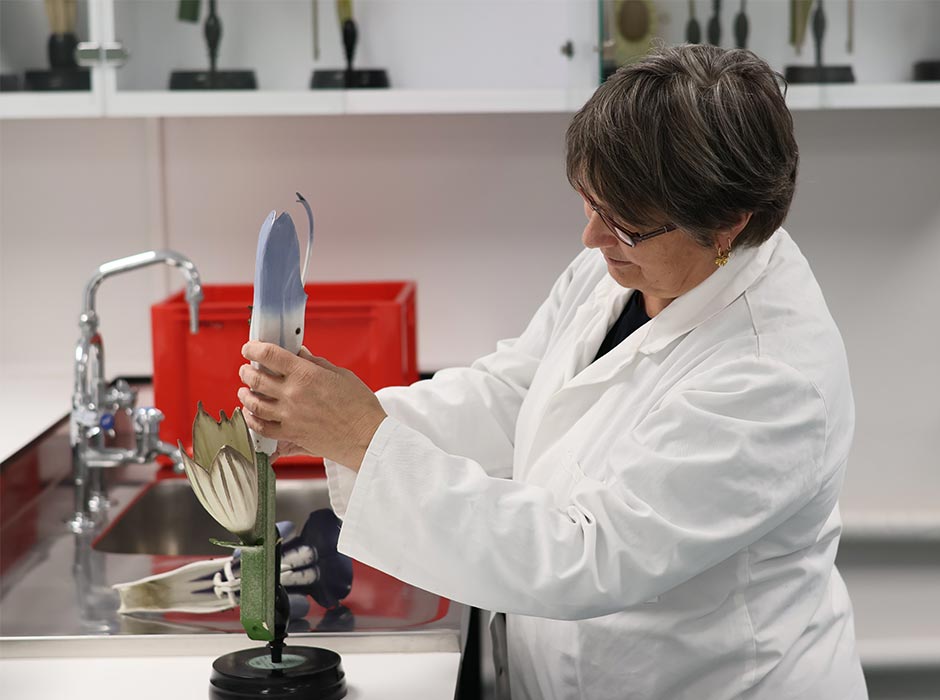
Botany Professor Janice Lord reassembles the Brendel model of a Salvia officinalis, common sage flower. The model is 15 times larger than the actual flower.
Otago’s models range from grasses and flowers, through to insectivorous plants like the Venus fly-trap, and even common fungi like bread mould.
“Someone has been looking at bread mould spores and painting them by hand,” Janice marvels.
“There was no 3D printing in those days. The skill that’s gone into creating these completely accurate representations is just incredible. The models are a connection to the passionate botanists of the past.”
Janice says the lessons the models teach are just as relevant now as when they were first made, and “the students think they’re amazing”.
“I love the flair that the original artists brought to these models, reminding us that scientific knowledge can be beautiful as well as useful, and that understanding can involve the emotions as well as the mind.”
The models haven’t only fascinated Botany students – they’ve also been exhibited at Hocken Collections, inspired Frances Hodgkins fellows including Miranda Bellamy and Amanda Fauteux, and featured in photographer Marion Wassenaar’s 2019 ‘The Anatomy of Plants’ exhibition.
“I love the flair that the original artists brought to these models, reminding us that scientific knowledge can be beautiful as well as useful, and that understanding can involve the emotions as well as the mind.” – Professor Janice Lord
But beautiful as the models are, nothing can compare to real plants in Janice’s eyes – even if she does make them sound like candidates for the villain in the next monster movie.
“Plants compete for mates, nurture offspring, defend themselves and communicate, all without a brain or central nervous system,” she says.
“They manipulate animals, and at times even eat them. They can outlive us and dwarf us, many are potentially immortal and most are totipotent – meaning that almost any plant part can become reproductive.”
Happily, the 72,000 plant specimens in the Otago Regional Herbarium are pressed, boxed, stored in climate-controlled conditions, and unlikely to be plotting their takeover just yet.
Established in 1946, the Herbarium includes more than 120 type specimens, including some collected from the French Transit of Venus Expedition in 1873. But it’s an assuming grass that’s captured Janice’s heart.
“If I had to pick a favourite it would be Zotovia thompsonii, a tiny wetland grass. I like the little things.”
From grasses and bread mould to murderous plants and antique works of art, the Botany Department has it all.
You can view artist Marion Wassenaar’s photographs of the Brendel models
– Kōrero by Kathryn van Beek, Communications Advisor | Kaiarataki Pārokoroko
Study Botany at Otago
Studying Botany gives you a deep understanding of plant biology, ecology, evolution, physiology and biotechnology. It’s a subject that blends discovery, sustainability and science, revealing the vital role plants play in shaping life on Earth.
More about Botany