
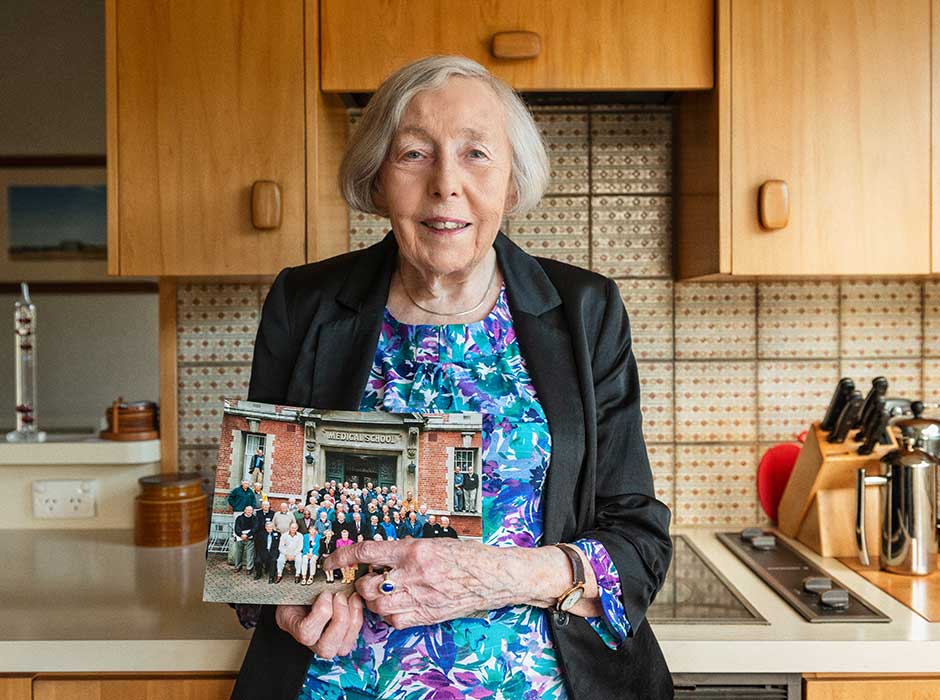
Dame Norma Restieaux: “I saw with my own eyes that women could, and were, practising medicine.” Photo: Alan Dove.
The Otago Medical School marked its 150th anniversary over King’s Birthday Weekend 2025 with a vibrant programme of events celebrating a century and a half of medical education, clinical training, research and innovation across its three campuses - Ōtepoti, Ōtautahi and Pōneke.
The milestone weekend brought together alumni, staff, and students from across Aotearoa and beyond, offering a chance to honour the School’s legacy of firsts and look ahead to the future of healthcare in New Zealand.
Dame Norma Restieaux, now 91, had her first experience of women in medicine at an early age.
In 1945, the then 11-year-old was admitted to Dunedin Hospital. With many men still overseas following the end of World War 2, she was cared for by two female doctors.
“I saw with my own eyes that women could, and were, practising medicine.”
This experience would be the catalyst for her to become a doctor despite numerous obstacles.
Awarded the rank of Dame Commander of the British Empire in 1992 for her contributions to medicine and cardiology, Dame Norma was a renowned cardiologist, researcher and lecturer before her retirement in 2005.
Dame Norma’s first obstacle to becoming a doctor came when she attended Otago Girls’ High School in the 1940s.
At the time Otago Girls’ did not offer high-level teaching in all science subjects, so she completed that work at nearby Otago Boys’ High School.
“Getting science knowledge to a high enough level was a real challenge,” she says.
In 1953 she began her first year of study at the University of Otago to meet requirements for entry into medicine. She passed all papers but her Physics grade was not high enough for medical admission. Undeterred, Dame Norma repeated the subject the following year and secured a place in the medical class of 1955.
“We women were in the minority,” she says.
Female students had a separate common room and for most of her undergraduate years, all lecturers were male.
“I saw with my own eyes that women could, and were, practising medicine.”
These experiences motivated Dame Norma to mentor other women during her career. One of them was Emeritus Professor Dawn Elder, an organising member of the Otago Medical School anniversary committee.
Elder says Dame Norma provided mentorship to her in two important ways.
“First from my experience as her house surgeon – when she commanded respect as a doctor in the way she practised medicine; and later in my career she had faith in me when I encountered tricky hurdles during advanced training in paediatrics.”
Between Dame Norma’s third and fourth years of undergraduate study, she was one of three students in her class to do the research-focused Bachelor of Medical Science.
In 1960, she graduated with her medical degree. Women made up fewer than 10 per cent of her graduating class of 120.
After completing specialist training in London and Boston, Dame Norma returned to Dunedin in 1970 to become a consultant cardiologist and University of Otago lecturer and researcher.
“By that time there were far more women going through [medical school] and the tutoring had become more student-centric rather than dictatorial. It was lovely to see such a big change in such a short time.”
Dame Norma continued working at the University and in a clinical role until her retirement.
Her distinguished career includes serving as Head of the Department of Cardiology at Dunedin Hospital, Associate Professor of Medicine at the University of Otago, and Chair of its Medical Admissions Committee. She was also the first female President of the New Zealand Medical Association and the first woman appointed to the Board of Examiners for the Royal Australasian College of Physicians.
Her many roles allowed her to see the evolution of medicine and its practitioners over the years.
“The biggest change has been the percentage of women in medicine which is, obviously, a very positive change. The entry to medical school of greater numbers of people from diverse backgrounds and strengths has also been a positive change and allows the profession to truly serve the community.”

Dr Chloe Priebe: “Becoming a vascular surgeon, however hard this will be, will allow me to use my skills to do something positive for our people.”
Like Dame Norma, 2024 medical graduate Dr Chloe Priebe had her sights set on medicine from an early age. She also overcame barriers to enter medical school and has supported other students since her undergraduate years.
During her fifth undergraduate year, Priebe was the inaugural recipient of the University of Otago’s Āwhina Scholarship, which supports Māori or Pacific undergraduate medical students involved in, and committed to, Māori or Pacific communities.
“As long as I can remember I wanted to be a surgeon,” Priebe says.
“I also wanted a job where I helped people.”
Priebe grew up in rural Eastern Bay of Plenty. Her parents were supportive of her academic and professional aspirations but did not have medical backgrounds.
“I had to work really hard to get good grades at my small high school. I just pushed through. It was a little hard not having anyone to talk with about medical school or medicine.”
In 2019, Priebe flew to Dunedin to begin her studies. Having never left the North Island before, she experienced bouts of homesickness – but becoming part of the Māori whānau on campus helped.
Until starting university, Priebe says she never identified with her Māori heritage.
“I don’t look Māori. I never felt I belonged. I felt a bit whakamā about engaging with that aspect of myself,’’ she says.
“When I went to uni and experienced the whānau environment, I felt like I truly belonged. This support and validation gave me the confidence to get involved and try out for new things such as various execs and mentorship roles.”
Since 2020 Priebe has been a mentor for Health Science First Year students and involved with the Ka Rikarika o Tāne student mentorship programme. In 2022 she was voted onto the Ngā Puna Hauora Executive (Māori Health Professional Student Executive) and in this role sat on the Wellington Health Professional Students’ Association as liaison between the Māori student executive and wider health professional executive at the medical school.
Priebe says one of the highlights of her medical studies was experiencing the Māori models of health to prepare medical students to integrate cultural and clinical competencies and help eliminate health inequities for Māori.
She aims to become a vascular surgeon – a specialty she believes will allow her to make a difference to the health of Māori.
When Priebe graduated last year, females outnumbered males in the medical degree programme, 866 to 641, with five students identifying as gender diverse.
Kōrero by Kim Thomas
This story first appeared in issue 58 of the University of Otago Magazine. Check out the full edition here.
Bachelor of Medicine and Bachelor of Surgery (MB ChB)
The Bachelor of Medicine and Bachelor of Surgery (MB ChB) degree is commonly referred to as the “medical degree”. University of Otago medical students graduate as doctors committed to high-quality, patient-centred, evidence-based medical care.
Find out more