
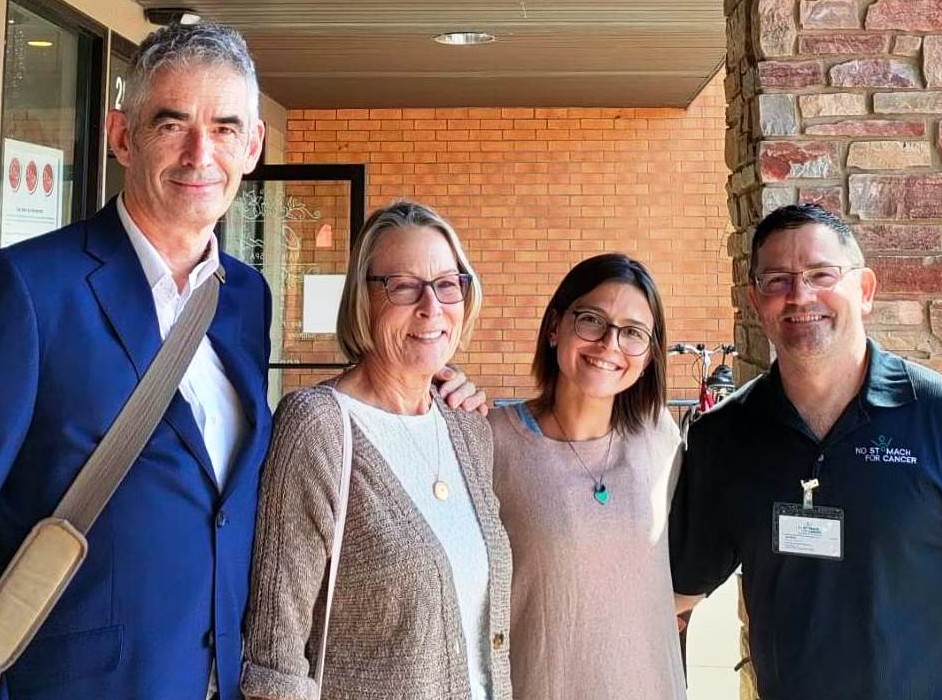
From left, University of Otago – Ōtākou Whakaihu Waka Professor Parry Guilford, with No Stomach For Cancer founder Karen Chelcun Schreiber, HDGC researcher Ana Rita Matos and NSFC Executive Director Jon Florin, in Madison, Wisconsin in 2022.
The power of human connection lies at the heart of the partnership between US-based non-profit No Stomach For Cancer and the University of Otago’s Cancer Genetics Laboratory in New Zealand.
It started with an email 17 years ago. No Stomach For Cancer’s founder, Karen Chelcun Schreiber, reached out to world-leading cancer geneticist Professor Parry Guilford, beginning a conversation about his research into inherited stomach cancer and how to improve care and outcomes.
In 1997, Parry, the Principal Investigator at the Cancer Genetics Laboratory in Dunedin, in collaboration with members of the McLeod whānau in Tauranga and clinicians from Tauranga Hospital, was the first to identify the CDH1 gene mutation that causes Hereditary Diffuse Gastric Cancer (HDGC). The mutation was causing members of the McLeod whānau to die from stomach cancer at a young age.
The HDGC project team also includes the University’s Te Tumu – School of Māori, Pacific and Indigenous Studies Professor Karyn Paringatai. Karyn discovered she carried the CDH1 gene in 2009.
When Karen Schreiber emailed Parry, she and her family had not long learned they carried the gene. They had lost their mother Elaine to stomach cancer in 1982, and her brother Greg was diagnosed with the same disease in 2007, sadly passing away two years later.
“It was immediately obvious that here was someone who meant business,” says Parry. “There was no way she was taking this lying down.”
The Chelcun family decided to establish No Stomach For Cancer (NSFC), based in Wisconsin, in 2009. Their mission was to raise awareness and funding for research, directed particularly at finding alternatives to stomach removal for CDH1 gene carriers.
The conversation between Karen and Parry set in motion an inspiring and enduring collaboration.
NSFC awarded its first donation to Parry’s gastric cancer predisposition research in 2013. This support has continued through the years, and, in total, NSFC has contributed close to NZ$1 million towards the Lab’s research.
Parry says the support has been particularly helpful in providing funding stability and enabling the Lab to hire additional researchers.
Since discovering the gene in the late 90s, research by Parry’s team led to the development of a genetic test for the CDH1 gene, giving stomach cancer patients the ability to identify and understand their risk of cancer and take life-saving action.
The test has dramatically decreased the mortality from this form of inherited cancer, saving many hundreds of lives in Aotearoa New Zealand and thousands around the world.
The HDGC team won the New Zealand Prime Minister’s Science Prize in 2023.
Research is now well underway on the next step – the development of a chemopreventative drug, which would eliminate the need for stomach removal for those with HDGC syndrome.
“You cannot understate the impact Karen and NSFC have had on the progress that has been made to improve outcomes for stomach cancer patients,” says Parry.
“Funding for medical research is very unstable. There is no way we would have reached the point in our research that we are at today without NSFC.
“Thanks to Karen and NSFC, we are now very close to beginning human clinical studies on the chemoprevention of HDGC.”
Over the years, Karen visited Parry and the team in New Zealand twice, with Parry visiting NSFC in Wisconsin in 2022 and 2023. Sadly, Karen passed away in 2023 of an unrelated cancer.
Karen and Parry’s shared mission has had a profound impact on the lives of thousands of people with stomach cancer around the world, progressing research which has saved lives and provided hope for the future.
Building on the legacy
Executive Director and Chief Patient Advocate of NSFC, Jon Florin, says the partnership with Parry’s Cancer Genetics Laboratory is the cornerstone of the organisation, and the primary focus of their research funding.
"The community looks to us to continue championing the work Karen and Parry began together," Jon says.
"That partnership — from Karen's first contact with Parry through all the years that followed, as founder, director, board member and friend — is the focus of what we do as an advocacy organisation. We're seen globally as the leader in HDGC, and that's because of that relationship."
Jon joined NSFC in 2015. Among the biggest changes he has seen is growing participation in clinical research, which has given researchers enough data to shift the standard of care.
"That's been a really great thing to see. Early on, so little was known about the disease that most people — if not everyone — had no choice but to have their stomach removed.
"But now, because of years of research across different countries — Parry championing it from New Zealand, researchers in Portugal, the United States and Italy focusing on this gene mutation and this syndrome — we have enough data to be able to say to families, 'let's take a deeper look at your family history, and let's consider surveillance and regular testing.' That has made an enormous difference to the community."
Looking ahead, Jon points to two priorities. The first, and the focus of Parry's current research, is a chemopreventative drug that would stop cancer developing in people who carry the genetic mutation. The second is helping more families feel comfortable sharing their history and data with researchers, so the evidence base keeps growing.
"What would be even better is to complement that research by funding clinical trials as well — from the earliest stages through to the last.”
Taking the research forward
In recent years, the team has screened thousands of drugs for effectiveness at killing CDH1-mutated cells, leading to a shortlist of candidate chemoprevention drugs. They have identified two classes of drugs with sufficient chemoprevention activity to justify progression to human studies.
In work led by colleagues at the University of Otago’s School of Pharmacy, they have also developed a drug delivery system to get chemoprevention drugs directly to the stomach, reducing the risk of side effects.
They have also identified a promising alternative approach to drug-based chemoprevention based on immunotherapy.
Going forward, Parry says their aims include:
- Adapting the drug delivery system to enable its effective use in CDH1 mutation carriers who are undergoing gastric surveillance. The team would then be able to start staged human clinical studies that aim to test their chemoprevention approach in CDH1 mutation carriers who wish to delay or avoid having a gastrectomy.
- Better understanding the role other genes have in modifying the risk of mutation carriers developing cancer, helping them to predict better the risks faced by individual mutation carriers (some families have very high lifetime risk of stomach cancer, in others the risk is much lower), leading to more informative genetic counselling and risk prediction.
- Identifying environmental factors that increase cancer risk in HDGC families.
Director of Development and Alumni Relations at Otago, Shelagh Murray, says the University is extremely grateful to No Stomach For Cancer for its generous and ongoing support for Parry and his team’s research.
“Over the years, the connection that began with a personal story and a shared mission has grown into a ground-breaking collaboration, with a global impact,” says Shelagh.
“This unique partnership continues to be a game changer for people with inherited stomach cancer, driving progress and improving outcomes.”
About No Stomach For Cancer:
 Founded in 2009, No Stomach For Cancer is a global leader in stomach cancer awareness and education, connecting patients, survivors, and families through a worldwide support network and funding research into prevention, screening, early detection, and treatment.
Stomach cancer is the fifth most common cancer worldwide and the fifth leading cause of cancer death, with roughly 980,000 new cases and 642,000 deaths each year.
Learn more at nostomachforcancer.org.
Professor Parry Guilford
Professor Guilford's work with both a fatal form of inherited stomach cancer, and bladder cancer, has seen the development of diagnostic tools that have profound effects on saving lives. In 2017 he was awarded the Distinguished Research Medal, the University of Otago's highest research honour. His work has also been recognised with the top Health Research Council of New Zealand medal; the Beaven Medal, for his contribution to translational research, the Royal Society of New Zealand's Sir Charles Hercus Medal for biomedical sciences and the Prime Minister’s Science Prize. Read more about Professor Guilford and his work.
- Kōrero by Margie Clark, Communications Adviser, Development and Alumni Office
Donate to Otago
Would you like to support Professor Parry Guilford and his research into inherited stomach cancer? Consider donating to the Hereditary Diffuse Gastric Cancer (HDGC) Endowment.
Find out more