
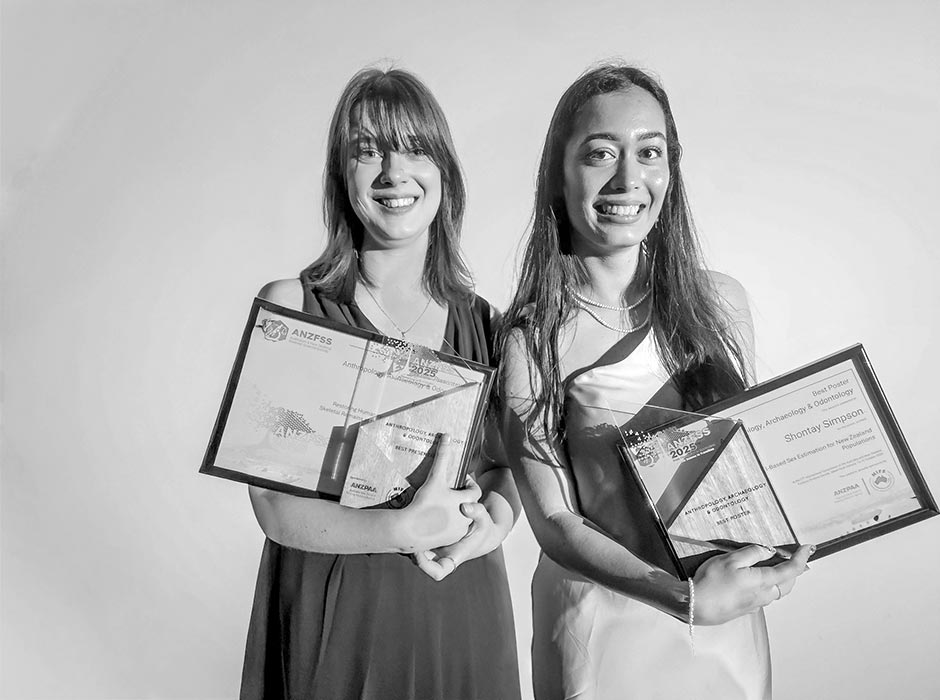
Faculty of Biomedical Sciences Forensics students Esmé Hewitt and Shontay Simpson, who are studying in the only undergraduate Forensic Science Degree in New Zealand, recently won awards at the Australian and New Zealand Forensic Science Society (ANZFSS) Symposium.
Two budding forensic scientists in the making at Otago have been internationally recognised.
The Department of Anatomy students, who are studying in the only undergraduate Forensic Science degree in New Zealand, recently won awards at the Australian and New Zealand Forensic Science Society (ANZFSS) symposium in Melbourne.
Shontay Simpson (current honours student) won best poster presentation and Esmé Hewitt (fourth-year undergraduate student) won best oral presentation, both in the symposium’s Anthropology section. The students’ supervisors include Jade De La Paz, Siân Halcrow, Chris Smith, Catherine Collins, and Jamie Metzger.
Not only did the Department take home both awards, five Otago students at the symposium also presented their research. This included three current honours students, one undergraduate student, and an honours alumni student who presented a keynote talk.
"...The last thing I expected was to win an award, so you can imagine my shock. As I was walking up to receive my award, Shontay’s name was called for Best Poster, and I was so beyond happy for her. I am so proud of both of us." – Esmé Hewitt
Shontay and Esmé both pay tribute to their supervisors for their support and guidance.
It was Shontay’s first ANZFSS conference, and she says she was very nervous, particularly being surrounded by so many bright and talented students and professionals.
“I was genuinely shocked when I heard my name get called out. I was still so excited that Esmé had been called out as best oral presenter that my brain went blank, and I didn't know what to do.
"Being as this was our first international conference, I am so proud of myself for winning this award, but also so grateful for my amazing supervisors. It was a literal pinch-me moment.
"And I feel happy that the people I met at the conference passed on so much knowledge and experience that will forever shape the way I go about research and forensic science.”
Shontay says she’s loving studying Forensic Science, in particular the opportunities to learn from field professionals from different specialisations, and gain hands-on knowledge through hospital tours and mock casework assessments.
It’s Esme’s fourth year of undergraduate study (BASc majoring in Forensic Analytical Science and Anthropology) and she also has thoroughly enjoyed her studies.
“The Forensic Science course is very flexible, which has meant I could study in a wide range of disciplines as well as the areas that particularly interest me. This past semester I was fortunate to do an internship at the WD Trotter Anatomy Museum where I worked with some of the skeletal remains housed there,” she says.
“I presented my internship project at the ANZFSS conference and although I was nervous before speaking, I really enjoyed sharing what I had learnt and some of the stories of the deceased individuals that I had been working with. But the last thing I expected was to win an award, so you can imagine my shock. As I was walking up to receive my award, Shontay’s name was called for Best Poster, and I was so beyond happy for her. I am so proud of both of us.
"It was inspiring to meet more professionals and academics in the forensic anthropology field, and I am really grateful that I was able to learn so much from them.”
Esmé was also selected as a student representative of the ANZFSS New Zealand Branch to present her proposed internship research at the ANZFSS Annual General Meeting in Melbourne in 2024.
Forensic Science Degree Programme
The Bachelor of Science programme in Forensic Analytical Science focuses on the vital analytical techniques of Forensic Biology, including DNA, and Forensic Chemistry covering spectroscopy and traceability. The key strength is acquiring analytical skills.
The honours programme is a new addition, having started in 2024.
Dr Jade De La Paz, who supervised both Shontay and Esmé, was hired at Otago in 2023 as a subject matter expert in Forensic Anthropology. She has helped to develop the Forensic Analytical Science Degree Programme, tapping into casework experience and forensic science networks in New Zealand and the US to provide students with a high standard of forensic science education.
With the honours programme only in its second year, Jade says she's really excited to see such engagement, growth and success.
She says students recognise they have a unique opportunity to gain a Science degree while also getting trained by these forensic professionals with real-world experience in the field.
“We are proud of the real-world forensic science partnerships and real casework experience for honours students, which includes specialised training opportunities from the International Committee of the Red Cross, and guest lectures from around the world.”
She says opportunities for work or further education in both science and forensic related fields are possible with this degree.
– Kōrero by Claire Grant, Communications Advisor, Faculty of Biomedical Sciences
Why study Forensics?
If you’re someone who asks, “How do we know that?” then Forensic Analytical Science is for you. Explore the analytical techniques behind Forensic Biology and Chemistry, including DNA profiling, spectroscopy, and chemical trace analysis, that help solve problems across crime investigation, food safety, and environmental protection.
Find out more