
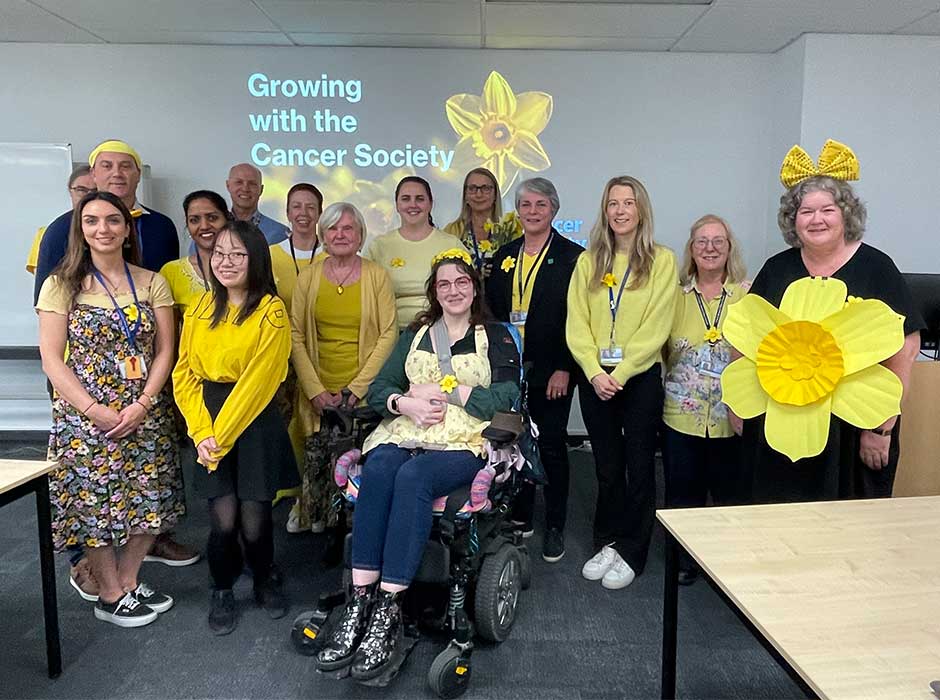
Staff and students lining up for the Best Dressed in Daffodil Yellow competition at the UOC event.
The Cancer Society’s annual Daffodil Day appeal was celebrated in style at the University of Otago Faculty of Medicine – Christchurch this year, with academic talks and shared kai raising awareness in support of the one in three New Zealanders diagnosed with cancer during their lifetime.
Four cancer researchers, all from the Department of Pathology and Molecular Medicine, took to the podium to present short talks on current Cancer Society-funded studies they are working on to help find cures for colorectal, leukaemia and melanoma cancers.
The talks were filmed by the Cancer Society-Southern’s Content Producer Georgia Hall, and then posted onto the Society’s national website and social media channels to promote the Society’s Daffodil Day activities. These videos can be viewed here.
Mackenzie Cancer Research Group (MCRG) Senior Researcher Associate Professor Marg Currie kindly introduced the event, expressing her own gratitude for the support the Cancer Society has extended to her since her arrival as a young researcher in 1998. Marg estimates the level of grant support amounts to $1,800,000 in total for projects she’s been involved with– funding eight PhD students, two Master’s and four Honours students over 27 years, springboarding young research talent in the field of oncology.
Mātai Hāora – Centre for Redox Biology and Medicine Research Fellow Dr Annika Seddon, the first of the 4 speakers, outlined how Cancer Society support has been integral throughout her career, funding her first Honours project, first Summer Studentship and her Postdoctoral Fellowship, focussed on potential treatments for the aggressive blood cancer acute myeloid leukaemia, which has poor survival rates, particularly in older adults.
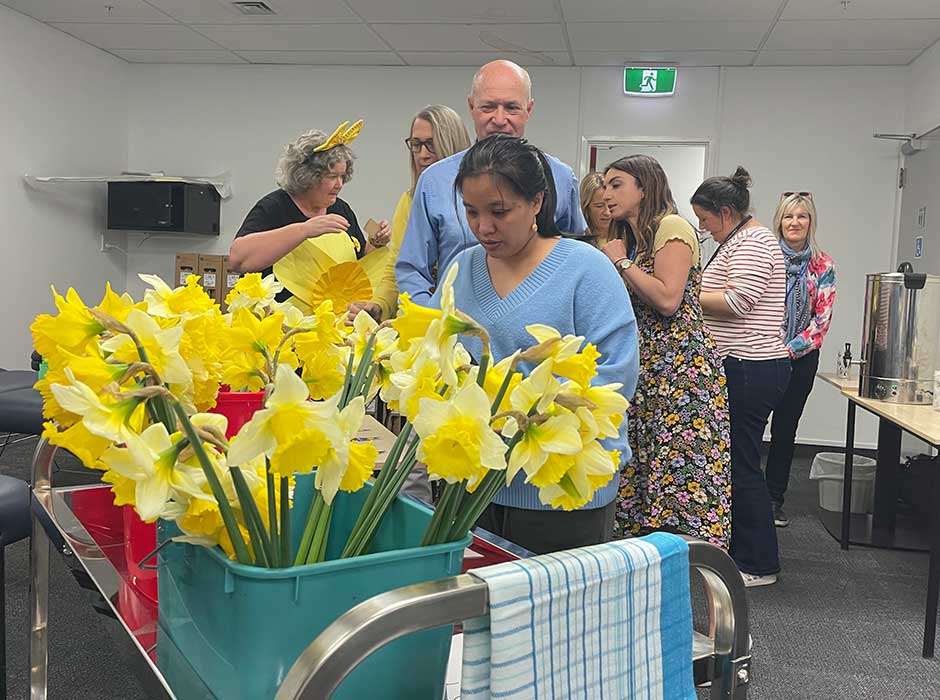
UOC staff and students raised $750 for the Cancer Society.
MCRG Researcher Dr Arthur Morley-Bunker explained the project he is leading into the use of digital pathology and AI for the detection of DNA microsatellite instability in New Zealand colorectal patients, to not only detect cancer from histology slides but predict genomic changes which lead to cancer.
Cancer Society support is helping fund studies which hope to one day develop an AI model capable of identifying patients who would benefit from immunotherapy, he said.
Postdoctoral Fellow Dr Citra Praditi spoke briefly about her Cancer Society-funded work investigating how external factors such as Vitamin C and oxygen levels dictate how cells behave, and how this aspect is thought to drive cancer resistance to therapies. She acknowledged how funding from the Cancer Society is helping her to not only conduct high quality research but also collaborate with experts in the UK.
The final speaker, PhD candidate Jayde Ngata, explained how immunotherapy has great potential as a treatment for colorectal cancer, yet limited success within solid tumours. His thesis is examining how certain bacteria present within colorectal tumours may influence tumour immune responses, and how these bacteria could be used to improve the efficacy of immunotherapies on tumour sub-type.
He’s involved in a three-year funded Māori PhD Scholarship supported by Hei Āhuru Mōwai and funded by the Cancer Society and Gut Cancer Foundation, to explore the use of tumour organoid tissue, donated from Māori patients. He will also investigate how well Māori patients and their whānau, wider support networks, clinicians and researchers, understand the causes of inequities in colorectal cancer and what system changes are possibly needed for a culturally grounded and more equitable health system.
The talks, superbly organised by the UOC Events Committee, were followed by shared kai, a best-dressed-in-yellow competition (won by Liz Ridder and Marama Gravett) and the popular sale of daffodil bunches.
A commendable total of $750 was raised by UOC staff and students for the Cancer Society’s Daffodil Day awareness campaign.
Kōrero by Lorelei Mason