
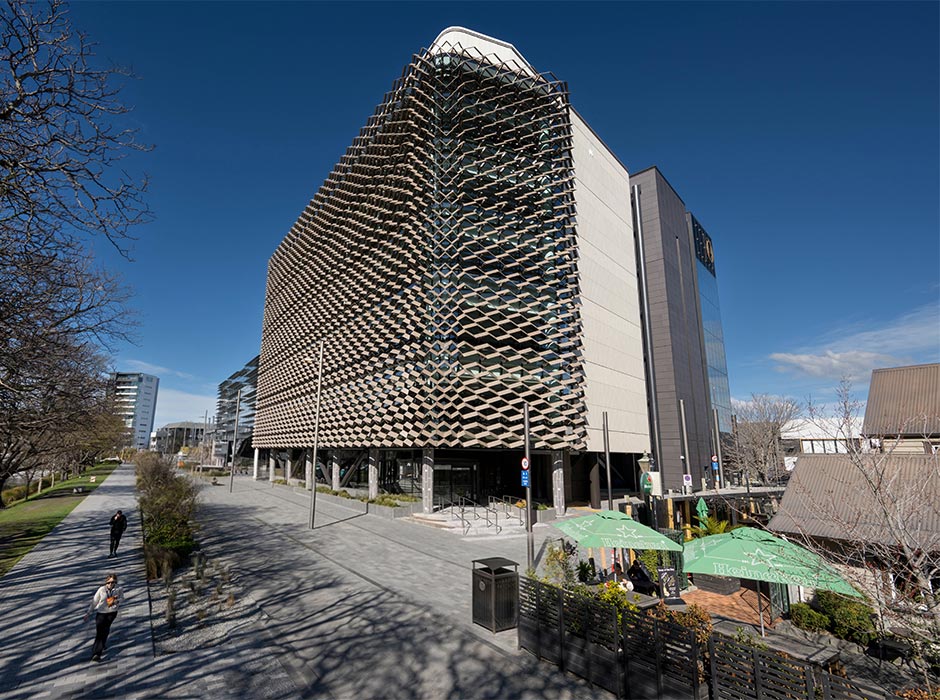
The University of Otago's new Ōtautahi Christchurch campus building, Wai Ora, which is set to officially open next week.
A powerful cultural narrative grounded in the histories, mātauranga and identity of Ngāi Tūāhuriri has been woven into every aspect of the University of Otago – Ōtākou Whakaihu Waka's new Wai Ora building in Christchurch Ōtautahi, which is set to officially open next week.
In this landmark health education and research facility, architecture, art and Indigenous knowledge all come together to inspire learning, discovery and wellbeing.
Approaching completion beside the Ōtākaro Avon River in Christchurch, the University's eight-storey Wai Ora building is the result of years of collaboration with mana whenua to create a place where Māori knowledge is embedded in the building's identity, rather than added as a decorative feature.
Wai Ora Project Owner Professor Suzanne Pitama (Ngāti Kahungunu, Ngāti Whare) who is also Head of Otago’s Faculty of Medicine, says the cultural narrative has shaped the building from the very beginning.
"The cultural narrative was part of the project from its inception. It was not a completed University design to which Māori elements were subsequently added.
"The narrative informed the evolving design and was progressively integrated into the architecture and the interior and exterior spaces. The University, mana whenua representatives, Ariki Creative, the architects and the wider project team worked together to consider how it could be expressed meaningfully and practically throughout the building,” she explains.
Named Wai Ora, meaning "water of life", the building's name was gifted by Ngāi Tūāhuriri Upoko Professor Te Maire Tau. It reflects the central place of water in Ngāi Tahu creation traditions and the narrative woven throughout the building: "Ko wai au?" – who am I? – and "Ko wai au" – I am water. The cultural foundations were developed through Matapopore using the histories and kōrero of Ngāi Tūāhuriri and Ngāi Tahu, before being brought to life by Ariki Creative through integrated artistic and architectural design.
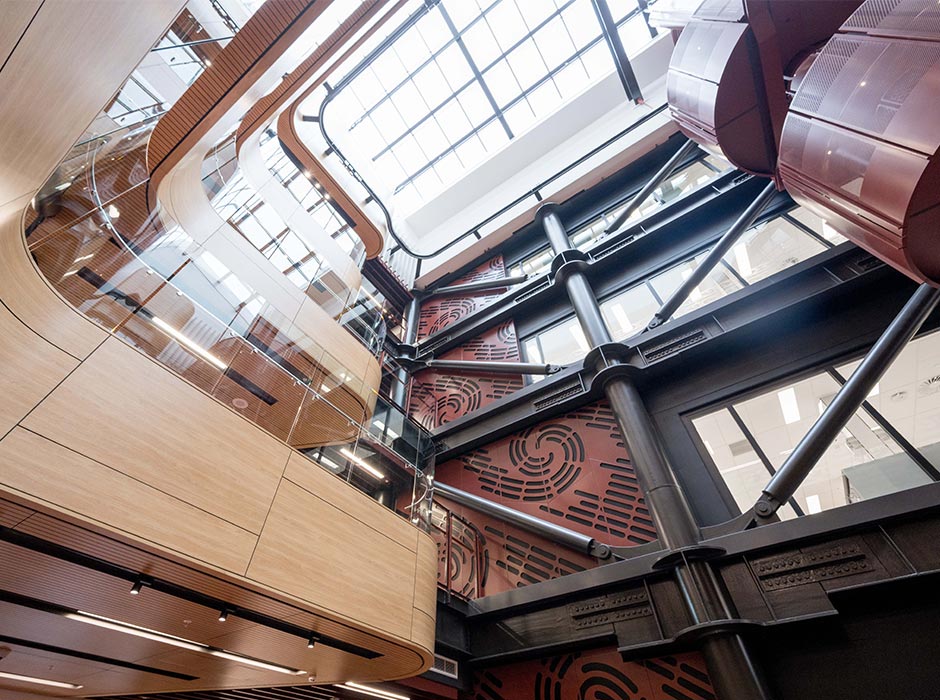
Motifs of whakapapa, hauora, wai, navigation and interconnectedness inform the narrative of Wai Ora.
Rather than existing as standalone artworks, the narrative is expressed throughout the building. Pouwhenua at the entrance feature haehae patterns representing the waterways of the nearby Ōtākaro River, while the paving's transition from dark to light reflects the journey from Te Pō into Te Ao Mārama. Throughout Wai Ora, motifs of whakapapa, hauora, wai, navigation and interconnectedness reinforce the relationship between people, place and wellbeing.
Professor Pitama says seeing the completed design has been deeply moving.
"It is incredibly moving to see the cultural narrative brought to life. The finished work is beautiful, but its importance extends well beyond its visual impact. It gives Wai Ora a distinctive identity that is grounded in this place, its mana whenua and its histories.
"I feel an enormous sense of gratitude to Ngāi Tūāhuriri, Matapopore and Ariki Creative, and to all those who helped carry the narrative from its early development into the completed building," she says.
Beyond its artistic significance, she says the building has been designed to create a sense of belonging while inspiring collaboration in education and research.
"The design helps to create a place in which staff, tauira and visitors can experience connection—to whenua, wai, whakapapa, knowledge and one another. Its presence signals that mātauranga Māori and Māori identity belong within our spaces of health education, science and research.
"For Māori staff and tauira, I hope it provides a meaningful sense of recognition, connection and belonging. For everyone who uses Wai Ora, it provides an invitation to understand the place in which we stand and the responsibilities that come with learning, teaching and undertaking research here," she explains.
"Interconnectedness is central to the cultural narrative. The waterways and tributaries remind us that knowledge, people and communities do not exist in isolation." – Professor Suzanne Pitama
Professor Pitama says the symbolism woven throughout the building also reflects how the University hopes research will be undertaken.
"Interconnectedness is central to the cultural narrative. The waterways and tributaries remind us that knowledge, people and communities do not exist in isolation.
"Together, these elements reflect our aspiration for medical teaching and research: different disciplines, professions, knowledge systems, campuses and communities working collectively towards better health and wellbeing.
"The symbolism reminds us that collaboration is not simply about working alongside one another. It requires relationships, reciprocity, shared purpose and respect for the knowledge and contribution each person or community brings,” she says.
Wai Ora also serves as a visible expression of the University's commitment to advancing hauora Māori through Te Tiriti-led teaching, research and service.
"Wai Ora visibly expresses our commitment to advancing Māori health through teaching, research and service. It reminds us that Te Tiriti-led research requires more than words. It requires enduring and accountable relationships with mana whenua and Māori communities, respect for rangatiratanga and mātauranga Māori, and research undertaken with—and accountable to—the people it is intended to serve."
Professor Pitama says the cultural narrative should inspire every researcher who works within the building to reflect on the purpose and impact of their work.
"It should inspire us to ask whose knowledge is valued, who determines our research priorities, who participates in research, and whether the benefits genuinely flow back to whānau and communities.
"These surroundings also support our wider commitment to Pacific health research and equitable health outcomes within our diverse communities. An environment that makes Indigenous knowledge visible, challenges narrow understandings of expertise, and places relationships and collective wellbeing at its centre provides a stronger foundation for both Māori-led and Pacific-led research to flourish.
"Ultimately, Wai Ora should continually remind us that the knowledge generated within this building must contribute meaningfully to the health, wellbeing and aspirations of the communities we serve,” Professor Pitama says.
Official opening ceremonies are due to take place on Thursday 17 and Friday 18 September.
– Kōrero by Lorelei Mason
University of Otago, Christchurch
Research and study in Christchurch for a career in Medicine and Health Science
More news from Christchurch