
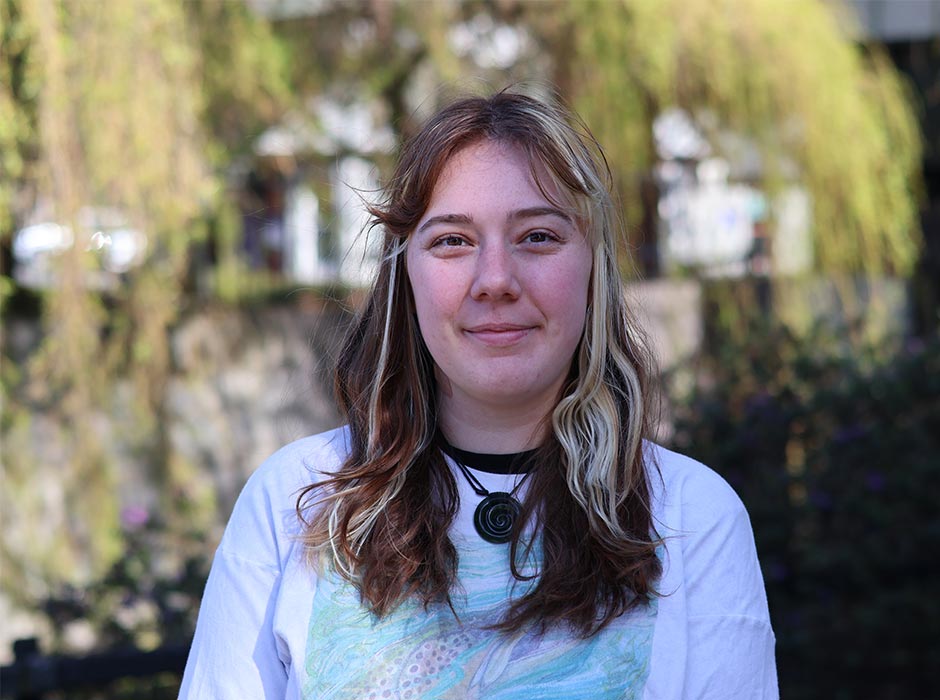
Genetics master’s graduate Ashleigh Iwikau has discovered a “secret” gene that enables a species of whitebait to rapidly evolve.
Ashleigh Iwikau (Ngāti Tūwharetoa) didn’t think her Master’s in Genetics was going to involve studying whitebait.
“All I knew about them before was that they’re quite delicious and it might be bad to be eating them,” she says.
Though she “always had a passion for animals”, Ashleigh originally made the move from Pōneke Wellington to Ōtepoti Dunedin to study Medicine.
“I went through Health Sciences First Year and decided it wasn’t really what I was passionate about. But Genetics really interested me, so I changed my major,” she says.
“I realised I was really interested in looking at the evolution of species, and how things get to where they are from where they were.”
When it came time for Ashleigh to do her Master’s, she signed up to work on Zoology Professor Jon Waters’ ‘rapid evolution of kōaro’ project.
But neither of them expected Ashleigh to discover a “secret” gene – research so surprising, it featured in National Geographic.
“Whitebait are the babies of five different species of galaxiid, and the one I work on is the kōaro,” Ashleigh says.
“They’re a little fish and they don’t have any scales. They’re sort of like a slimy tube. I think they’re quite darling really.”
They’re also adventurous. After the eggs hatch in estuaries, the larvae get washed downstream to the sea, return up the river as whitebait, and live their adult lives in freshwater.
“My fish is also really good at climbing,” Ashleigh says.
“It’s got really strong front fins, and it can climb up vertical surfaces. Because they’re so good at climbing, they can penetrate really far inland and enter lakes that other fish can’t get into.”
If they get too far inland, or if new lakes form through geographic change or human intervention, they can’t return to the sea to complete their migration.
But that’s no problem for the kōaro. Like characters from the Marvel Universe, they simply transform from a migratory ecotype to distinct freshwater form.
“We knew they did it, but my research was looking at how they did it,” Ashleigh says.
“When was the last time humans evolved? A long time ago, I guess. But in some of the human-dammed lakes, galaxiids have evolved during the last 40 years. I wanted to understand why they changed so quickly.”
The answer was “jackpot individuals” – super-evolvers who are primed for whatever life throws at them.
“There are a bunch of genes to do with fecundity and musculature, that are all in a single chunk of the genome like a module,” Ashleigh says.
Freshwater kōaro have the freshwater module, and migratory kōaro have the migratory module.
And Ashleigh discovered that some kōaro have both.
“We found in the migratory samples that about five per cent of kōaro were heterozygous, meaning they have both version of the gene,” Ashleigh says.
“So, if you’re a migratory fish but you secretly have the freshwater copy, if you end up in freshwater you can survive and pass on your genes. It’s sort of like a backup plan that’s encoded in their genomes.”
“It’s really important to know how species like kōaro will adapt to a changing environment with climate change and increased agricultural and water demands."
Ashleigh says that continuing this research could help us protect our taonga species.
“It’s really important to know how species like kōaro will adapt to a changing environment with climate change and increased agricultural and water demands. Knowing about the genetic health of the kōaro could help us learn about the closely related galaxiid that are really endangered.”
Ashleigh’s research wasn’t all lakes and waterfalls – finding the genes also involved mush and computers.
“We catch the fish, take a little clip of their fin, and release them back in the water,” Ashleigh says.
“Then we take the tissue and digest it down into some mush, breaking the cells open so the DNA can get loose. We filter all the mush out through washes, pull the DNA, and put it in a machine that prints the DNA out in a big file. It’s just a bunch of letters that means nothing, so you have to put it though programmes to map the data.
“Because genomic data is taonga for native species you have to do a lot of discussion with the iwi groups that are kaitiaki of the populations to see if they’re happy with the data being open access. Almost all the population data I used in my study is open access, and there’s also the Genomics Aotearoa controlled repository.”
Having completed her Master’s, Ashleigh is supporting tauira both in the genomics lab and as a tutor while she contemplates a possible PhD.
“I really love my project. There was heaps of stuff I did that didn’t quite make it to the final cut which I’d like to explore.”
Ashleigh’s also enjoying Otago life.
“Dunedin’s a really awesome city. Doing my undergraduate study here gave me a chance to meet my supervisor, and then everything turned out pretty awesome for me.
"I’ve also developed a really nice community down here. I’ve made lots of friends with outdoorsy people who’ve been dragging me on camps, which I think’s been good for me.”
And though she never expected to end up studying fish, perhaps it was preordained.
“I volunteered at the Marine Education Centre in Wellington from the age of about 11 to 16, so I guess I do have fish experience,” she says.
“It’s crazy how everything works out.”
– Kōrero by Kathryn van Beek, Communications Advisor | Kaiarataki Pārokoroko
Mātai Ira
Genetics is the study of genes and inheritance – from the molecular basis of life to whole organisms, populations, and evolution.
Genetics at Otago