
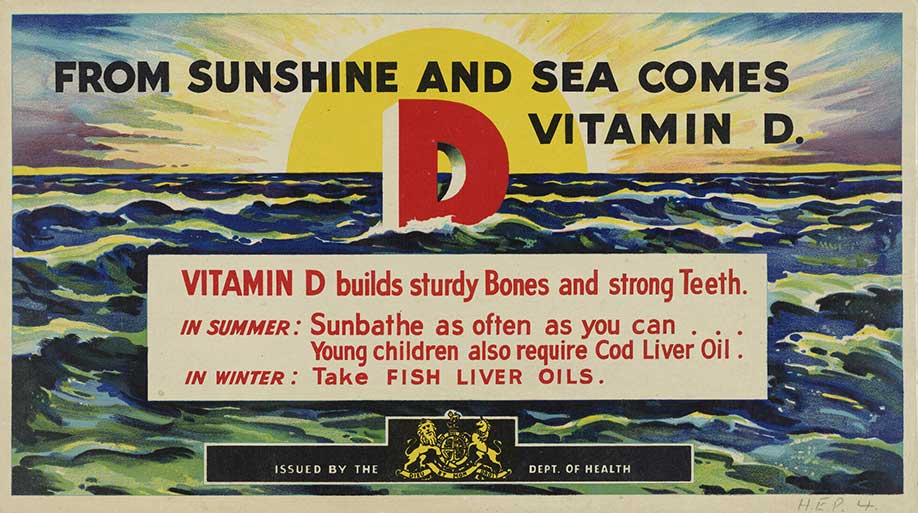
A New Zealand Department of Health | Te Tari Ora display card to promote the benefits of Vitamin D, circa 1920s-1930s, from Hocken Collections | Uare Taoka o Hākena
An Otago academic will explore why sun-seeking remains such a strong part of the New Zealand psyche, despite almost 100 years of official health advice warning of the dangers of sunburn.
Historian Dr Claire Macindoe has received a University of Otago Research Grant for this project, titled Burning: Sun Culture to Skin Cancer.
Through this research, Claire aims to deepen our understanding of Aotearoa New Zealand’s cultural relationship with the sun.
Scientific evidence about the dangers of sun exposure has been widely communicated for decades. Yet skin cancer continues to be a significant cause of illness and death in New Zealand.
“To better understand our high rates of skin cancer, and the ongoing prevalence of sunburn each summer, particularly among teens and young adults, we need to understand how New Zealanders have historically viewed and engaged with the sun and sun protection,” Claire says.

Dr Claire Macindoe aims to deepen our understanding of Aotearoa New Zealand’s cultural relationship with the sun.
She hopes the research will inform public health education efforts and ultimately help reduce cases of skin-cancer and healthcare costs.
“Public health advice cannot have the impact it needs unless we understand this as a cultural issue, not just a health issue. We need to change attitudes and relationships beyond advising people to be ’sun smart'.”
This project will initially focus on mid-century New Zealand, with plans to expand to a larger examination of sun culture spanning the twentieth century.
Claire says the mid-century is an ideal starting point as there is a well-established culture of linking leisure and physical recreation, with many activities centred outdoors such as hiking, sports, and spending time at the beach.
During this period the Department of Health also shifted its focus away from communicable diseases and infections to those of lifestyle and longevity.
Campaigns included information promoting sun exposure for Vitamin D and warning against getting sunburnt.
“This is a dynamic period where ingrained socio-cultural behaviours and growing health concerns regarding overexposure to the sun begin to intersect,” Claire says.
“The UORG enables me to undertake preliminary research to create a solid base for a considerably larger project. There are so many facets to explore in relation to growing our understanding of New Zealand's risky sun culture, and my intent is to meaningfully contribute towards increasingly positive outcomes in reducing rates of skin cancer across Aotearoa.”
-Nā Communications Advisor | Kaiarataki Pārokoroko Antonia Wallace
Study History at Otago
Immerse yourself in fascinating accounts of human societies through time. Graduate with the analytical and communication skills that will give you an edge in any career.
View