
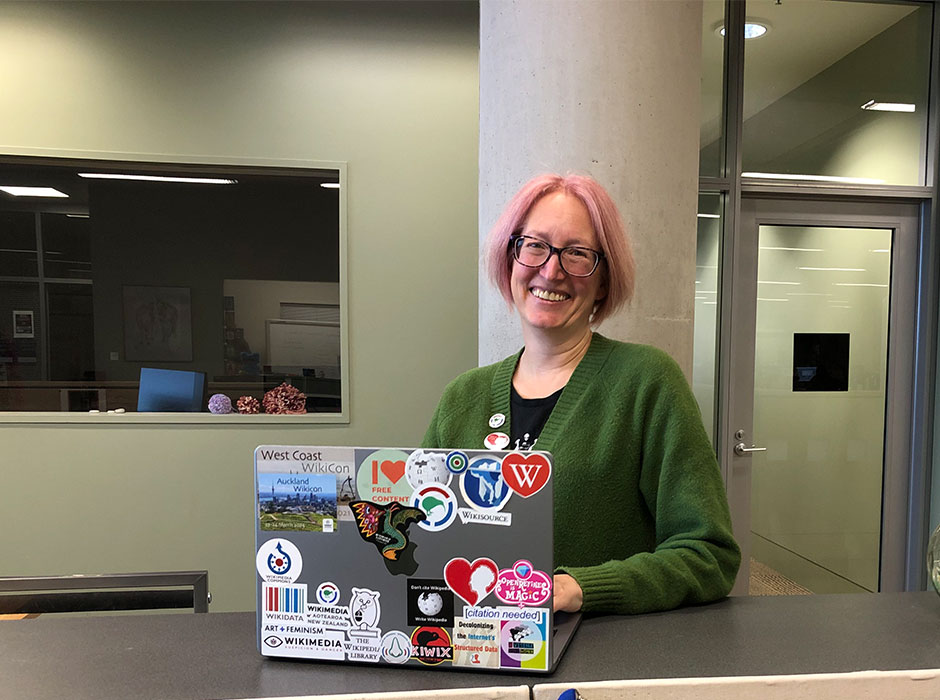
Otago's Wikipedian in Residence Dr Tamsin Braisher would like to improve the relationship between the University community and Wikipedia.
Anyone who finds themselves wondering ‘what is a lemon pig?’, and then uses Google to find out, will come across an informative Wikipedia page written by Otago’s very own Wikipedian in Residence, Dr Tamsin Braisher.
Tamsin’s role as a Wikipedian in Residence is funded by Wikimedia Aotearoa New Zealand and sees her facilitating the University’s engagement with Wikipedia and other Wikimedia Foundation projects. She is hosted by the University’s Central Library.
“I am working with staff and students to release images and other material under open licenses, work on improving or creating Wikipedia articles relevant to university teaching and research, and generally develop the relationship between the institution and the wider Wikipedia community.”
It is important to her that she can help students read Wikipedia critically by examining aspects like the history of a page, the discussions on its talk page, and the quality of the sources supporting the information on a page.
Tamsin first got involved with Wikipedia around 2018, when she started editing Wikipedia pages, and not long after, had a go at creating her first Wikipedia page about a book she had read.
The page was immediately deleted.
“I didn’t know anything about Wikipedia notability guidelines, you can’t just make a page for anything, it has to be for something that’s considered notable,” Tamsin says.
The person that deleted Tamsin’s page contacted her and explained what she could do to make her pages stick around.
“I learned more about how to choose what pages to do, and how to cover people properly, and it just grew from there.”
During the 2024 Christmas holidays, Tamsin wrote the page about lemon pigs which she describes as a “cultural phenomenon” she had not previously encountered.
“It’s where you take a lemon and you turn it into a pig by sticking matchsticks in for legs, and a clover or a peppercorn for nose and for eyes.
“This thing’s been going on since Victorian times, and it’s quite hilarious, really.”
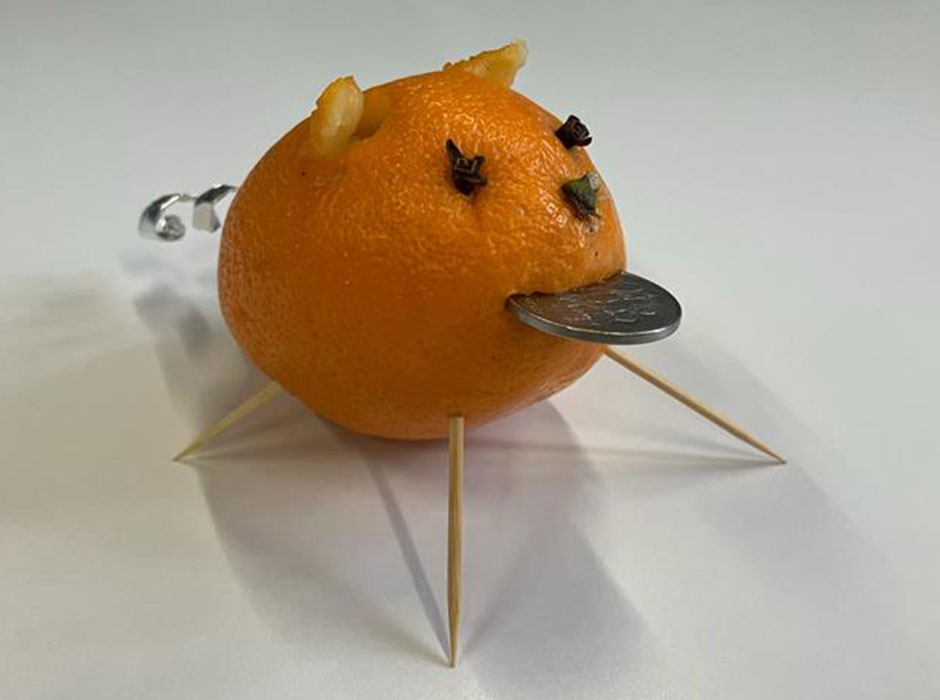
If you have a lemon, some cloves, tin foil, toothpicks and a coin then you have everything you need to make a lemon pig. Photo: Koren Allpress
Tamsin says she has worked on pages covering a variety of topics including social events, cultural events, people and places.
“One of the things that I really enjoy about Wikipedia is if you see a gap, you can fill it … you can work on anything.”
Wikipedia has a database called ‘Wikidata’ which holds a list of names of people who may not quite deserve a page of their own, but have contributed to something – such as a book - which does deserve a page.
Tamsin has written many pages as a result of Wikidata.
“The more you look, the more gaps you see.”
Wikipedia has guidelines to help people create proper pages.
“It isn’t necessarily about having done amazing things, it’s about having sources that prove you did amazing things.”
The sourcing of the information for the page is very important, she says.
“You have to have these independent, reliable sources that show that somebody did things which are significant.”
It can be harder to find reliable sources for some groups of people than others.
“If you’re working on a group of people who’ve generally been ignored by news sources, like maybe women or minorities, then it can be harder to prove those significant achievements.
“Sometimes you have to fight to keep those pages on Wikipedia because people will challenge them. That’s part and parcel of doing the work but it can get a bit depressing.”
Since 2018, editing and writing pages has become an enjoyable and “quite satisfying” hobby for her.
“You can go ‘yeah, look, there’s a page on Wikipedia now for this notable person or this notable place’, whatever it is, and now everyone can know about it.”
She likes how writing Wikipedia pages uses all of the education she has accumulated, such as how to research topics, assess resources and using the library .
“You can give it as much or as little time as you like, it’s nice and flexible.”
Tamsin went through a phase of improving existing pages last year, in particular stubs – a Wikipedia entry that is not quite long enough to be considered a page.
Tamsin says you need three to five reliable, independent and verifiable sources, and they do not have to be online.
“Obviously it’s easy to search for stuff online, but it can be books, it can be newspaper articles.”
Tamsin has a couple of pieces of advice for anyone interested in editing or creating Wikipedia pages.
“First off, don’t write a page for yourself. Wikipedia has a strict conflict of interest policy, saying you should never write or edit about yourself or your family members.”
She suggests finding a topic you are interested in, and if it has an existing page, find a good source on the topic so you can make some small edits to it, before taking on writing a new page.
“I’m always happy to show people how to do that, it’s relatively straightforward. And there are, of course, lots of online resources as well that people can find for how to get started.”
Tamsin also recommends creating an account and using an anonymous name to begin with, and not linking it to your real name straight away.
“You can absolutely be anonymous, which I think is a lovely thing about Wikipedia.”
An account name can be changed to reflect a person’s real name at a later date, but once it’s done, it can’t be undone.
“All edits on Wikipedia are open and visible to everybody, and the whole history, even if you change something, it’s stored there in the history of that page.”
Tamsin would really like University academics to focus on how they can get research covered on Wikipedia, and the work of the University.
She urges people to look at pages which are centred around their research areas and improve them. She recently worked with a group of anatomy students who were looking at articles about a specific group of muscles, and it turned out the articles that had not been heavily edited since 2009.
“They’re out of date, they need improving, and that would benefit everybody, worldwide.
“It would be really nice if we looked at how good those pages are, and tried to get them a bit better so that students are getting good, reliable, up to date information when they check Wikipedia.”
She always encourages students to look at the sources and citations, because we want students to be critical of the information they are taking in.
Tamsin encourages anyone interested in learning more about Wikipedia to keep an eye on events in the library, where she will be running some sessions on learning to edit and well as meet-ups for people already editing.
-Kōrero by Koren Allpress, internal communications adivser
Research at Otago
The University of Otago is ranked in the top 1% of higher education institutions in the world and has been awarded 5 stars plus1 – the highest possible rating for teaching and research. 1. QS (Quacquarelli Symonds) World University Rankings and QS Stars rating.
Find out more