
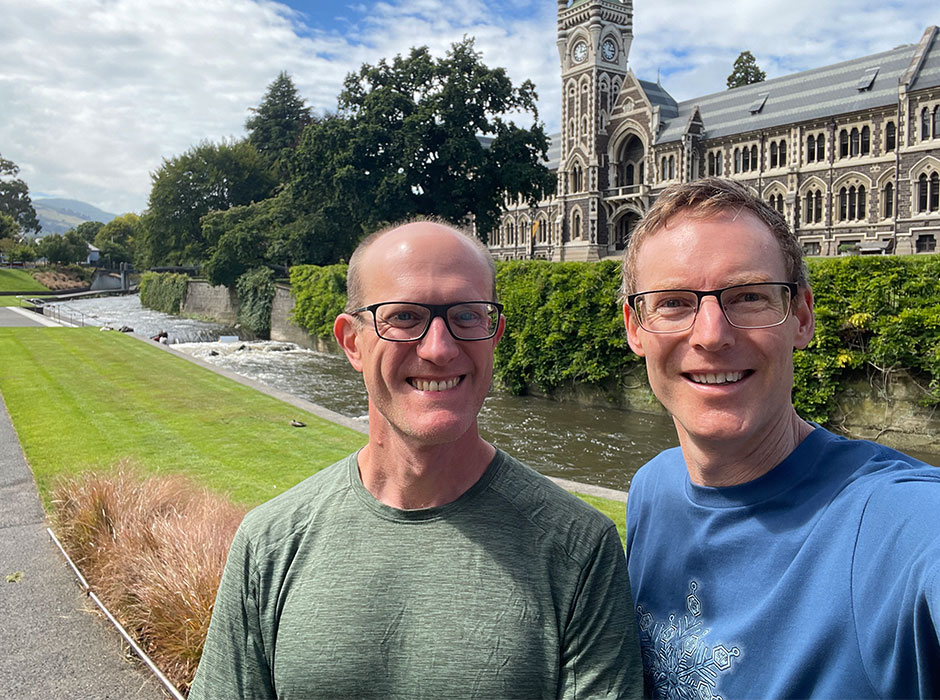
Professor Jacob Corn from the ETH's Institute of Molecular Health Sciences in Switzerland working with Professor Peter Fineran, Department of Microbiology and Immunology on genome editing technologies.
How do good cells cope when bad things happen to them?
As part of the Chaffer Fellowships, Professor Jacob Corn from the ETH's Institute of Molecular Health Sciences in Zurich is currently on campus, working with Professor Peter Fineran in the Department of Microbiology and Immunology.
His research aims to better understand and treat disease with next-generation genome editing technologies; his lab focusing on how human cells maintain health in the face of constant stresses.
Jacob will be presenting a talk on genome engineering and DNA repair in the Microbiology Building on Monday, 2 March, addressing detail of how cells cope with challenges and what that could mean for human health.
He will follow this up with a further talk in the Biochemistry building on Tuesday, 17 March on protein/organelle quality control.
Peter says it’s fantastic to host Jacob in his Phage-host interactions (Phi) lab.
“He is very generous with his time, actively engaging and providing invaluable scientific advice to our lab members, which will make a difference to us,” Peter says.
The Phi lab focuses on bacterial ‘immune’ systems research, looking at how bacteria resist phages, which are viruses that specifically infect bacteria. Their goal is to leverage their fundamental research to develop smarter phage-based antimicrobials against bacterial pathogens and or other tools for biotechnological applications.
Jacob's lab in Switzerland studies human DNA repair responses. His group excels at functional genomics; the work leading to new insights into human cell homeostasis and improvements in genome editing. He collaborates widely with clinical groups seeking to create “CRISPR medicines”, and several of these efforts are already in the clinic.
“Jacob is bringing in internationally recognised expertise in high-throughput screening, computational biology, genome editing and translational biotechnology. His engagement with our team is strengthening our capability in a wide range of fundamental and more applied projects,” Peter says.
The Chaffer fellowship funds visiting distinguished overseas scientists or clinicians, the aim being to further medical progress and research at Otago.
-Kōrero by Claire Grant, Communications Advisor, Faculty of Biomedical Sciences
Professor Peter Fineran's current research
The Phage-host interactions (Phi) laboratory led by Professor Peter Fineran aims to understand the interactions between mobile genetic elements, such as bacteriophages and plasmids, and their bacterial hosts, and apply this fundamental knowledge to generate new biotechnologies.
Learn more here