
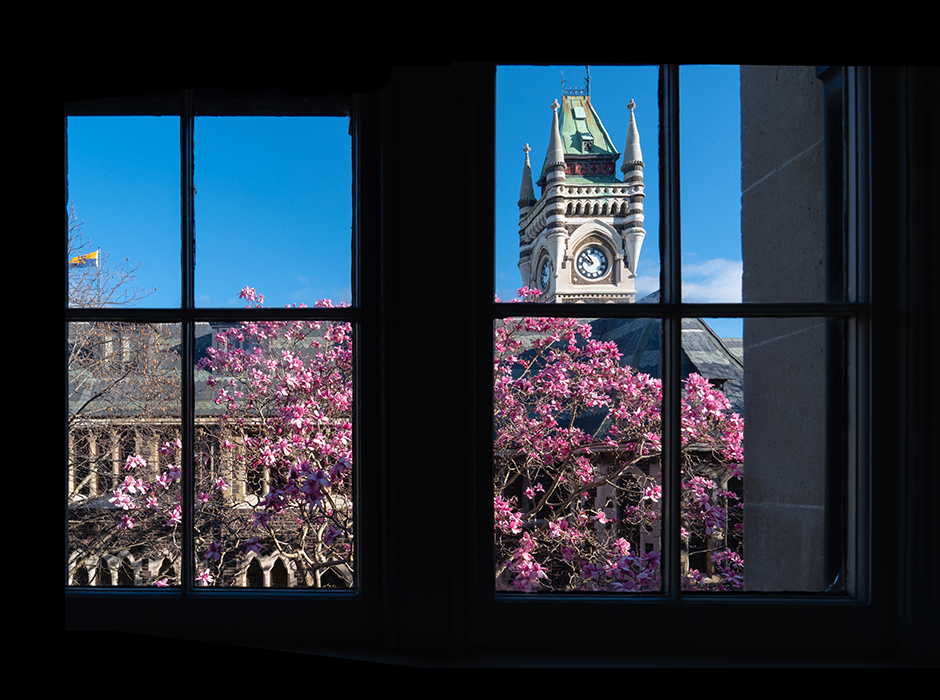
The University’s “Magnolia Day” tree, located in the historic Quad, is the surprising star of the winning staff entry in Writer 2023. Photo: Dave Bull.
The two staff winners of Writer 2023, the University’s annual creative writing competition, set their works on the University campus and featured University flora – but with quite different takes.
Molly Crighton, of the University’s Bioethics Centre, won the staff fiction section of the contest with her story 95 Million Years which features a cardigan-wearing administrator who secretly feasts on University flora with surprising results, while Research Services Librarian Mandy Phipps-Green won the staff poetry section with The Wisdom of Tūī, which contemplated a community of tūī living in the Banksia trees at the north end of the University’s Burns Building.
The pair were thrilled to be named alongside the other category winners:
- Student poetry: Kim Cope Tait
- (Runner up: Kathy Nam)
- Student fiction: Sydney Rodriguez
- (Runner up: Judah Song)
- Staff poetry: Mandy Phipps-Green
- (Runner up: Melissa Audeau)
- Staff fiction: Molly Crighton
- (Runner up: David Jenkins)
- Alumni poetry: Val O'Reilly
- (Runner up: Charissa Murphy)
- Alumni fiction: Caellin (Monti) Rodgers
- (Runners up: Anne Lim and Feby Idrus)
The full winning entries can be found here.
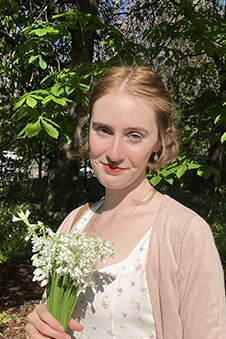
Bioethics Centre Administrator Molly Crighton, who won the staff fiction section, with a story called 95 Million Years.
Crighton was inspired to write 95 Million Years by the many “stunning” stories, myths and poems she has read that feature metamorphoses, such as Annihilation by Jeff Vandermeer, the myths of Daphne and Arachne and fairytales such as The Six Swans.
“I love to read and write about that kind of impossibility, so ended up using it to interpret the theme of ‘The getting of wisdom.’ Magnolias were really forefront in my mind the week I wrote the story – there are some lovely ones on my walk to work, and our beautiful campus magnolia was in full bloom at the time – so I ended up using that imagery to work with the theme.”
Her imagery resonated with judge, current University of Otago Burns Fellow Kathryn van Beek – who says she was “utterly charmed by this story”.
“I enjoyed the contrast of the everyday university environment with the fantastical elements, and the interesting science facts that were woven through. The imagery was also strong, e.g. 'the corridor is a dancehall for dust motes'.”
Phipps-Green’s poem was also inspired by her daily walk through campus – writing The Wisdom of Tūī, as a way of crystalising thoughts she’d had nearly every day for many months.
“I walk past the trees and tūī that feature in my poem every workday. I hear the birds (they can be really loud!) but rarely see much more than the occasional wing and moving branches. But it's so busy in there, seemingly a whole community of tūī, and every day I'd wonder about them, and what their lives were like. So, the poem was inspired by my daily observations and imaginings.”
Van Beek loved the sense of place evoked by the poem, which many staff will know well.
“Excellent use of language, and the poem also poses some interesting questions. I enjoyed the rhythm of the last line, which chimed with the first stanza and which had a fitting 'walking' rhythm.”

Research Services Librarian Mandy Phipps-Green, who won the staff poetry section with The Wisdom of Tūī.
Phipps-Green says she is an occasional creative writer, getting words down when something draws her interest or focus, or when she feels she has something to share.
“I love reading and language, so it's really satisfying to craft something that captures my thoughts and feelings eloquently, and create a piece that others might enjoy also.”
She says she was honoured to be named among the winners and is grateful for the competition.
Crighton agrees.
“I’ve loved reading the winning entries ever since the competition’s inception in 2019. This is the second time I’ve entered, but the first time I’ve entered as a staff member, and it was fun to share my draft story with my lovely colleagues. It ended up prompting some great discussions – we talked about our favourite short stories, and some of the reasons we love reading. That was really why I wanted to enter – because writing is fun, reading is even better, and sharing those with other people is a great social activity.”
For the second year in a row, the contest was open to alumni in addition to staff and students, and both the turnout and standard was very high – with sex, murder and diarrhoea among the topics explored in the nearly 100 entries.
Van Beek says other ideas explored included the place of artificial intelligence in society, the wonders of the natural world, and of course, Barbie (or more specifically, Ken).
“After Ken, the tūī is the character that makes the most appearances in these lively and intelligent stories and poems, which demonstrate the incredible wealth of creative talent in the University of Otago whānau.”
She says different writers had different takes on the 2023 competition theme: “The getting of wisdom.”
“For some, wisdom can be gained by paying attention to the world around us. For others, wisdom can be found within ourselves, or be passed down through generations. Many characters stumble in their quests to gain wisdom, making for playful and amusing scenarios.”
She says all of this year’s entrants should be proud of their work.
“Each piece is thoughtful, funny, lyrical, well-structured, or emotionally moving, and many pieces have all of these qualities. Though artificial intelligence is a common theme, the compassionate hearts and curious minds of these writers reassure me that computers are no match for us yet. Aldous Huxley wrote: “Words can be like X-rays if you use them properly – they’ll go through anything. You read and you’re pierced.” The writers in the University of Otago whānau can be commended for their X-ray words that reveal much about the human condition.”
The competition was established in 2019 as part of the University’s 150th celebrations. It is organised by University Publications Editor Lisa Dick and English and Linguistics Programme Senior Teaching Fellow Nicola Cummins and supported by University Book Shop, Otago University Press, Dunedin City of Literature, Otago Access Radio and the Otago Daily Times.
But back to Crighton and her winning story. Did she taste a magnolia flower during her research phase?
“Not even a nibble, I’m afraid! The least-edible thing I ever ate was a wasp – and no transmutation took place (thankfully).”