
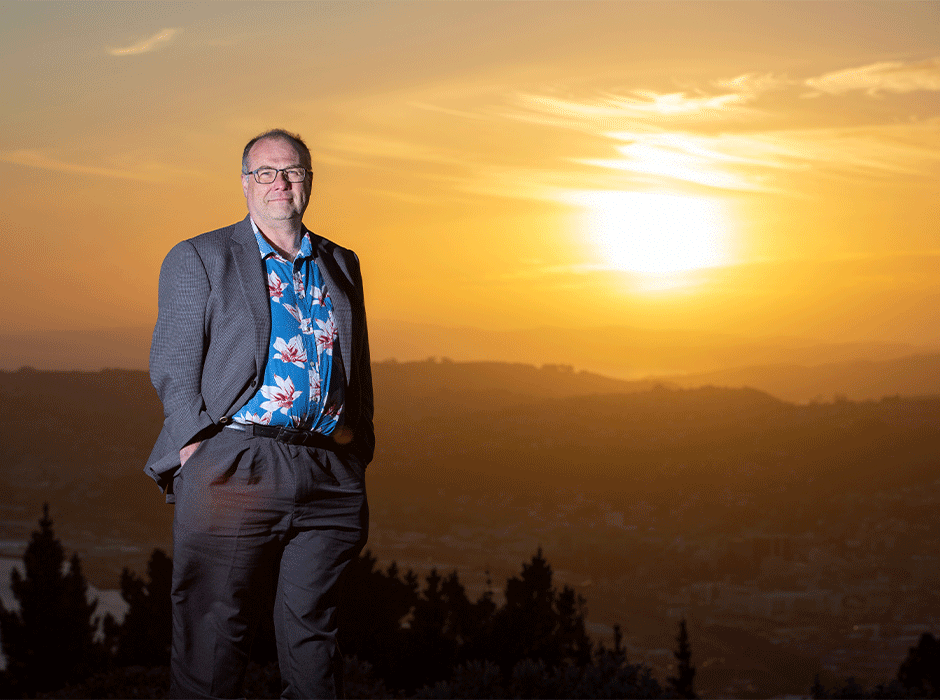
Professor Craig Rodger, of the Department of Physics, has won the International Union of Radio Science's Karl Rawer Gold Medal.
A University of Otago – Ōtākou Whakaihu Waka space physicist is following in the footsteps of a “global science giant” as just the second person from Aotearoa New Zealand to receive an award from an international science organisation.
Professor Craig Rodger, of the Department of Physics, has won the International Union of Radio Science’s (URSI) Karl Rawer Gold Medal.
URSI is one of the leading international bodies in radio science, space physics and electromagnetics. The medal honours the late Professor Karl Rawer, a German scientist who dedicated his professional life to exploring the Earth's ionosphere and the inner magnetosphere.
Professor Rodger was recognised for his internationally-influential research in space weather and near-Earth plasma physics, particularly the interaction between radiation-belt particles and the Earth’s atmosphere, which has implications for satellite systems, communications, and technological infrastructure.
He described himself as surprised and grateful.
“I have seen the people who have won awards over the last decade or so, some of whom are friends of mine. They are so clever, and their work has been so impactful,” he says.
“I knew I was being nominated but I was deeply unsure if winning this medal was possible for me.”
Professor Rodger says it is recognition for his more than 20 years of research, expanding from ground-based measures in New Zealand, to the Arctic, then Antarctic and onwards to Earth-orbiting satellites.
His expertise has also been crucial to the New Zealand electricity industry, helping to protect the power grid during weather events such as solar storms.
“That shift was challenging but having this work recognised by a major science organisation helps signal that it was worthwhile.”
Professor Rodger is thrilled to be just the second New Zealand scientist to win a senior URSI award, after astrophysicist and space scientist, the late Sir Ian Axford, won the URSI Appleton Prize in 1969.
“He was a global science giant whom I met when I was an early career researcher when he was late in life.
“Being linked to such a mighty Kiwi, who did great science, worked hard for the international science community and education in New Zealand, and was also cool, is such a deep honour.”
Professor Rodger will receive the medal at the URSI's next General Assembly and Scientific Symposium held in Poland in August, where he will also be the New Zealand delegate to the Council.
“I’m excited to go. Parts of my family have Polish roots and it’s always stimulating to meet the URSI science community.”
Head of the Department of Physics Associate Professor Ashton Bradley says the medal is a major achievement for Professor Rodger, his research team, and the Department.
“This recognition comes alongside Craig’s continuing leadership in space weather research, including work to better understand and mitigate the impacts of solar storms on modern infrastructure,” Associate Professor Bradley says.
“Craig is a leading light in the Physics Department and we couldn’t be more proud of his achievements!”
Department of Physics
Physics explores the fundamental laws of the universe, which underpin modern technology and sustainable energy solutions.
Learn more here