
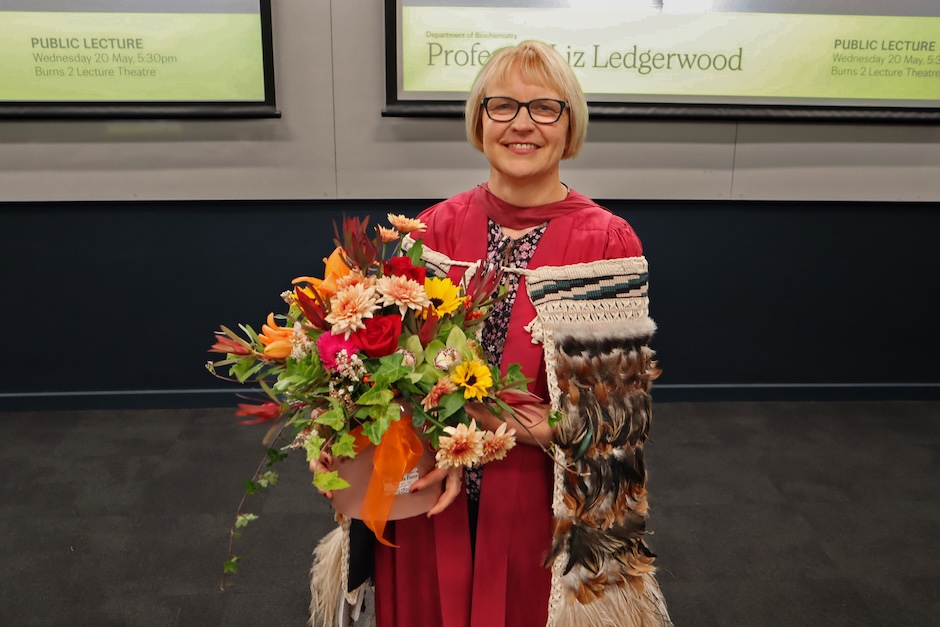
Professor Liz Ledgerwood at her Inaugural Professorial Lecture.
Recently the Department of Biochemistry gathered again to celebrate the promotion of a colleague to professor at an Inaugural Professorial Lecture (IPL) - this time honouring a long‑standing and central member of the department, Professor Liz Ledgerwood.
IPLs are special public lectures given by academic staff who have recently been promoted to professor. They provide an opportunity for new professors to reflect on their academic journey and the research that has shaped their careers, while also allowing colleagues, students, whānau and collaborators to come together to celebrate this milestone.
Liz currently serves as Deputy Head of the Department of Biochemistry, Associate Dean Academic in the Faculty of Biomedical Sciences, and is a member of Mātai Hāora – Centre for Redox Biology and Medicine. Having worked in the Department since 2000, first as a research fellow, then as a lecturer from 2010, Liz has been a constant and influential presence for more than two decades.
Senior university leaders at the lecture spoke with warmth and gratitude about the support they received from Liz as they stepped into their own leadership roles. The depth of appreciation expressed was a powerful indicator of just how central Liz is to the academic and professional life of the department. Descriptions such as strong, smart, generous and deeply supportive were recurring themes.
As she proudly wore Manurere, a traditional feather cloak made by members of the Faculty of Biomedical Sciences (read more about it here), Liz gave a lecture that traced a career marked by curiosity, adaptability and a willingness to build community.
Born in Dunedin’s Māori Hill, Liz spent most of her childhood in that suburb, before moving with family to Hong Kong at the age of 14 - a dramatic shift that opened her eyes on life and education in other parts of the world. She returned to New Zealand for her final year of schooling, boarding in Auckland while she gained her University Entrance qualification, and exceling enough to earn direct entry into medical school.
However, during her first year at the University of Otago, chemistry classes prompted a change of direction towards a Bachelor of Science with Honours. Her interests further developed during her undergraduate years before settling on a major in Biochemistry. A first taste of research came through a summer studentship at the DSIR in Wellington, followed by an honours project in the Otago Department of Biochemistry in 1989 with Professor Pat Sullivan, working on an enzyme from the yeast Candida albicans.
After graduating, two years in a research role in Christchurch further confirmed her interest in medical research, and Liz began a PhD at the Otago Christchurch campus with Professor Stephen Brennan, studying blood proteins. It was also during this formative time in her career that Liz found and married her life-long partner, Andrew Taggart.
Liz and Andrew then headed overseas, with Liz starting a postdoctoral fellowship at the University of Cambridge’s Department of Clinical Biochemistry (Addenbrooke’s), working with Sir Steve O’Reilly. Research focused on tumour necrosis factor, and this was where Liz’s long‑standing engagement with mitochondrial biology began.
Two factors drew Professor Ledgerwood back to Dunedin in 2000: an HRC Repatriation Fellowship to continue mitochondrial research with Professor Mike Murphy in the Department of Biochemistry, and the desire to be closer to family ahead of the birth of her first child. Although Mike returned to Cambridge a year later, Professor Ledgerwood continued to build an independent research programme while raising a young family.
Several interconnected themes have defined Professor Ledgerwood’s research, all relating back to mitochondria - the parts of the cell responsible for producing the chemical energy required for life.
One of the major projects she has been part of has focused on cytochrome c, a key mitochondrial protein best known for its role in energy production and programmed cell death (apoptosis). The project originated when a staff member in the department with mildly low blood platelet levels sought to understand the cause of this affliction. Professor Ian Morison’s group traced the condition through family studies, identifying an inherited mutation in the cytochrome c gene.
Initially, the findings were met with scepticism. Cytochrome c had not previously been linked to platelet disorders, and the connection was far from obvious. Liz joined the project to help solve this puzzle. By studying blood stem cells from affected family members, the team showed that during platelet formation, some platelets were being misdirected into tissue rather than released into the bloodstream, among other discoveries.
Publicity around the project led to contact from other families with similar symptoms, enabling the identification of additional cytochrome c variants both within New Zealand and internationally. While the full mechanism is still being unravelled, the underlying role of cytochrome c mutations in low platelet counts is now well accepted - a significant shift from the project’s early reception.
Another major research focus has been exploring the role of reactive oxygen species and the proteins that work with them. A by-product of energy production in mitochondria, reactive oxygen species are unstable, highly reactive chemical molecules containing oxygen. In the right place at the right time, these reactive oxygen species can be important signaling molecules with roles in many cellular functions. In the wrong place at the wrong time and in the wrong quantities, reactive oxygen species can be bad, causing oxidative stress and cellular damage, and are a contributor to various diseases and to aging.
In recent years, Liz has been contributing her knowledge in this area to the world-renowned Dunedin Study, which follows a cohort of individuals born in Dunedin in 1972–73, first recording their growth and development, and now focusing on how the cohort ages. Liz’s work examines redox homeostasis, oxidative stress and mitochondrial function, contributing to measures such as the study’s “pace of aging” score. Notably, this research has shown a correlation between increased mitochondrial dysfunction and a faster pace of aging in midlife.
Beyond research, Professor Ledgerwood’s impact as a mentor has been profound. Over the years, a large number of postgraduate students have been supervised or co‑supervised, many of whom have gone on to careers in research, industry and leadership roles across Aotearoa New Zealand and internationally, including senior positions in overseas biotechnology companies.
Until recent years, Liz worked part‑time (60–80%), balancing an academic career with busy parenting. This is one of many achievements highlighted during the IPL - a clear demonstration that it is possible to sustain excellence, leadership and promotion in academia while working flexibly.
Liz’s IPL was a compelling reflection on a career defined by intellectual rigour, generosity, resilience and purpose. It was also a celebration of a colleague whose influence extends far beyond publications and grants, shaping people, communities and the culture of the Department of Biochemistry itself.
Professor Liz Ledgerwood’s profile page
A video recording of Liz’s IPL can be viewed via YouTube:
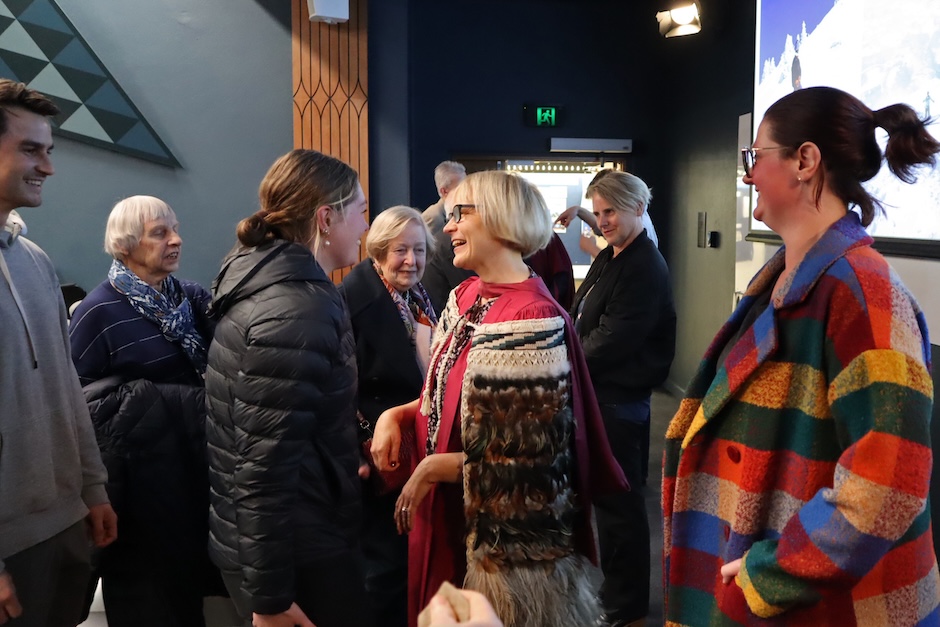
Family, friends and former students congratulate Professor Liz Legderwood after she finishes her Inaugural Professorial Lecture.