
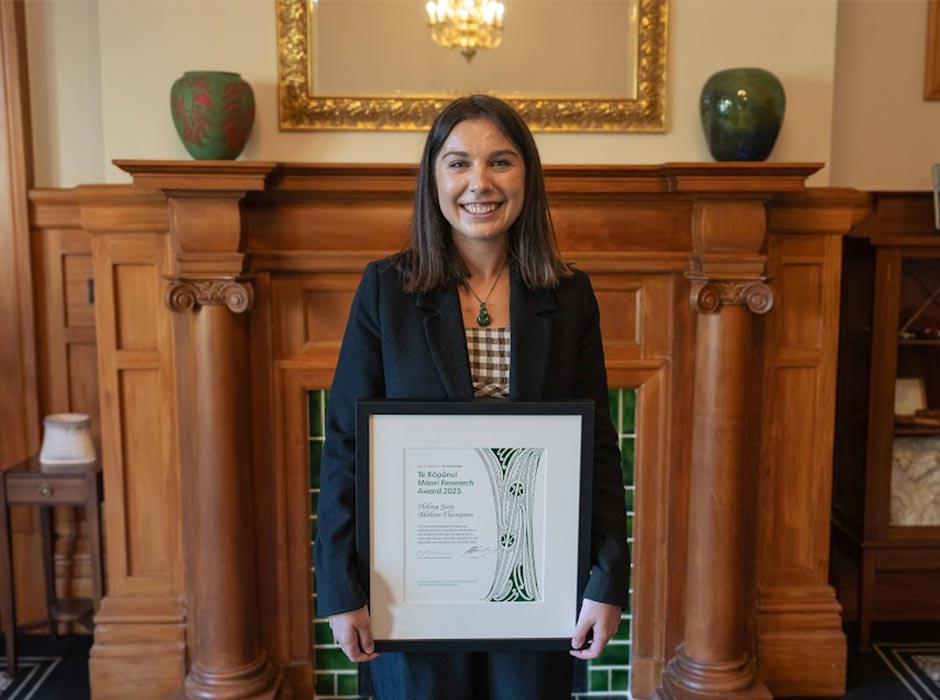
PhD candidate Helena Abolins-Thompson, pictured with her Te Kōpūnui Māori Research Award, will graduate tomorrow after completing her thesis on tikanga-guided genomic approaches to breast and ovarian cancer for wāhine Māori.
For PhD candidate Helena Abolins-Thompson, being able to work closely with her community and whānau during her post-graduate studies has been an “absolute privilege”.
Helena – who has whakapapa to Ngāti Toa Rangatira, Ngāi Tahu and Rangitāne o Tamaki-nui-ā-Rua, as well as to Latvia and Scotland – will graduate tomorrow after completing her PhD in her hometown of Te Whanganui a Tara (Wellington).
“I’m biased obviously, but I love living and working in Wellington, so to be able to do such exciting community and people-centred research here is amazing,” she says.
“I’ve had so many unique experiences that wouldn’t have been possible if I weren’t based here with the team that we built for this project.”
For her thesis, Helena looked at the use of precision medicine, genomics, and Kaupapa Māori science to better understand breast and gynaecological cancers affecting wāhine Māori.
“This topic was important to me because it gave me the opportunity to work very closely with my community, while also developing my confidence as a researcher working at the interface of two quite different ways of thinking – Te Ao Māori and Western science.
“Learning how to move between those spaces, and to do that work respectfully and meaningfully, was something I really valued and enjoyed.”
“A lot of how I think and work now has been shaped by listening to the experiences of wāhine in my community and in my own whānau." – Helena Abolins-Thompson
As she progressed through her PhD, health equity quickly became a passion as well, particularly in the context of cancer outcomes, Helena says.
“A lot of how I think and work now has been shaped by listening to the experiences of wāhine in my community and in my own whānau.
“Similar to many people who go down this path, I had seen the effect cancer had on the people I cared about and on my community and decided that Biomedical Sciences could be a way I could work towards making a small change for the better.”
While Helena already had a Bachelor and Master of Biomedical Sciences, she didn’t quite feel ready to leave the world of research, she says.
Her PhD, done through the Department of Surgery and Critical Care, came about as a product of “luck and good timing.”
“My supervisor, Associate Professor Kirsty Danielson, dreamt up a project in collaboration with Dr Bridget Simonson at the Broad Institute doing advanced sequencing studies in a Māori cohort, helping to ensure our Indigenous communities in Aotearoa are better represented in modern translational studies and scientific datasets.
“I approached Kirsty around the same time, and it all fell into place after that.”
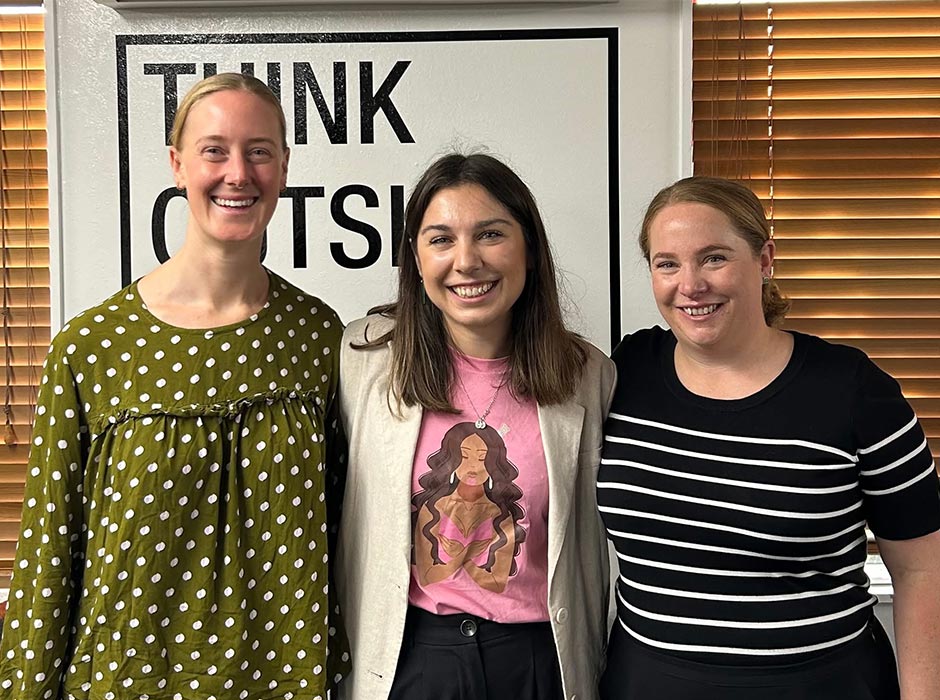
Helena Abolins-Thompson, centre, hopes to continue working in the cancer, women’s health, or health equity spaces after graduation. Pictured with Helena are, from left, Dr Claire Henry and Associate Professor Kirsty Danielson, two of Helena’s supervisory team.
A big part of her project was around developing culturally informed ways of working with human samples and live human tissue, she says.
“Overall, the aim was to build a stronger understanding of the genetic profiles of these cancers, while also increasing the representation of wāhine Māori in the data that underpins personalised cancer treatments.
“I think research – and pursuing a PhD specifically – can be a challenging feat, both academically and personally when you are working so closely with community and whānau, but it’s also such a privilege.”
Helena’s commitment to helping others has already translated into an impressive list of awards and accolades.
In 2022, she was one of three researchers to win $160,000 at the inaugural Māori Early Career Development in Cancer Research Awards.
“This award was pretty life changing for me in all honesty,” she says.
“Not only did it support me in doing my PhD, but it created a whānau of Māori cancer researchers who I can now call my peers, friends, and mentors. That community has been so important as I’ve gone through my PhD.”
In 2025, she received Te Kōpūnui Māori Research Award, which is awarded to early-career Māori researchers who demonstrate excellence and innovation in their work.
“I was fortunate to be nominated and awarded this honour from the Royal Society late last year, for the work my team and I did embedding culturally grounded frameworks into our study.
“I feel humbled to have my name on this award, as this work was such a team effort and really benefited from the knowledge that was shared with me from across all my various communities.”
Helena has also been named an Emerging Leader in Te Rau Ora’s list of 100 Māori Leaders.
“I still have difficulty calling myself a future leader to be honest,” Helena says.
“The PhD journey really encouraged a lot of personal growth for me, which I hadn’t fully anticipated, so to be recognised in this manner alongside some powerhouses in Māori leadership is pretty cool. It means a lot.”
With this kind of recognition comes a sense of responsibility, she says.
“At the end of the day, the most important thing for me is doing right by my community and by the people contributing to my work, by making sure their voices are heard in my research – as much as one student can achieve!
“It comes with a lot of responsibility, and sometimes a bit of self-inflicted pressure. At the same time, I have had nothing but aroha and support guiding me throughout, and everything I do has been backed by an amazing team of supervisors, mentors, knowledge holders, and community leaders.”
Helena is now wrapping up some work in a postdoctoral role in the Surgical Cancer Research Group and will then take some time to figure out her next move, she says.
“I’m hoping to stay in the cancer, women’s health, or health equity spaces if I can, but we’ll see what happens.”
First, she’ll get to celebrate her graduation in Dunedin this weekend.
“I’ll be spending time with my partner, my family and my support network. And celebrating the end of the road of my student journey.”
– Kōrero by Internal Communications Adviser Laura Hewson