
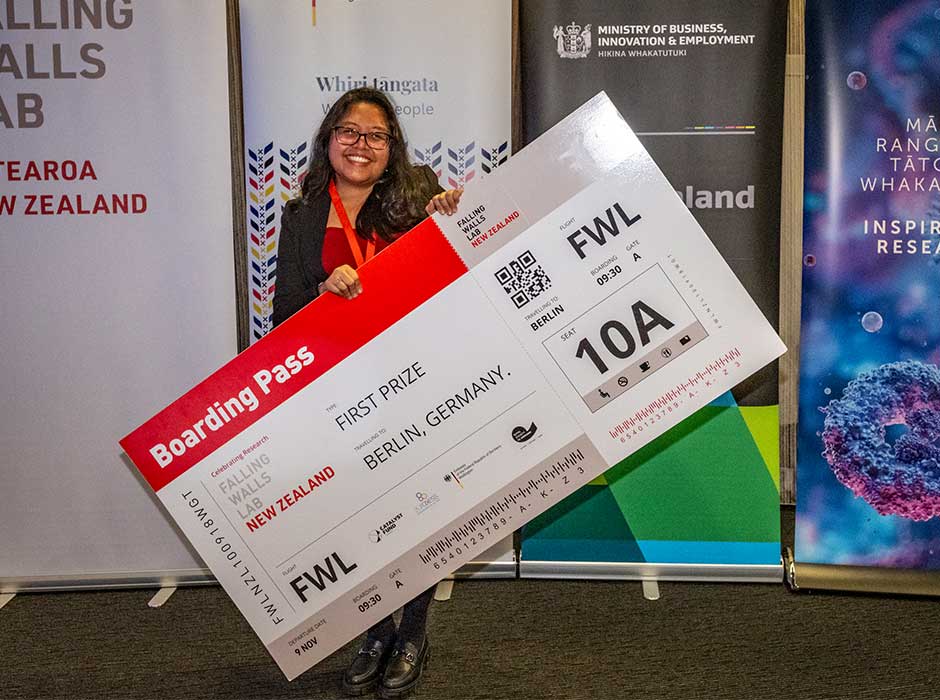
Dr Judy Ann Cocadiz will be winging her way to Germany as the winner of the Falling Walls Lab Aotearoa New Zealand competition 2026.
Dr Judy Ann Cocadiz took only 180 seconds to persuade New Zealand’s science experts her innovative and potentially life-saving cancer detecting device could save lives.
Judy Ann, a post-doctoral fellow based in the Department of Biochemistry, won the recent Falling Walls Lab Aotearoa New Zealand competition, and will go on to represent New Zealand at the global final in Berlin, Germany.
Organised with support from the Royal Society Te Apārangi and the German Embassy Wellington, Falling Walls Lab is an international, interdisciplinary pitch competition designed to celebrate and connect the world’s next generation of scientists.
Students and early-career scientists present their breakthrough ideas to tackle global problems - and have only three minutes to do so.
Judy Ann presented her ground-breaking ctDNA device project on stage at the German Embassy in Wellington.
She says incredibly grateful for the win, and the opportunity to take it international.
“Standing in that room with so many brilliant researchers, I really didn’t expect this outcome. Everyone’s work was genuinely incredible, and it was a privilege just to be part of it. Turning years of research into a three-minute pitch is something I definitely didn’t do alone, and I’m very aware of how many people helped me get to that stage.”
Judy Ann is excited about going to Berlin, and the opportunity to meet inspiring researchers, innovators, and experts from around the world.
“As an early-career researcher, I’m hoping to learn from people working on exciting challenges, gain new perspectives, and connect with others working in areas related to cancer diagnostics and biomedical device technology. I’m also really looking forward to the networking opportunities that come with being part of the Falling Walls community.
“Research can sometimes feel very focused within your own lab or field, so I’m genuinely excited about the chance to meet people from different backgrounds, exchange ideas, and build new connections. I hope these conversations will open up new opportunities and collaborations as I continue building my research career here in New Zealand,” she says.
Judy Ann’s novel ctDNA device project is part of her research into developing new technologies to better capture circulating tumour DNA (ctDNA) —tiny fragments of tumour DNA that are released into the bloodstream.
These ctDNA fragments can provide important information about the presence of cancer, but are incredibly rare in the early stages of disease and can be difficult to detect from standard blood tests.
“To address this challenge, I am developing a small device, around the size of a grain of rice, that can be temporarily placed into a vein to sample blood directly from the bloodstream. By interacting with a much larger volume of blood than a traditional blood draw, the device aims to increase the capture of these rare DNA fragments and improve the sensitivity of cancer detection.”
With support from the Cancer Society of New Zealand, she is currently working towards developing this technology into a clinically useful tool that could help detect cancer earlier.
“Ultimately, this earlier detection will improve treatment monitoring and make cancer diagnostics more accessible and equitable - and, therein, closer to communities that may not always have easy access to specialised healthcare,” she says.
The motivation behind Judy’s work is also very personal.
“When I was a child, I noticed that a friend of mine bruised very easily and mentioned it to his mum. That small comment led to a doctor’s visit and an early-stage leukaemia diagnosis. Because it was caught early, he received treatment and is still alive and well today.
“That experience showed me the life-changing impact of early detection and has continued to inspire my research.”
Judy Ann completed her Bachelor of Science in Biochemistry at the University of the Philippines, followed by a Masters in Science and a PhD at the University of Otago.
Watch Judy Ann’s pitch via this link here.
-Kōrero by Claire Grant, Communications Advisor, Faculty of Biomedical Sciences
Department of Biochemistry
Biochemists find out how the molecules in living things work. By unravelling the secrets underlying fundamental biological processes, we can find innovative approaches to challenges in medicine, biotechnology and agriculture.
View