
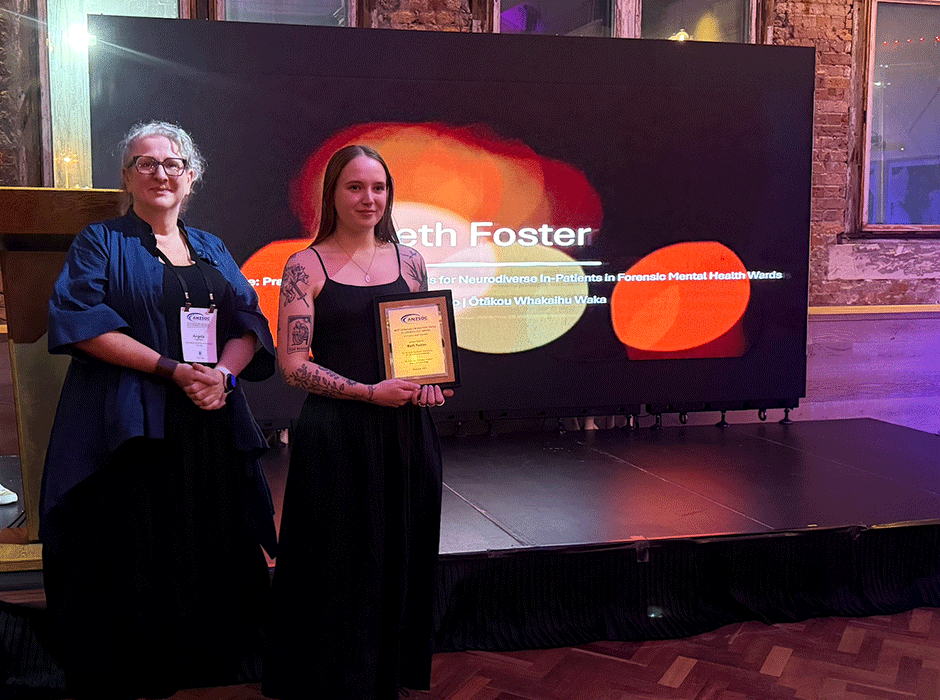
Beth Foster, right, receiving her Best Honours or Masters Thesis in Criminology Award at the 2025 Australian New Zealand Society of Criminology Conference held in Queensland, Australia, recently, with Associate Professor Angela Higginson, left, from Queensland University of Technology.
When Beth Foster decided to return to Ōtākau Whakaihu Waka to do an Honours degree, four years after finishing her Bachelor of Arts in Psychology and Criminology, she was worried she may have lost some of her studying skills.
She shouldn’t have been worried, though, because her dissertation gained the highest Honours dissertation mark in Criminology in New Zealand for 2024. Her mark was so good, in fact, that she has recently been fast-tracked from doing a Masters degree this year, to a PhD instead.
Beth celebrated all of this recently when she attended the 2025 Australian New Zealand Society of Criminology Conference held in Queensland, Australia, at the start of December. There, she received the Best Honours or Masters Thesis in Criminology Award and spoke on her research.
Her dissertation was titled Constructing Care: Practice Recommendations for Neurodivergent In-Patients in Forensic Mental Health Wards, which was inspired by the job she got after finishing her BA – that of a forensic mental health assistant at Wakari Hospital.
“Basically, in New Zealand, if you are found not criminally responsible for a crime, either through mental illness or because you’re neurodivergent – which includes ADHD, autism, foetal alcohol spectrum disorder – you can be placed in an inpatient psychiatric ward for an indefinite period of time until you’re deemed by the justice system or health system that you’re well enough to leave,” Beth says.
New Zealand’s Mental Health and Disability Acts have strict criteria, meaning for anyone to be treated by the disability services, they have to have an IQ of 70 or less.
“But, a lot of neurodivergent people aren’t intellectually disabled. So in that case, they get placed in a regular mental health facility.
“I realised there was a subset of the population that were neurodivergent, but they didn’t have mental illness, and they were being treated in this space, and there wasn’t a lot of information about how to treat them.”
It was this realisation that sparked her Honours dissertation.
“My goal was to make practice recommendations on how to care for this particular subset of population, because we just don’t really know, there’s not a lot of research.”
Beth says while all of the recommendations she made in her dissertation were from literature, a key component of her research was making sure it was patient-centred.
“That’s what a lot of disability advocates have been talking about over the years – ‘nothing about us, without us’.”
Her PhD research will see her taking the recommendations she made in her Honours dissertation and present them to people that are being treated in mental health facilities, as well as their family members, carers and staff members to see if the recommendations are appropriate.
“Does it work for them? And if not, what would be better.”
While reflecting on her win and trip to Australia, Beth says she is experiencing a little bit of ‘imposter syndrome’.
“Because I was out of education for four years, then I came back, I thought I’d lost all of my skills… and it was a very hard learning curve to get back into it.
“So I just thought I’d kind of, like, do ‘okay’, but I didn’t think I would do well enough to win an award.”
She was nominated for the award by her supervisor Professor Anita Gibb and a fellow postgraduate student.
Why study Criminology?
Criminology is currently one of the fastest growing and most popular areas of study in the social sciences internationally. Students studying criminology have the opportunity to learn about many of the social, cultural and political dynamics that surround the social phenomenon of crime.
View