
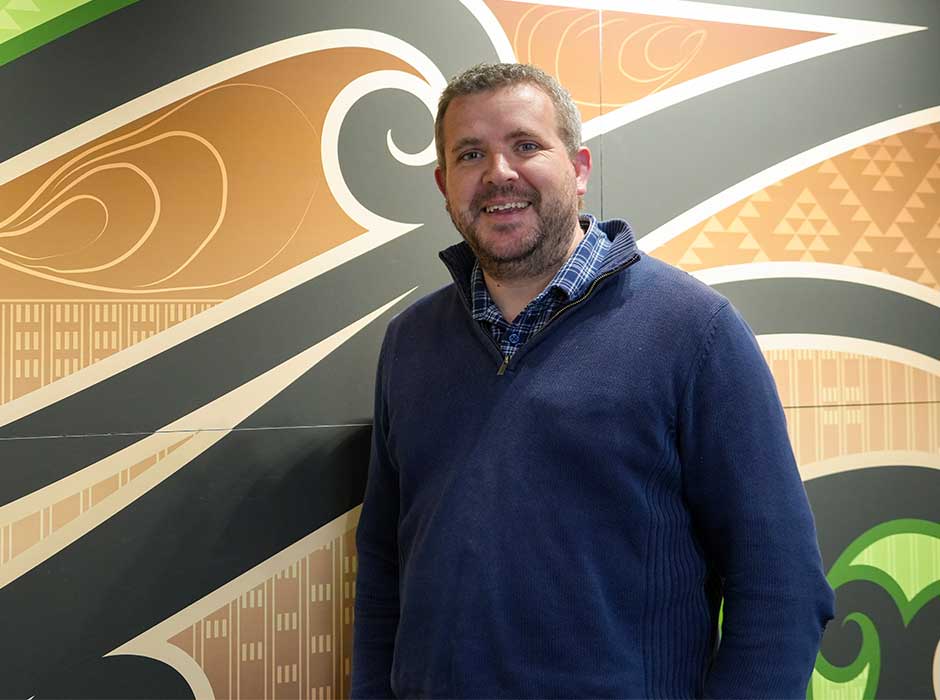
Senior Lecturer and Associate Dean Māori for the Department of Biochemistry Dr Nathan Kenny looks forward to better safeguarding our native freshwater species.
University of Otago - Ōtākou Whakaihu Waka researchers have secured funding to combat an invasive golden clam threatening freshwater ecosystems in Aotearoa New Zealand.
The project, developed in partnership with Ngaa Muka Development Trust in Waikato, has recently been granted $350,000 from the Ministry of Business, Innovation and Employment He Ara Whakahihiko Capability Fund – aimed at contributing to the aspirations of Māori-facing organisations to deliver benefit for Aotearoa.
Associate Dean Māori for the Department of Biochemistry Dr Nathan Kenny (Ngāi Tahu and Te Ātiawa), had already been involved in a Waikato-based project for the last couple of years, researching the impact of acidification, particularly on kākahi – native freshwater mussels.
During this work, field experiments with local Māori groups introduced him to the emergent problem at the forefront of their minds – Corbicula – an invasive golden clam.
Fortunately, the clam has not yet been found in the South Island, but Nathan warned there was a high chance this could change.
“They get everywhere. They reproduce like crazy.”
He says the clam likely came to Aotearoa on someone's recreational fishing apparatus and survived just long enough to reach Waikato. Though only growing to around the size of a 50-cent coin, the clam severely impacts its surroundings, posing a threat to our native species.
“They change the riverbeds and water chemistry, altering them to suit themselves. They outcompete kākahi and they don't provide a good food source for a lot of native organisms – some freshwater fish could eat them, but not to the extent needed to remove the problem.”
His earlier work in Waikato focused on kākahi, a taonga species for Māori.
“They’ve been used as a food source for a long period of time, and they’re real ecosystem engineers.
“But we don’t really know what they can cope with and what they can’t.”
Nathan explained the project was less about attempting to remove “literally billions of them”, and more about developing the tools to find and protect the places the clam was not yet present. Kaitiaki from Ngaa Muka will be doing most of the “on the ground testing” using the new diagnostic tool provided by the University. The new molecular approach will allow testing in the field, providing rapid assessment to identify where and when Corbicula might have moved into new locations.
“If we can effectively stop Corbicula from spreading, that can only be good for Aotearoa. And the quicker we can get these tools into the hands of people looking for them, the easier it will be to stop problems going forward.”’
Kauri dieback focus of second MBIE project
Another MBIE-funded project, co-developed by Te Rūnanga o Te Rarawa and the University of Otago, will use the same tool to help detect kauri dieback – an incurable disease that infects and starves native kauri. Associate Professor Michael Knapp from the Department of Anatomy says the project will take place in one of the largest kauri forests left in the country – Warawara Ngāhere.
The collaboration started in 2024 with Te Rūnanga o Te Rarawa’s Kauri Ora team looking for a quick and easy way to detect Kauri dieback in the field rather than through month-long laboratory work.
Michael’s team at Otago developed some prototype approaches for detecting kauri dieback in soil samples which were then trialled by the Kauri Ora team. After a year of experimenting, the team had come up with a fast but somewhat complex approach that could detect the pathogen on site within just a few hours. Since then, Michael’s team has been working on ways to simplify the process to make it accessible for those not trained in molecular biology.
“We are all pretty excited about the potential to have an easy-to-use diagnostic tool for kauri dieback at the end of this project which can be used by communities to protect kauri forests in their rohe.”
Both projects make use of a new approach to environmental DNA testing developed by Otago postdoctoral fellow Benjamín Durán-Vinet from the Department of Anatomy. The approach combines AI and CRISPR technology to create molecular tools for identifying unwanted organisms in a wide range of environments.
“We have the opportunity to make the latest biotechnological innovations accessible to communities,” Michael says.
“These technologies can facilitate community-led environmental management, and I believe that is in many ways the most effective way to preserve our regional biodiversity.
“Nobody knows an area better than its kaitiaki.”
-Kōrero by Ani Ngawhika, Māori Communications Adviser
Department of Biochemistry
Biochemists find out how the molecules in living things work. By unravelling the secrets underlying fundamental biological processes, we can find innovative approaches to challenges in medicine, biotechnology and agriculture.
View