
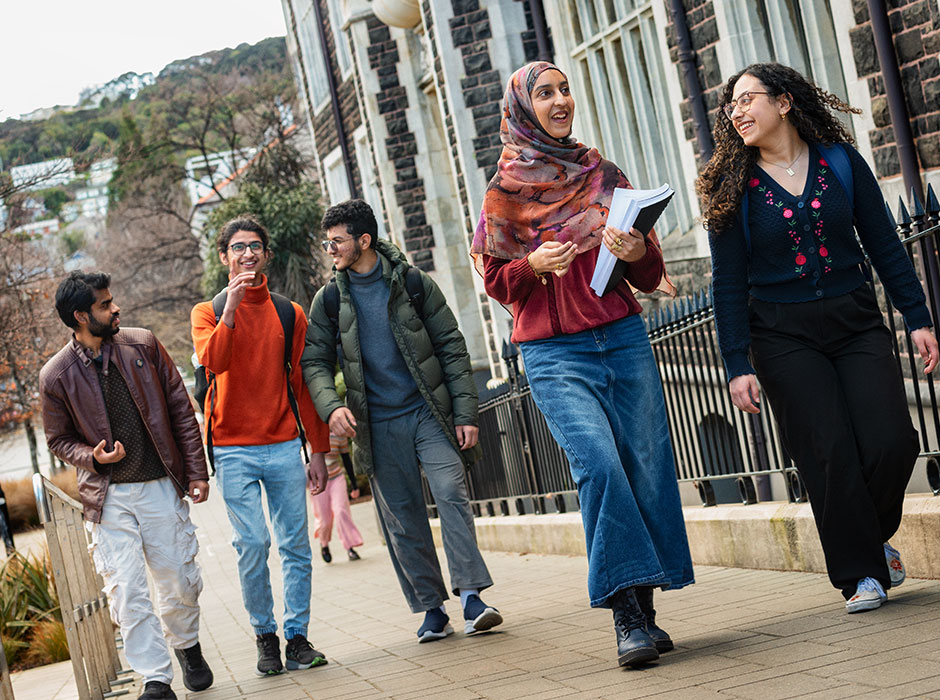
Members of the University of Otago Muslim Students’ Association (from left) Iqbal Mohammad, Abdul Wasay Rashid, Saud Al Badr, Aasiya Ather and Jomana Moharram. PHOTO: Alan Dove
Otago lecturer Dr Usman Afzali is helping to better understand and give voice to Muslim experiences in Aotearoa.
Usman was born into political turmoil in Afghanistan and grew up with his Muslim family in a refugee camp in neighbouring Pakistan.
He began studying medicine in Pakistan but was able to return to a more politically stable Afghanistan to complete his Doctor of Medicine degree at Shaikh Zayed University in the southeastern city of Khost.
Usman followed his fiancée and her family to Christchurch, where he completed a PhD in psychology and undertook post-doctoral research at the University of Canterbury – all in English: his fourth language – before taking up a position in the Religious Studies Programme at Otago at the start of this year.
The Christchurch mosques attacks of 15 March 2019 – during which 51 Muslims were killed and 89 were injured – had a profound effect on Usman, who was in the musallah or prayer space at the University of Canterbury at the time.
“I lost friends in the Christchurch shootings, and many of my friends got injured, and many families were shattered,” Usman says.
The experience led to him becoming involved with the New Zealand Attitudes and Values Study: a 20-year, longitudinal, national study of social attitudes, personality, ideology and health outcomes of more than 70,000 New Zealanders.
One of his Canterbury colleagues, Associate Professor Kumar Yogeeswaran, invited him to contribute to a paper on anti-Muslim prejudice in New Zealand following the attacks, as part of the Attitudes and Values Study, and he went on to co-author further papers with the study.
This in turn led to Usman (as the principal investigator) and four colleagues to establish A National Longitudinal Study of Muslim Diversity and Flourishing in Aotearoa New Zealand (known as the Muslim Diversity Study), with postdoctoral funding he had received from the Templeton Religion Trust set up by the British billionaire and philanthropist, Sir John Templeton.
Kumar was one of his colleagues, along with Usman’s mentor and supervisor, Professor Joseph Bulbulia from Victoria University of Wellington; Professor Chris Sibley from the University of Auckland; and an Auckland-based Muslim lawyer, Aarif Rasheed.
Usman says that while the New Zealand Attitudes and Values Study had more than 70,000 participants, the Muslim sample size was very small, fluctuating between 50 and 70 people each year, so they set up the Muslim Diversity Study as a “booster sample” to the larger project.
“We lack data on Muslims in New Zealand and it is important to have objective research-based evidence for policy and advocacy and so on,” Usman says.
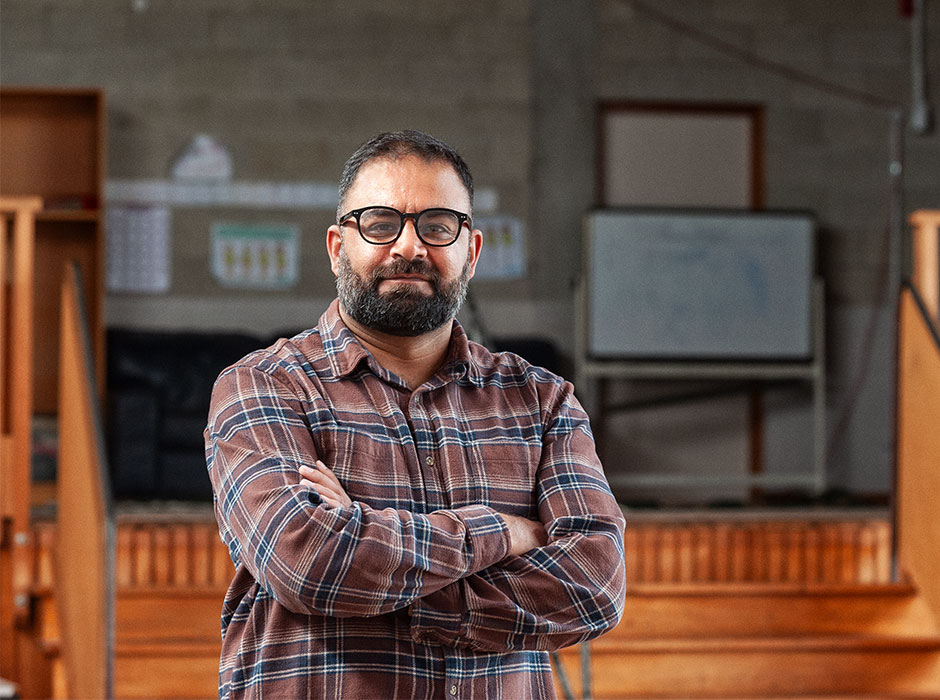
Otago Religious Studies Lecturer Dr Usman Afzali has led the National Longitudinal Study of Muslim Diversity and Flourishing in Aotearoa New Zealand (the Muslim Diversity Study). PHOTO: Alan Dove
Usman, who now co-leads the on-going Muslim Diversity Study with Bulbulia, explains that it is a community-led, nationwide, research initiative that “focuses specifically on the experiences, resilience, wellbeing and social attitudes of Muslims living in Aotearoa New Zealand”.
He says that, through the use of questionnaires, the study “uses survey data to foreground the voices of Muslim individuals and communities who have long been underrepresented in social research, and does so in comparison with other community groups”.
At the study’s peak, Usman coordinated a team of 30 research assistants nationwide who were already working with Muslim communities. They recruited participants by working with 80 mosques, and religious, community and youth organisations, increasing the sample size to 667 individuals.
The study has also reached thousands of people through 30 community talks across six cities – Dunedin, Christchurch, Wellington, Palmerston North, Hamilton and Auckland. More than 100 people attended an Auckland talk earlier in the year.
“These talks first encouraged participation in the Study and now serve as a platform to share early findings with the very communities who contributed to the research,” Usman says.
The study’s findings are also being disseminated through various publications, and through a website: muslimdiversitystudy.com
“I have co-authored with 23 researchers from the Muslim community,” Usman says. “For a lot of them it was the first time they were published.”
The way the researchers have gone about their work has played a significant role in shaping community engagement, and has drawn praise from community leaders such as the Auckland University Muslim Chaplain, Shahela Qureshi.
“The Muslim Diversity Study is built with sensitivity and respect for engagement within the Muslim community,” Shahela says. “We deeply appreciate this approach.”
The Study’s findings have been readily taken up by Muslim community leaders and organisations in various advocacy and wellbeing initiatives.
“From the community leaders’ perspective, they are appreciative of it because they now have objective data to look at, and when they advocate for Muslims, when they go to government and tell people in what areas Muslims are suffering, in what areas they need help, there is some information that they can fall back on,” Usman says.
This is endorsed by prominent Muslim organisations such as the Federation of Islamic Associations of New Zealand (FIANZ).
“The Muslim Diversity Study provides valuable insights that inform FIANZ’s community engagement research and policy advocacy,” the Federation’s Chairperson of Advocacy and Community Development, Abdur Razzaq, says. “Its findings are frequently referenced in our development of policy advice, reflecting its relevance and depth.”
The Study is also playing a significant role in shaping academic research.
“Dr Usman’s Muslim Diversity Study aligns with core Muslim values of respect and co-design in research and community initiatives,” Massey University Senior Lecturer, Dr Fatima Junaid, says. “Having conducted the first baseline study of Muslim experiences, I’ve learned both methodologically and substantively from the Muslim Diversity Study. I’ve cited it in my work with Muslim women and plan to integrate its findings into future studies.”
Usman and the Muslim Diversity Study have further contributed towards greater understanding of Muslim communities by coorganising the first Muslim-led, Muslim-focused, academic conference in New Zealand – on experiences and challenges of Muslims in Asia and the Pacific – held in Wellington in May.
He is now organising a follow-up conference to be held at the University of Otago in May 2026, co-sponsored by the University, which will focus on expanding Pacific and indigenous Muslim experiences, among other themes.
-Kōrero by Ian Dougherty, He Kitenga
This story first appeared in He Kitenga 2025 – Impacts. He Kitenga is the University of Otago’s flagship research publication, which showcases the University’s cutting-edge research and explores how it is making a difference to people’s lives.
Why study Religious Studies?
The study of religions is more than just learning about beliefs - it’s about exploring what it means to be human in a diverse, changing world.
View