
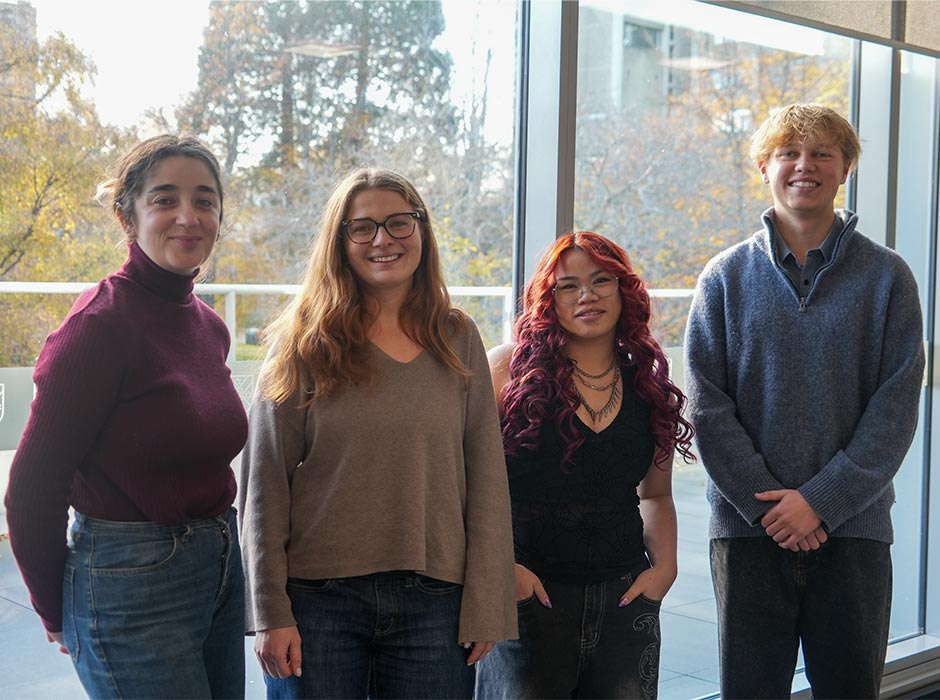
Otago tauira about to present on their HUMS 301/401: Internship Practicum experiences at a special symposium last semester are, from left, Lily Bond (Pacific Tourism Organisation), Megan Bowker (Regent Theatre), Sam Somerville (Highlanders) and QuQu Hoppe (RASA School of Dance).
If the word internship conjures up images of coffee runs and photocopying, you may be surprised to hear what the busy tauira who take HUMS 301 and 401 get up to.
The Internship Practicum paper, which is offered at 300 or 400 level, sees students from the Humanities Division matched with business and academic mentors in order to take on a project, a task, or research in a field relevant to their studies and career goals.
At a special symposium last semester, students spoke about their experiences at a range of organisations, including The Highlanders, Red Cross Otago, RASA School of Dance, Age Concern, Otago’s College of Education and the Pacific Tourism Organisation, among many others.
Associate Professor Gwynaeth McIntyre (Classics) and Sofia Kalogeropoulou (Teaching Fellow in Dance) are coordinating the paper this year. Gwynaeth says hearing about the students’ experiences was an absolute highlight.
“We love seeing the excitement of the students as they present their work. I’m always impressed by their professionalism, focus, and self-reflection and it’s great to see how they apply what they’ve learned in their lectures to work in organisations out in the community.”
Sophia says the internships not only boost students’ confidence, they also offer opportunities to challenge them while in a safe environment.
“It helps them to develop transferable skills in communication, problem-solving, and project management and, overall, enrich their professional skills and future career possibilities.
“Most importantly, it teaches students to be thoughtful citizens who can contribute meaningfully and make a difference to local communities,” she says.
Third-year Bachelor of Performing Arts student Megan Bowker’s internship focused on Back Stage and Health and Safety at the Regent Theatre, through the lens of accessibility.
“As a member of the Deaf and Disabled communities myself, it was a very exciting endeavour to undertake,” Megan says.
“During this internship I was learning to become a technical assistant, or ‘techie’, working backstage for a collection of shows.
”One of the highlights was supporting The Royal New Zealand Ballet production of ‘That Scottish play’ Macbeth.
“Being able to be a part of the team setting that up was awesome.
“My absolute favourite part was being able to learn the history of the Regent and explore the original 1928 architecture.”
Communication, especially in the bustling backstage environment, could be challenging, she says.
“When people are up high, up ladders, on the stage or below, all yelling… being a deaf person can be a problem because I, like many in the Deaf and Disabled communities, need to see faces to lip read and understand.
“Change and adaptation take time and it's vital to at least start a discussion for wider accessibility.”
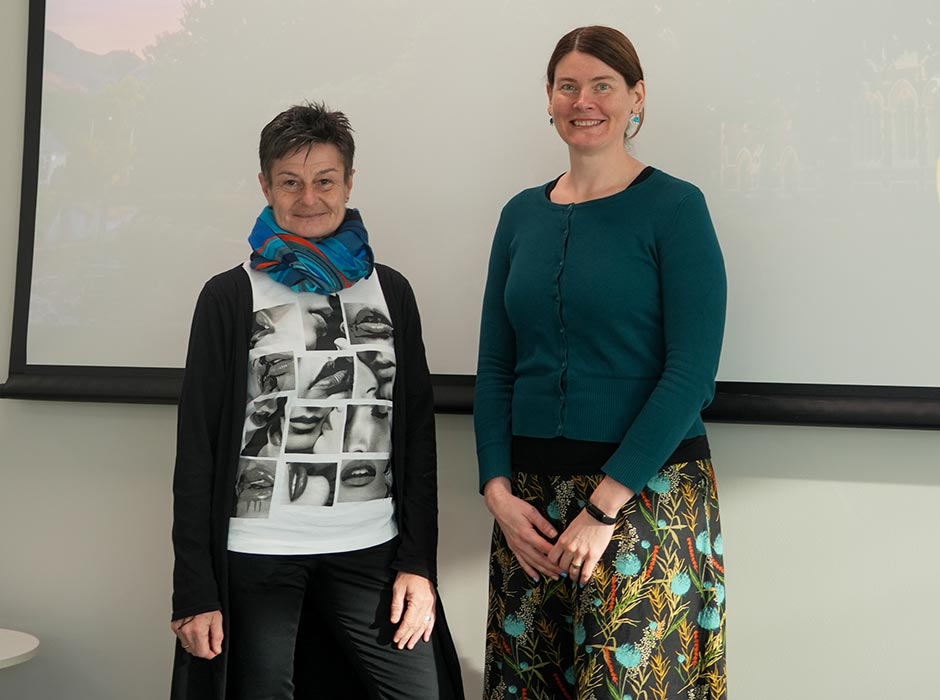
From left, Sofia Kalogeropoulou (Senior Teaching Fellow in Dance) and Associate Professor Gwynaeth McIntyre (Head of Programme – Classics) are coordinating the internship practicum paper this year, the first year two kaimahi are sharing the role.
Academic Mentor Martyn Roberts, Allen Hall Theatre Manager and Senior Professional Practice Fellow in Theatre Studies, gave Megan a great introduction to technical design and the backstage life of theatre, she says.
“Because this internship was the first of its kind, the mentor was more of a teacher and guide to learning the inner workings of the Regent. I learnt a lot about industry norms, as well as what the industry is lacking.
“It’s convinced me to continue work in this area. I’m hoping to work with Arts Access Aotearoa and eventually do a Masters specialising in accessibility within theatre, dance and music.”
Naomi Sopoaga – in her third year of a Bachelor of Laws and a Bachelor of Arts, majoring in Pacific Islands Studies – completed her internship with Matatū Rugby.
Naomi has whakapapa to Papa Sataua and Saanapu in Samoa, and Rakahanga, Manihiki, and Penrhyn in the Cook Islands. Her internship aimed to explore how Pacific values influence the sporting experiences of Pacific athletes within the Matatū women's rugby environment.

Naomi Sopoaga
Matatū is a professional rugby union team that competes in the Super Rugby Aupiki competition.
“I wanted to do this internship because Pacific women’s voices remain underrepresented in sport sociology and academic literature,” Naomi says.
“Super Rugby Aupiki is also still so new, which means the existing research to draw from is limited.
“Representation matters. People say you can’t be what you can’t see, and I believe that Pacific women need to be supported, celebrated, and visible if they are to thrive in sport and beyond.”
Naomi is also currently a player, which gave her a valuable inside perspective, she says.
“One of the greatest privileges of this internship was the talanoa (conversations) that took place with both past and present players. Hearing about their journeys, sacrifices, and what this team means to them deepened my understanding of the history and deeper kaupapa behind the franchise I now have the honour of representing.”
Naomi’s academic mentor Dr Michelle Schaaf, who is the Associate Dean (Pacific) Humanities, helped guide her through any uncertainty, she says.
“Because the internship was largely self-designed, I didn’t have a template to follow. Finding Pacific literature can often be challenging, but she helped me locate resources and encouraged me to trust the value of Pacific knowledge and perspectives.
“This project has helped me to discover a desire to potentially pursue further study in this topic, which I never thought about prior to this paper. Hopefully down the track I will aim to expand on not just Pacific female athletes in Matatū, but beyond.”
Her business mentor, Matatū Rugby General Manager Sarah Munro, was also incredibly supportive throughout the project – sharing knowledge, welcoming her questions and creating a space that encouraged meaningful conversations, she says.
“What I appreciated most was her respect for the participants and the integrity of the research process. Many of the talanoa were deeply personal, vulnerable, and reflective.
“Her respect for confidentiality allowed players to speak openly and honestly, knowing their experiences would be protected and valued.”
Gwynaeth says the programme couldn’t exist without these supportive community partners and local businesses.
“We rely on them to help support and guide our students and, in return, they get to work with our vibrant and engaged students, injecting new ideas and energy into their projects and goals.
“In some cases, businesses have appreciated the work of the interns so much that they have gone on to hire them as permanent staff members. We’re delighted when things like this happen, as one of the goals of the programme is to help facilitate students’ transition from their studies into paid employment.”
Both tauira would highly recommend the paper to other Humanities students.
“It gives you a chance to really dive into an area you're interested in and feel committed to,” Megan says.
“I am so grateful to have had this opportunity and would do it all over again if I could.”
Naomi says one of the greatest strengths of the paper is its flexibility, giving students the opportunity to build around something they are genuinely passionate about.
“Many students have interests, communities, or organisations they care deeply about and could talk about for hours. This paper gives you the opportunity to turn that passion into meaningful research and real-world experience.
“You never know where an idea might take you unless you’re willing to give it a go.”
More about HUMS 301/401
The Humanities internship is a paper for undergraduate and postgraduate full-time students from any of the Humanities disciplines, which include all Arts subjects, as well as Law, Theology, Social Work, and Performing Arts (Dance, Music, Theatre).
As part of the paper’s requirements, interns are based with an organisation for one day a week for 13 weeks. What they take on during that time is negotiated between the student, the organisation and the supporting academic programme.
This is the first year two Humanities kaimahi have shared the internship coordinator role, but it makes sense seeing as there is a real desire to expand the programme, Gwynaeth says.
“I was eager to take on this role to further promote the excellent work our students do in the community, continue to build our links with external groups and organisations, and champion the Humanities.”
Sofia says teaming up as coordinators has also given them the opportunity to establish a stronger infrastructure.
“The internship papers are complex, as they need to navigate the University administration and also ensure students have the appropriate supervisor and a fitting internship based on their interests and study.
“This way, we are confident that we can place students in a safe and inspiring space to gain first-hand insights and even test their future career pathways. At the same time, the local organisations are clear about the expectations of the internship.”
Sofia and Gwynaeth say the role of local organisations is indispensable to the programme and welcome questions from anyone interested in mentoring an intern.
– Kōrero by Internal Communications Adviser Laura Hewson
Humanities at Otago
Investigate the human world, what it is to be human, and how human beings relate to their diverse and changing environments.
Explore Humanities