
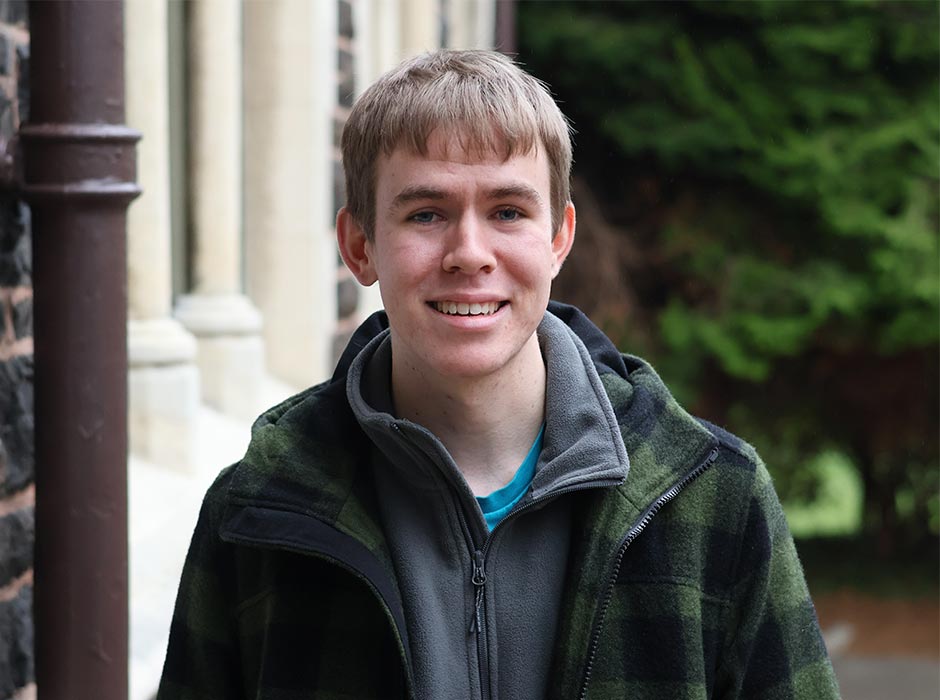
Fourth-year tauira Oliver Mitchell has been inspired by Sam Neill as he prepares to embark upon an Otago Global Student Exchange to the University of Alberta, Canada. “My favourite fictional palaeontologist would have to be, without a doubt, Dr Alan Grant in ‘Jurassic Park’. He’s just the epitome of cool,” Oliver says.
From the quarries of Otago to the hoodoos of Alberta, Oliver Mitchell’s hot on the trail of stone-cold fossils.
The fourth-year tauira, who is doing a Bachelor of Science and Arts, has long had a passion for all things prehistoric.
“As a child you imagine monsters and dragons – but dinosaurs really did exist, and that fascinated me,” Oliver says.
“A childhood passion can turn into something you can study. You don’t need to give up on it. You can go and study what you’ve always dreamt of studying.”
The former Wellington High School student was drawn to Otago by the prospect of studying prehistoric life. And it wasn’t long before he realised a childhood dream – discovering a fossil.
“We were at a limestone quarry and we got to go fossil hunting. I was finding rocks and bashing them open, and I found this lovely seashell that looks like a scallop, called a Lentipecten. Finding a full, intact fossil was quite lucky.”
As part of his Geology coursework, Oliver’s gone on to discover and prepare other fossils, donating the nicest specimens to Otago’s Geology Museum.
“More recently I found some really exciting fossil brachiopods and dolphins,” Oliver says.
“We also did an analysis of what turned out to be a preserved turtle inside a big rock outcrop. It’s a very large, 25-million-year-old relative of the leatherback turtle, several metres in diameter. It might be one of the largest turtle species ever found in New Zealand.”
“A childhood passion can turn into something you can study. You don’t need to give up on it. You can go and study what you’ve always dreamt of studying.” – Oliver Mitchell
Finding a fossil’s the easy part – preparing them is a labour of love.
“Fossils are rocks within rocks,” Oliver says.
“Preparing fossils involves using brushes, pressurised air and other tools to very slowly chip away the surrounding rock, which can be quite a lengthy and delicate process.”
Oliver will put his skills to the test this semester during an Otago Global Student Exchange to the University of Alberta in Canada.
“They have a volunteer fossil preparation lab, which I’m really excited to volunteer in,” he says.
“The University of Alberta’s one of the top universities for palaeontology on the planet. They’ve got animals from the Ice Age like mammoths, and Canada’s got really big dinosaur records. There’s a world-famous palaeontology museum I’m looking forward to going to.”
Mammoths and dinosaurs will make a change from seashells and turtles, but Oliver says Otago also has unique fossil records.
“Squalodontidae dolphins are extinct archaic dolphins that had sharklike teeth. Learning about the ancient dolphins was fascinating to me, and there are some really interesting specimens in the collections, including a complete skull. In our Geology department there are lots of unique whales, dolphins – and penguins, which first evolved in New Zealand.
“We also had giant marine reptiles like plesiosaurs and mosasaurs. They’re not dinosaurs, but they lived around the same time. My favourite one would be the massive Kaiwhekea katiki skeleton which is on display in Tūhura Otago Museum. It was one of the first things I went to see when I moved to Dunedin.”
Doing a double degree has given Oliver a unique lens through which to view the events of the past.
“I major in History and Geology and I minor in Archaeology, which is the perfect mixture of both. Going from History to Geology is like switching sides of my brain. I’ll be thinking about cultural reactions to different historical events, and then I’ll be numerically modelling the interior of the earth.
“With how double degrees are structured you can take so many interesting combinations of papers. I’ve taken Archaeozoology, Italian history, Biology – it really broadens your knowledge base. And our lecturers are internationally recognised and at the top of their field.”
Constructing past paleoclimates gives us important insights into climate change today – but the human interest in palaeontology runs bone deep.
“It’s part of the human condition – wanting to find out more,” Oliver says.
“What makes a fossil so special is that you’re looking at a direct link back millions and millions of years. I can hold a fossil shell in my hand and think that once upon a time it was a little egg that grew and had its own little life.
“It’s a link to an age so long ago you can’t really comprehend it. Twenty-five million years ago the environment was so different, and yet there’s still life, like dolphins, that we recognise. And what humans have discovered is just scratching the tip of the iceberg. Every day, all over the world, people are uncovering new species.”
– Kōrero by Kathryn van Beek, Communications Advisor | Kaiarataki Pārokoroko
Geology at Otago
Geologists study rocks, minerals, landforms, climates and biota, and the processes that affect them. As one of New Zealand's leading geoscience departments, Otago offers an active postgraduate programme and practical undergraduate foundation.
Study Geology