

Geology PhD candidate Natalia Seliutina is studying the chemical structure and mechanical properties of nephrite jade, which is also known in Aotearoa as greenstone or pounamu. Nephrite jade also has cultural significance in Siberia, where Natalia is from.
PhD candidate Natalia Seliutina has followed gemstones from the negative 30-degree temperatures of Siberia to the carving studios of Ōtepoti and the particle accelerators of Taiwan in her quest to discover why pounamu is one of the toughest natural materials on Earth. Fresh from the publication of Natalia's paper in the New Zealand Journal of Geology and Geophysics, Kathryn van Beek catches up with her to find out how understanding the properties of pounamu might one day help us explore space.
“Why did I choose to study rocks? That’s a deep question,” Geology PhD candidate Natalia Seliutina says.
“Consciously, I think it’s a good choice because geologists are always needed. Subconsciously, I think it’s because of my grandma.”
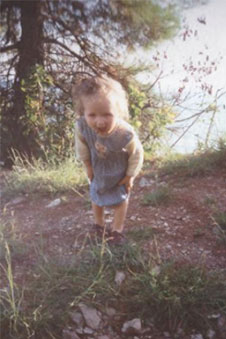
A young Natalia Seliutina, at around the age she would have been when her grandmother was reading her fairy tales, “being excited about rocks”.
Natalia grew up in Siberia, Russia, where her grandmother used to read her fairy tales.
“She was from the Udmurt Indigenous group in the Southern Ural Mountains, which are famous for rich mineralisation and a variety of rocks,” Natalia says.
“In her tradition there were a lot of fairy tales where the main characters were kind of rocks, so I always had this attraction to it.”
Natalia’s love of rocks also comes from her Siberian side.
“Nephrite jade is an important part of the culture. We have a belief system around it, and we feel drawn towards it,” Natalia says.
As a result of Indigenous groups being separated during the Soviet Union era, Natalia says there is no united opinion about the cultural meaning of jade.
“The traditions were not carried on through communities, and they vary from family to family. In my family there’s a belief that when the spirit of a woman dies, part of her spirit goes into a jade bracelet that is carried through the female line,” Natalia says.
“My mum has one of these bracelets, so the spirit of ancestral females is guiding her. It’s been carried through generations, and it has its own histories and tales attached to it.”
It was nephrite jade – which in Aotearoa is also known as greenstone or pounamu – that brought Natalia to New Zealand.
“When I saw there was an opportunity to pursue a PhD in nephrite jade I was like, that’s amazing. It combines a personal interest for me with an advanced question about material science.”
Natalia is studying the microstructure and mechanical properties of the stone, with the hope that it may help us develop new materials in the future.
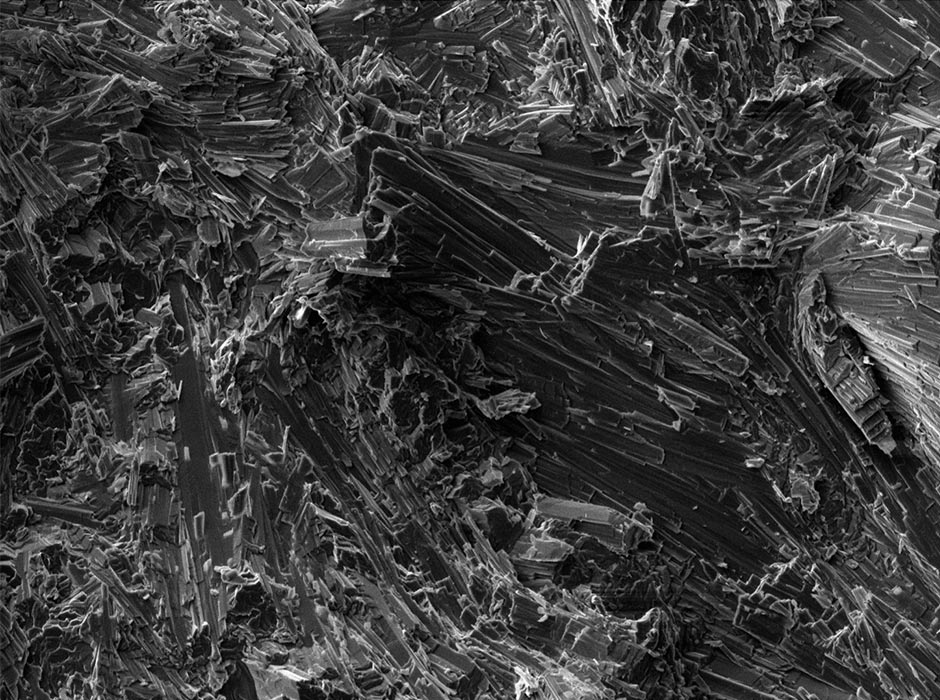
Pounamu as you’ve never seen it before.
“The umbrella project is about the toughness of pounamu. It’s extremely, exceptionally tough. It’s one of the toughest natural materials to ever exist,” Natalia says.
“It’s not clear what is responsible for this unique toughness, so I’m describing the structure and trying to identify if there are any patterns or reasons that I can notice. It’s a very complicated material, so I think it’s going to be a combination of parameters.”
In 2024, Natalia had the opportunity to visit the National Synchrotron Radiation Research Center in Taiwan, where she used a particle accelerator to learn more about pounamu.
"It was a unique opportunity and type of experiment that we were able to do there.”
“A particle accelerator allows you to look at the materials with precision and explore the molecular and crystal structure. Nephrite jade has very small grain sizes, like needles several times thinner than your hair,” she says.
“Particle accelerators use magnets and very big tubes that allow the particles to be sped up to high velocities and high energies. Electrons bombard your sample and the detector records how they interact with the sample so you can identify different properties. It was a unique opportunity and type of experiment that we were able to do there.”
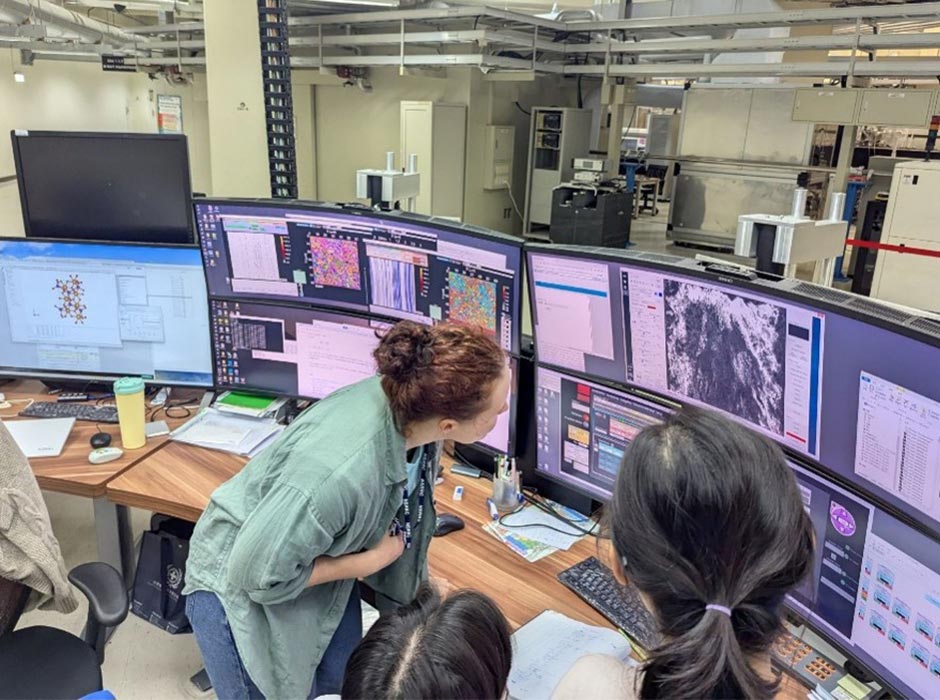
Natalia Seliutina visited the National Synchrotron Radiation Research Center in Taiwan, where she used a particle accelerator.
It was the first synchrotron-based study of microstructure to have been conducted on nephrite jade, so to use pounamu – one of two types of jade – was particularly special.
“It was insanely scary and cool,” Natalia says.
“It’s a very big sense of responsibility. You obviously want to make everything right and process the data very carefully and precisely, because it is a very big deal culturally and scientifically. It’s the type of study that has the potential for a big impact.”
The spark for this research idea didn’t come from ivory towers, but from pounamu carvers.
“My supervisor Dr Simon Cox has a personal interest in pounamu. He’s spent a lot of time with different iwi over the South Island, and lot of time the same question was being asked: Why is pounamu so tough? The initial question was asked by Māori, not scientists,” Natalia says.
In October last year, carvers from across Aotearoa were invited to a workshop where researchers and carvers exchanged knowledge.
“I can tell you the thing that shocked me the most,” Natalia says.
“I asked the carvers to rank the pieces of pounamu in terms of what they felt was the best for carving, and their choices lined up almost perfectly with what I got for my fracture resistance assessment. This was without any physical testing. The only reasoning they used was their experience, their senses, their feelings, and mātauranga – traditional knowledge.”
The carvers are also benefiting from her research.
“The carvers had a lot of questions about how the crack systems work, because you can have a big piece of pounamu that from the outside looks nice, but it can be cracked inside. We have discovered that by putting sound waves through material, usually we are able to predict how many impurities it contains. It could help carvers predict the material so they have less carving waste.”
“I asked the carvers to rank the pieces of pounamu in terms of what they felt was the best for carving, and their choices lined up almost perfectly with what I got for my fracture resistance assessment. This was without any physical testing."
The amphibole mineral in pounamu is not particularly strong, but pounamu is uniquely fibrous.
“Fibres often act like reinforcement systems in materials. Pounamu is similar to the ceramics that humans produce, where some fibres are bent and interlocked. Something happens when amphibole unites into those structures, and it becomes almost indestructible.”
Natalia says that having a deeper understanding of pounamu could help us develop new materials with the corrosion resistance of ceramics and the fracture-resistance of metal.
“If we understand how it works, then that can help significantly to improve our material science understanding. It could contribute to the development of new, corrosion-resistant materials that could be used in space. It’s genuinely an exciting project, because you feel the purpose of it.”
Working in a country with a different belief system around jade is interesting, Natalia says.
“Russia values the brighter and whiter varieties a bit more. In New Zealand the attitude towards pounamu is completely different. There is no praise for one variety over another, it’s more personal to people. It’s more about what people feel towards a particular piece.”
These aren’t the only different attitudes she’s encountered in Aotearoa.
“New Zealand is better than I ever expected, but at first I was terrified because a lot of the cultural norms are reversed. If a stranger smiles at me on the street it feels creepy to me. I was walking on the streets and thinking ‘What is happening’? But as you get used to that and it becomes part of everyday life, you understand how it does create a friendly environment.
"And of course, it’s not minus 30 degrees, so that’s nice.”
*Read Natalia's paper in the New Zealand Journal of Geology and Geophysics, 'Mechanical Properties and Fracture Behaviour of New Zealand Nephrite Jade (Pounamu): Implications for Fibre-Toughening Mechanisms in Amphibole Monomineralic Rocks'.
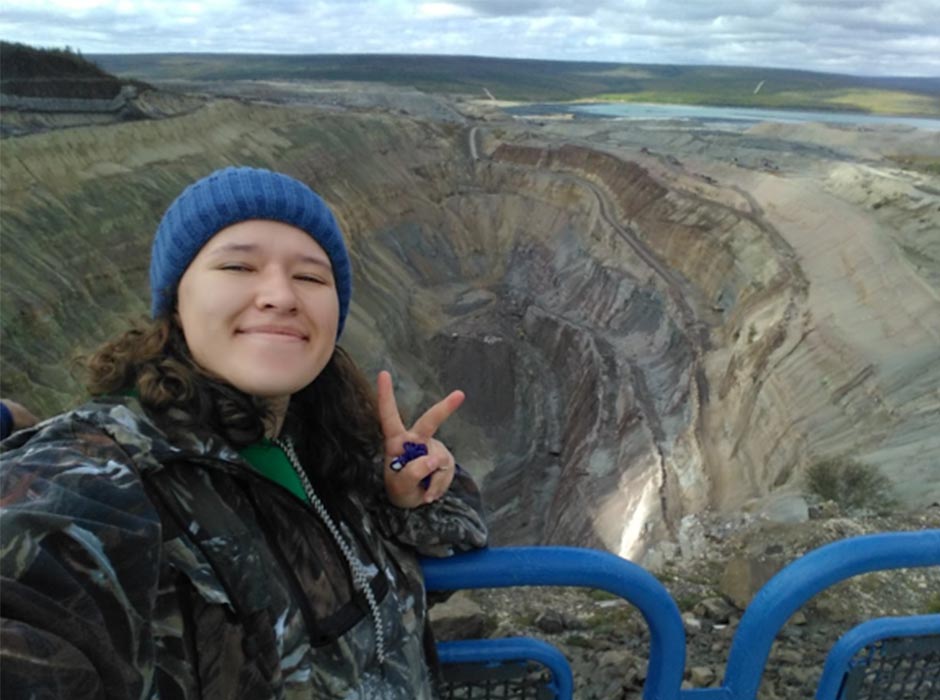
This isn’t Natalia Seliutina’s first foray into gemstones – during her master’s, she studied kimblerlite, a magmatic rock that brings diamonds towards the Earth’s surface. “When it rises it captures the diamonds from the depths and drives them upwards," Natalia says. She is pictured here on a field trip to kimberlite pipes in Siberia.
Study Geology
The Geology Department is research-intensive and broad – learn directly from faculty doing cutting-edge work on earthquakes, gold, glaciers, volcanoes, climate history, biological evolution, Antarctica, and more.
Geology at Otago