
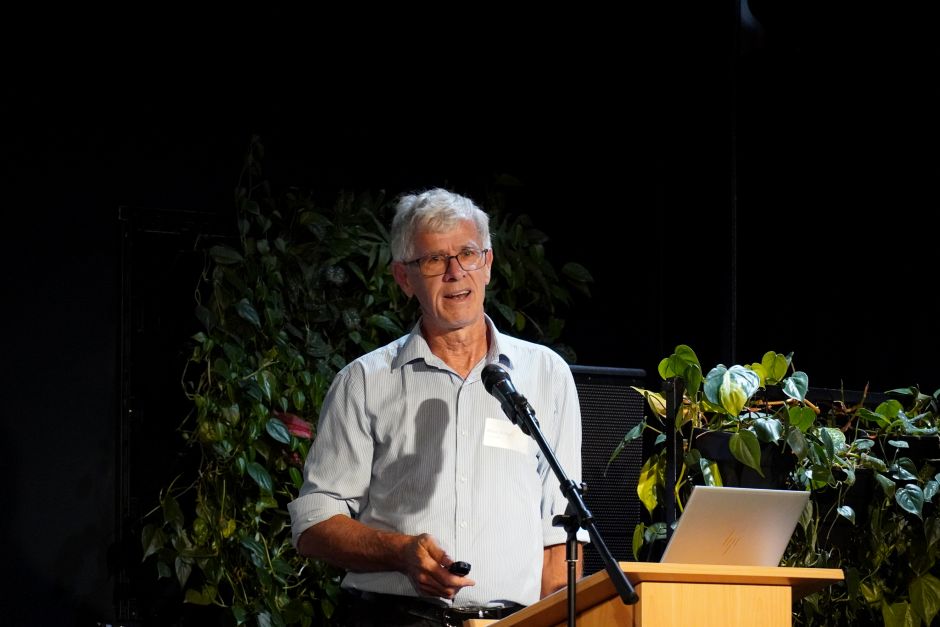
In his new role as Honorary Enterprise Fellow in the School of Surveying, alumnus and Trimble leader and innovator, Mark Nichols, is keen to encourage multi-discipline collaboration to inspire a new generation of tauira.
Enterprising is a word that fits Mark Nichols perfectly.
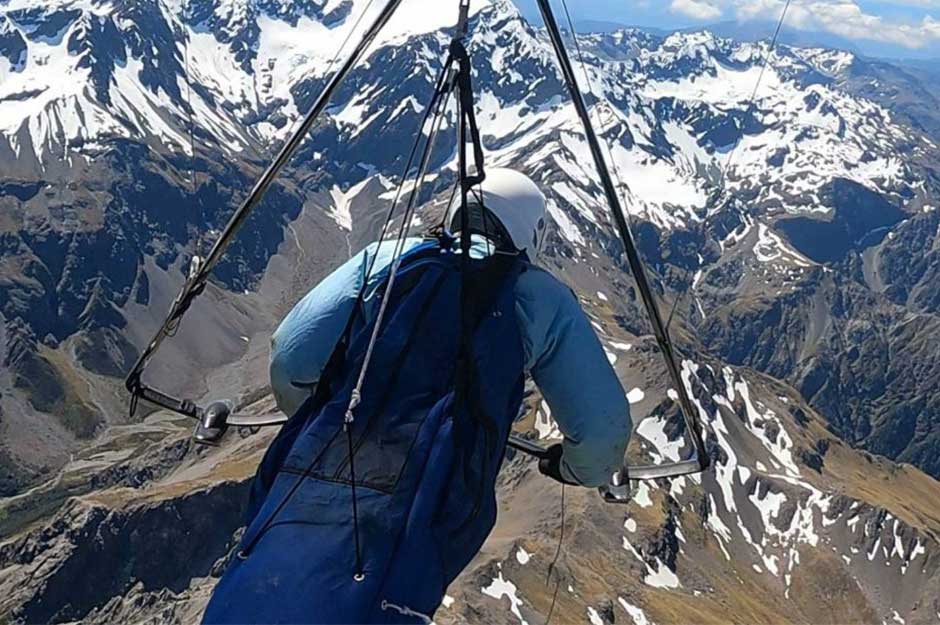
From his first job as a surveyor’s chainman watching the chain snap and thinking ‘there must be a better way to do things’; to working out how to study more effectively as a student, so he had more time for hang gliding; to jumping at career opportunities around the world – Mark has always been focused on what’s coming next in his profession, and how to get the most out of life along the way.
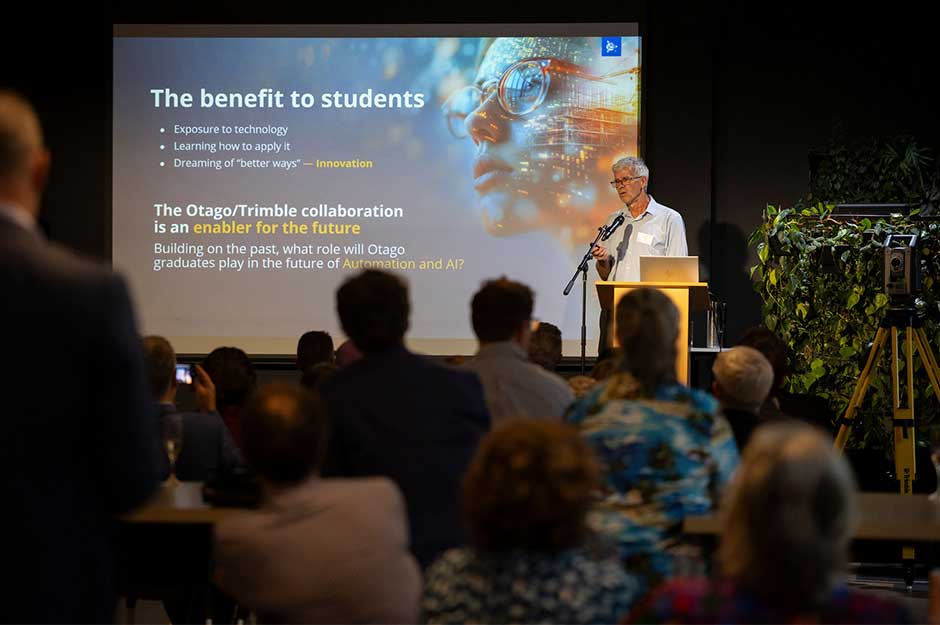
So, it’s very fitting that he has just been appointed an Honorary University of Otago Enterprise Fellow within the School of Surveying. Drawing on decades of leadership and innovation at global technology company Trimble, as an Enterprise Fellow he will help serve as a catalyst for the growth and impact of the Trimble Technology Lab, which was launched at Otago at the end of last year.
Mark graduated from Otago with a Bachelor of Surveying in 1978. The time he carved out during his degree for hang gliding also paid off, as he represented New Zealand at the World Hang Gliding Championships in 1979.
During his career, he grew the geospatial business and founded the agricultural and construction businesses within Trimble, focusing on productivity, work-place safety and sustainability. He was the first of many Otago alumni who have worked for Trimble, including more than 60 graduates who are currently professionally connected to the company.
From 2010-2023, Mark was a General Manager at Trimble, based in Christchurch, and although he supposedly then retired, he’s back “in learning mode”, working with a digital marketing company making strides with the use of AI.
In this Q and A, Mark talks about the importance of lifelong learning, what he values most from his career, and shares some advice for students today.
Q: Why did you decide to study Surveying at Otago?
When I was at high school, I did some work for a civil engineering company, working with a surveyor as a chainman. In those days, you measured distance with a steel band that you'd pull out.
On the first day we went to measure over some trees down a bank and the chain broke. I looked at it and thought, you'd think there'd be a better way of doing this. Then we put a whole lot of stakes in the ground to mark out where they're going to build a road. And since the locals didn't want it, we went away on Friday, came back on Monday and they'd all been pulled out. Again, I looked at it and went, you know, you'd think there'd be a better way of doing this.
Those two observations ultimately took me on a journey where I made a decision to go to Surveying School, which meant Otago.
Q: What are the things you value most from your degree?
Number one, every subject that I learnt, including the two optional subjects - computer science and anthropology. Every aspect of what I was taught, I have used in my career. Whether it was photogrammetry, astronomy, engineering, design, survey measurement or law. So, I think of it as being a very valuable foundation to build on.
Surveying is an interesting degree. It's a mix of practicality as well as the theory. When you're away on a field camp, you get to know everybody to a greater degree than if you're just going into and out of a lecture theatre. I’ve built strong relationships that have stood the test of time with people from Otago.
Part of the learning was also basically how to work, because to get through Surveying School you really have to be able to work, and learn how to work efficiently. I had a passion for hang gliding and I found every year if I worked out how to work more efficiently, I could go flying more.
To me, a key thing about a degree is it teaches you to think and develop an appetite for learning.
Q: How influential have those Otago friendships been in your career?
After I graduated, I worked for the Department of Lands and Survey, which is now LINZ, in Blenheim and on completing registration, in Napier. I took a secondment down to Twizel with the Ministry of Works and Development. While I was there, I wrote software for one of the first available portable computers, and that enabled me to improve the efficiency of the way I was working.
I'm from Christchurch originally, and I wanted to come down [from Napier] to go skiing. I was talking to Steve Critchlow who I went through Otago with. Steve said there's this crowd in Christchurch that's a part of Datacom that are working on a data collector for surveyors. While you're in Christchurch, you might want to go and see them?
I went to see them, on a day when it was blowing a howling norwester, so no good for skiing, and they offered me a job. So I moved to Datacom, and that part of Datacom was acquired by Trimble in 1991. That’s how I ended up in Trimble. It ties back to that cross-pollination between alumni of the University.
Q: So that appetite for learning and inquiry which started at Otago stayed with you?
Yes, it carried me right through. In the Datacom days, we did a trip around the world and looked at what was going on in the surveying industry in different countries. Out of that, we developed a strategy to build a software product that was called SDRMap [a companion product to the SDR field data collectors], which ended up becoming, I'll call it the de facto standard, for surveyors in New Zealand in the late 1980s, 1990s.
In 1992 I moved to Silicon Valley to work for Trimble on the development of centimetre accuracy GPS. After we released this to the Geospatial industry, I then turned around and went, how do we apply this to the mining industry, the construction industry, and agriculture? I pioneered those three markets for Trimble, but that involved, again, learning about the industry, learning about what value the technology could bring.
Q: What are some of the formative moments in your career?
I put together a joint venture with Caterpillar. That was an interesting experience, learning how to work with a very large corporation, learning how to successfully build relationships. At the time we did that, Trimble was a couple of $100 million in revenue and Caterpillar was about $20 billion.
I ended up doing a lot of work in China and put together three joint ventures, learning about different cultures and different ways of working.
In a little anecdotal story, I sat down with the chairman of what was at the time, I believe, the largest construction company in the world.
He described that he employed 300,000 people and 1.2 million people worked for his company as subcontractors. And he goes, your technology may improve productivity, but my job is to look after my people. What I'm interested in is safety and sustainability.
There are different drivers in different parts of the world.
Q: Is there anything that stands out as the highlight of your career?
The thing that I value the most, is actually the people that I've worked with. I've had the opportunity to work with some great people and pull together great teams.
The personal relationships that we build – I've been to Everest base camp, up on the top of Kilimanjaro, with people that I've been working with – the relationships are the most valuable thing.
We've got the AI revolution going on right now, the internet came along and social media but for me, face-to-face communication with real people as much as possible is what it's about. Because at the end of the day, why do you go to work? It's to earn an income, to look after your family, and to look after others.
So people are at the heart of it.
Q: What excites you about the potential of the Trimble Technology Lab at Otago?
For the Survey School in Otago, there's real value in having access to the latest equipment. You can train graduates that are going to come out that are up to speed on current technology.
I think some of the greater value may come out of the research. Universities have a luxury that we don't have in the commercial world, where you have to continue to get products out and continue to advance on relatively short cycles. Longer term research is harder to do and that is where universities have real value.
You always want to try and tie the research to a deliverable goal, something that can actually be turned into something that provides value to society. I'm hoping that out of the collaboration we can achieve some of that high-quality research.
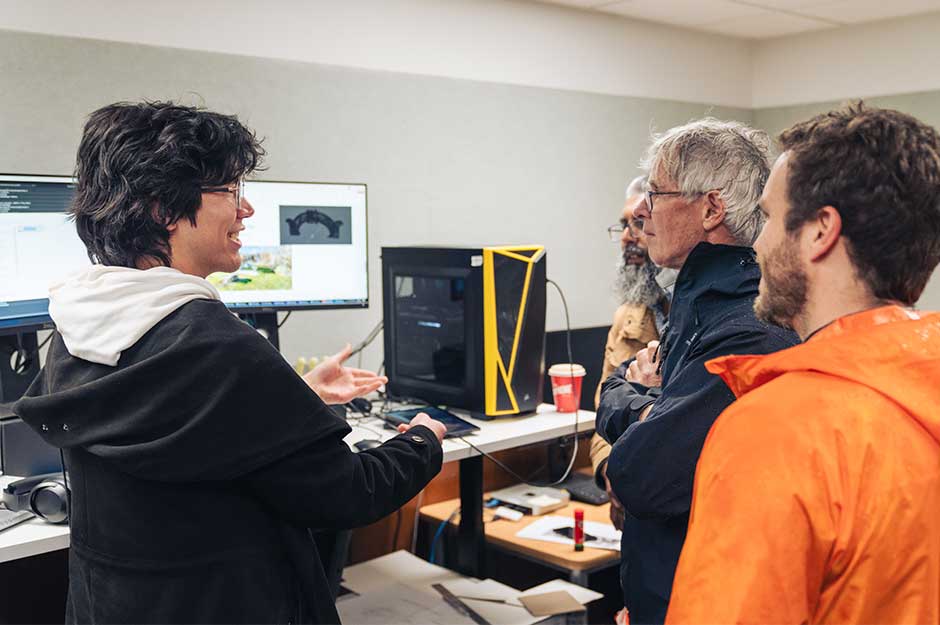
We had a meeting at Otago recently looking at potential research, and I was very impressed because in that meeting there were maybe 20-plus people in the room, from all around the University. The University is clearly looking at how to make the best use of the Lab.
Q: Coming full circle in your connection to Otago, tell us about your role as Enterprise Fellow
Very important in my thinking, is what I call cross-discipline work. You have a real advantage in Otago in that you've got Computer Science and Surveying co-located. If we're going to develop technology for the survey industry, we need computer science.
I'm trying to encourage what I'd call teaching and multi-discipline collaboration. Can we do a project that involves students in Otago and in Auckland, where the survey students, for example, go out and survey a site, civil engineering students in Auckland then design for that site. The surveyors then set out that site, but they collaborate through a cloud-based collaboration tool.
What we would be teaching is how to work remotely and how to collaborate across disciplines. This training would enable New Zealand-based firms to work remotely on projects across the country and all over the world.
One of the ways I have always looked at my career is not what is going on when I move from one role to another, but how well do things go on after I have left? Have I built something sustainable that continues to grow and develop?
As an Enterprise Fellow, I want to help build something that is sustainable.
Q: Considering all you have learned from your career, what would your advice be students today?
The first one is never stop learning. Have an appetite, have a curiosity, be willing to dig in and learn about things.
We're in a very interesting transition right now with the advent of AI, I think of it as a force multiplier of people with knowledge. Somebody with skills, domain knowledge, industry understanding can apply AI and achieve great things. Somebody that doesn't understand what they're doing can apply AI and create a mess. Focus on building a deep understanding of the industry you work in.
The other piece from my journey is always approach things with an open mind. Take opportunities when they arise, don't be afraid of having a go.
Q: As well as giving back to Otago and your venture into digital marketing, what else keeps you busy?
I belong to the Mainland Angels and I've invested in more than 15 startup companies, where I have provided capital to help fund start-up companies in New Zealand. They're across the spectrum, but the focus is medical and environmental.
Study Surveying at Otago
Strong employment prospects make Surveying an excellent career choice. Surveyors use drones, lasers and GPS technology to measure and map everything from building sites to the ocean floor.
View