
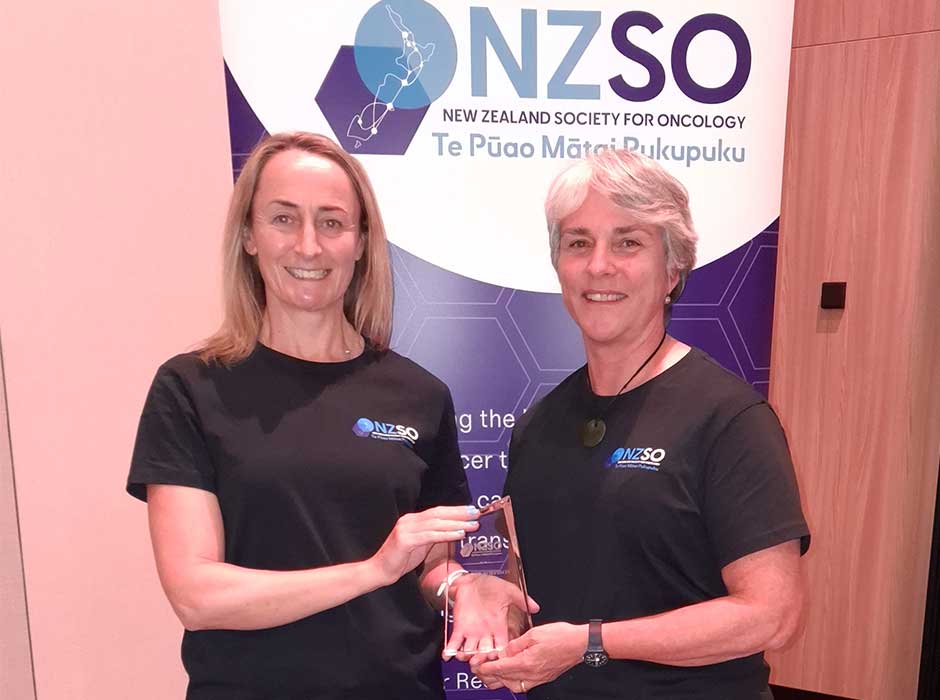
Professor Marg Currie (on right) accepts the Bridget Robinson Award from current NZSO Chair and UOC colleague Dr Rachel Purcell at this year's New Zealand Society of Oncology (NZSO) Annual Scientific Meeting.
University of Otago Christchurch cancer researcher Associate Professor Marg Currie has been recognised for more than 25 years of outstanding contributions to cancer research, receiving a prestigious national award.
Marg received the New Zealand Society for Oncology (NZSO) Bridget Robinson Award at the Society’s 2026 Annual Scientific Meeting in Wellington in October. The award acknowledges exceptional career achievements in translational cancer research.
Based in the Mackenzie Cancer Research Group at the Faculty of Medicine – Christchurch Ōtautahi, Marg has established an international reputation for her research into the tumour microenvironment, cancer immunology, obesity-related cancer biology and exercise oncology.
She says receiving the award was a tremendous honour.
“I am incredibly grateful to receive this recognition. It is a real honour to be awarded the Bridget Robinson Award, particularly given the calibre of researchers who have contributed to translational cancer research in New Zealand,” says Marg.
“I feel very fortunate to have had the opportunity to work alongside so many talented and committed colleagues, clinicians, students and collaborators over the years. This award is as much a reflection of their contributions and support as it is of my own work.
“Ultimately, what motivates me is the opportunity to translate research into meaningful improvements for people affected by cancer, and I hope our work will continue to make a difference.”
Marg’s research career has been distinguished by a strong emphasis on translating scientific discoveries into clinical studies and, ultimately, better outcomes for people living with cancer.
She has secured more than $14 million in competitive research funding and published more than 70 peer-reviewed journal articles. Her work has also helped foster important national and international collaborations, including the establishment of Exercise Oncology Aotearoa and multidisciplinary research networks bringing together researchers and health professionals.
A key feature of her approach has been building close working relationships with oncologists, surgeons, pathologists and allied health professionals to ensure research findings can be translated into practical applications in cancer care.
Alongside her research achievements, Marg is widely recognised for her leadership and commitment to supporting emerging researchers.
She has supervised or co-supervised more than 50 postgraduate students and mentored numerous early-career researchers and clinician-scientists. As the campus’s Associate Dean Postgraduate Studies since 2018 she has also played an important role in supporting postgraduate research and developing the next generation of research talent.
Many of her former students have gone on to successful careers in research, healthcare and academia, both in New Zealand and internationally.
Marg has also made a significant contribution to the New Zealand Society for Oncology over more than 26 years. She served as its Secretary and Vice-President before being elected President, a position she held from 2021 to 2023.
The Bridget Robinson Award is determined through nominations from the scientific and medical communities, with recipients selected by a panel of senior academic and clinical assessors. It also carries the opportunity to deliver a prestigious lectureship at the Society’s Annual Scientific Meeting.
The award recognises not only Marg’s significant contribution to cancer research, but also her leadership, collaboration and dedication to strengthening cancer research capability throughout Aotearoa New Zealand.
-Kōrero by Lorelei Mason
Department of Medicine, Christchurch
Staff provide a range of medical attachments to ensure that students develop the clinical skills necessary to take an accurate history and examination from patients, and learn the role of basic investigations.
View