
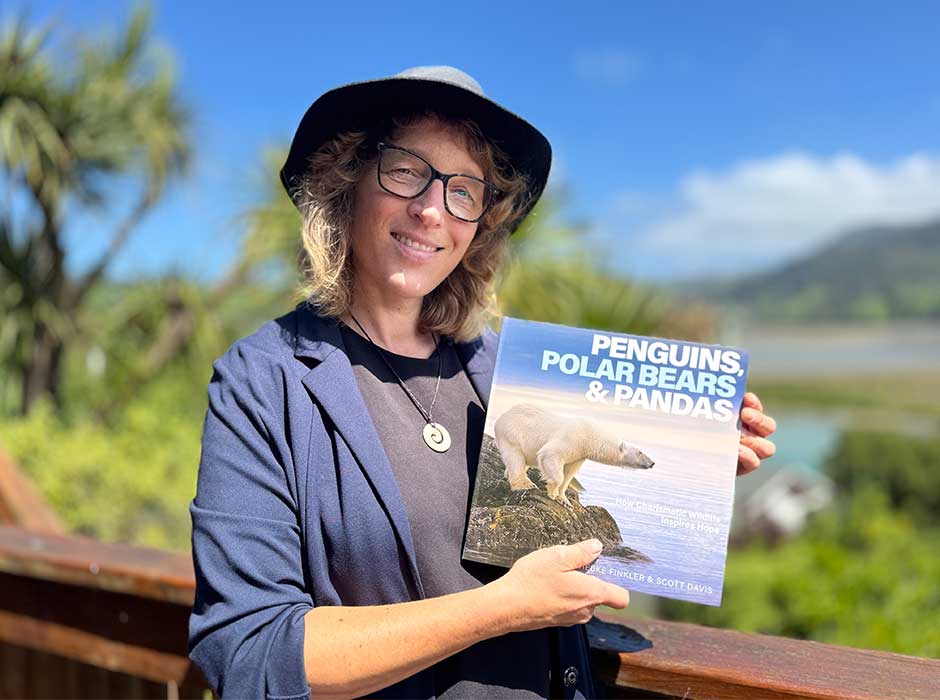
Dr Wiebke Finkler hopes her new book nudges readers nature-wards. “Sometimes it’s simply about paying attention to what’s right in front of us. A bird in the garden, an insect on a leaf or the changing seasons. I hope the book encourages people to slow down a little, look up from their screens and rediscover some of that everyday wonder.”
There’s a giddy revelation at the start of Dr Wiebke Finkler’s new book, Penguins, Polar Bears and Pandas: How Charismatic Wildlife Inspires Hope – one that says much about the slant of her inner compass.
“I must start with a confession: I love life. Even now – in a world crowded with conflict, climate anxiety and headlines that weigh heavily on the heart – I remain a complete and utter life-addict – someone who finds her daily high in small moments,” Wiebke writes.
She goes on to say that from a young age she found her bliss by lying in the grass of her local forest in Germany, observing the tiny, heroic labours of ladybirds and ants, or watching the graceful avian theatre overhead.
Several decades – and a whole lot of planet droop – later, Wiebke is still one of nature’s most fervent cheerleaders. But these days she’s focused on getting others to raise their gaze creature-wards. Her tool of choice? Charismatic wildlife.
Wiebke conducts most of her wildlife ministering from the Department of Marketing. This might seem an unlikely perch for a conservationist, but once you track her academic path, it all makes perfect sense.
A love of marine and ocean mammals led her through a Postgraduate Diploma in Science, a Master’s in Marine Science, a Postgraduate Diploma in Natural History Filmmaking and Communication, and a PhD in Tourism on sustainable whale watching.
“As I became more involved in conservation research, I realised that producing scientific knowledge was only part of the picture. We can know an enormous amount about environmental problems, but that knowledge doesn’t automatically translate into people doing things differently.”
Keen to make science more engaging and meaningful to an audience beyond academia, Wiebke strayed into new academic territory – marketing. She says it turned out to be a wonderful fit, for it offered an alternative means of addressing social and environmental challenges.
“At its core, marketing is about understanding human behaviour and influencing choices. Those same principles can be used to encourage people to reduce waste, protect biodiversity, improve their health or support their communities.
“Of course, there’s also a tension here. Marketing has contributed to some of the consumption patterns that have created our environmental problems in the first place. But that also means the discipline has a responsibility, and an opportunity, to be part of the solution. I think that’s a really exciting space to work in.”
For a crusading sciencey sort like Wiebke, marketing held fresh promise.
“Scientists are generally very good at understanding their subject matter, but we’re not always equally good at understanding the people we’re trying to communicate with. Marketing encourages us to start with the audience rather than the information we want to share.”
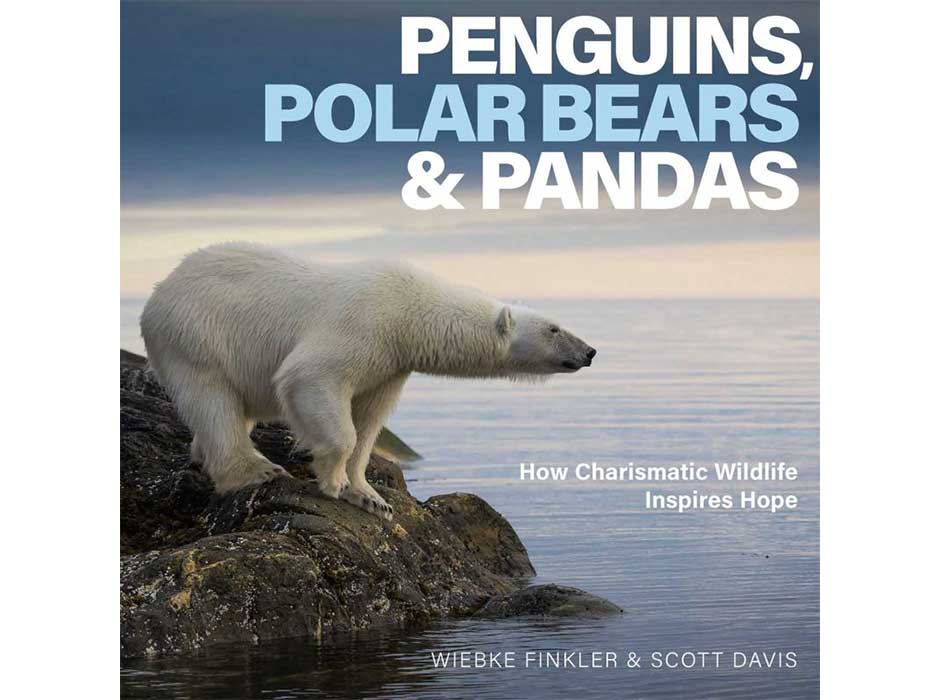
'Penguins, Polar Bears and Pandas' by Dr Wiebke Finkler with photos by Scott Davis (Exisle Publishing, 2026).
She walked the talk on this front in her new book, for it hits the mark on the audience-wooing front from the get-go. A revised edition of her previous work, The Science of Hope (which won the Foreword INDIES Gold Award in 2021), it hooks readers with lush imagery by wildlife photographer Scott Davis.
Alongside Scott’s visual morsels, Wiebke leads the reader through a range of inspiring conservation stories from around the world. And while her aim is to galvanise pro-environmental behaviour, there’s no earnest or hectoring tone here. Instead, Wiebke smuggles her messaging in via the Trojan horse of hope.
Having spent many hours enduring doom-laden “obituaries for nature” on the conservation conference circuit, Wiebke was more than ready to deploy some uplift.
“Constantly telling people how terrible everything is doesn’t necessarily inspire them to do something about it. Quite the opposite, in fact.”
Positive stories about the likes of penguins, polar bears and pandas, on the other hand, tread a tonic-rich route.
“Charismatic animals can provide an emotional doorway onto much bigger environmental issues.”
When asked if she’s always been a cup-half-full sort, Wiebke’s response shows that she’s no blithe Pollyanna.
“My outlook on life is less about believing everything will turn out well and more about recognising how precious life is, and how much agency we have in shaping our own stories.
“There’s a personal reason for this. When I was 15, I was diagnosed with a brain tumour. Some pretty difficult years followed, and at the time it certainly didn't feel like a positive turn of fate. But even back then, I began to realise that the experience had given me a different perspective on life.
“Being confronted with my own mortality so young taught me not to take myself too seriously, to appreciate the time we have and to recognise that we're all just small players in this extraordinary theatre of life. Our time here is both fragile and wonderful.”
She says this hard-won philosophy has shaped her professional life too.
“It drives my curiosity, my love of creative work and storytelling, and perhaps most importantly, my approach to teaching. As I get older, I find myself wanting more and more to encourage the next generation to be curious, courageous and willing to find and shape their own paths in life.”
These days, Wiebke splits her time between making films, writing books, and teaching papers in creative marketing. She’s pretty sure she’s hit the jackpot on this. But would her ladybird-worshipping younger self have approved of this career trajectory?
“I think she’d be rather surprised that I ended up in a business school! But she’d be delighted that I still get to spend so much of my life thinking about animals, nature and how we can protect the things we care about.
“These days I'm more likely to be holding a camera, writing a book or discussing behaviour change with students than collecting insects in the forest. But the underlying motivation is remarkably similar. I still want people to notice the natural world, appreciate it and feel inspired to look after it.
“And perhaps that’s the nicest thing about where I've ended up. Despite all the twists and turns, I haven't really moved that far away from what I loved doing as a child.”
-Kōrero by Claire Finlayson, Communications Adviser (Otago Business School)
MART333 Creative Marketing Communication
A project-driven paper that examines creativity in marketing communication, focusing on mobile and multimedia contexts.
View