
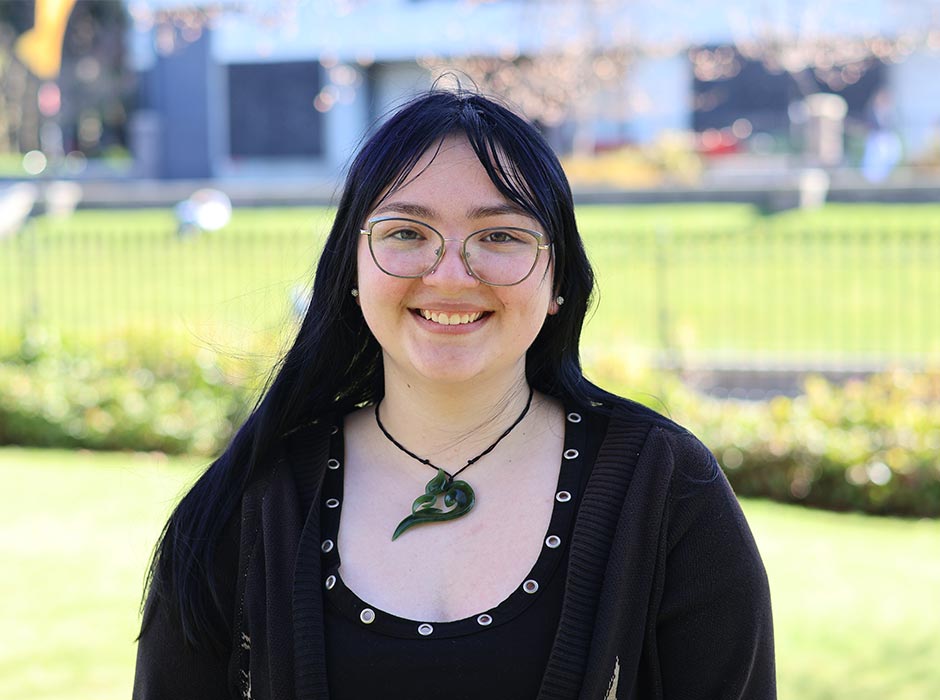
Rachel Eckhold is in her third year studying towards a degree in Physics with a minor in Māori Studies. Rachel recently collaborated with Professional Practice Fellow Kiringāua Cassidy to translate a cosmology poster into Te Reo.
If third-year Physics and Māori Studies tauira Rachel Eckhold (Kāti Māmoe, Kāi Tahu) could go anywhere in space and survive, she would choose to explore a dark, spinning place where matter is crushed and not even light can escape.
“I would go inside a black a hole, because they’re so mysterious and the way they behave breaks a million rules of physics,” Rachel says.
“I’d tell everyone what I’d learnt, and I would probably get quite rich and win a Nobel prize. It would really satiate my thirst for knowledge.”
Exploring dark, galactic realms might not be everyone’s destiny, but Rachel’s interest in cosmology was written in the stars.
“I’ve always had big questions about the universe and how it came to be, and that's what inspired me to do a Physics degree,” Rachel says.
“For me, that’s where all the answers are for the questions that I have.”
Rachel’s Kāti Māmoe and Kāi Tahu ancestors also looked to the heavens for answers.
“Māori culture at its core used to be a seafaring culture, and people navigated through the Pacific using star maps,” Rachel says.
“The Māori calendar revolves around moon cycles, with the atua – the ancestors – being constellations in the sky. Being able to work on something cosmology-based feels very in line with my cultural traditions.”
But the synergies between Māori culture and hard science weren’t always obvious to Rachel growing up.
“Physics can come across as quite separate and quite westernised. There’s a kind of narrative that science is a very ‘numbers thing’, and that doesn’t always mesh well with the holistic Māori world view.”
And coming from the predominantly Pākehā city of Invercargill, Rachel says even connecting with her cultural identity had its challenges.
“My marae and all my geographical markers like mountains and rivers are around the Ōraka, Colac Bay area. But there’s not that many of us, and every Māori family has some aspect of generational trauma with culture loss.”
As she’s learnt more about Te Ao Māori and Physics, Rachel’s found ways to combine them – with a little push from someone who saw her star potential.
“I approached Associate Professor Florian Beyer last summer to say I was interested in outer space and wanted some experience working in that field,” Rachel says.
Florian works in the Mathematics and Statistics Department, where he explores cosmological models and is a member of the Relativity Group.
“He gave me a project to work on, so I essentially spent the summer looking at different mathematical models for our universe,” Rachel says.
“A lot of people have a natural morbid curiosity about how it’s all going to end, so we thought it would be a fun idea to turn the findings into a poster and make them a bit more accessible for people.”
“Maths is truly the language of the universe. I was looking at density, radiation, dark energy and how if you play around with those a little bit you can find out how the universe will end – in billions of billions of years,” she adds, reassuringly.
“A lot of people have a natural morbid curiosity about how it’s all going to end, so we thought it would be a fun idea to turn the findings into a poster and make them a bit more accessible for people.”
Florian says Rachel’s project demonstrates how mathematics can help us explore big questions about the universe.
“What I find amazing and so exciting about this entire research field, which Rachel has contributed to, is that maths allows us humans to meaningfully connect to something as remote from everyday life as the universe and its history,” Florian says.
Noticing the alignment between cosmology and the Māori worldview, Florian suggested that Rachel create two versions of the poster, with one written in English and the other in Te Reo Māori.
“As soon as he said that I was like, ‘yeah that would be super awesome!’,” Rachel says.
“It’s good to showcase that using Te Reo in science is a possibly, and it’s great for me personally, because I don’t have to leave any of my identity behind at the door."
Rachel enlisted the help of her friend Kiringāua Cassidy (Kāi Tahu, Ngāpuhi, Ngāti Mutunga, Te Ātiawa), a Professional Practice Fellow within Te Tumu School of Māori, Pacific and Indigenous Studies, to help translate the poster.
“Te Reo is definitely still part of the personal journey I’m on,” Rachel says.
“Taking the first step to learn it can be quite a leap, but having input from people like Kiringāua has been really valuable to me. I definitely know a lot more Te Reo Māori now than when I started here.”
Rachel says that combining her Māori identity with her passion for the sciences has inspired her to help others.
“Aside from the research itself being really fun, the opportunity to translate the poster has been quite important for me specifically. I’m now working on creating a learning resource for students in Physics that connects with the Māori world view and knowledge base.”
Rachel would recommend a Physics degree to anyone who’s interested in asking big questions about our universe. And she’d love to see more tauira Māori in science.
“The advice I would give to any Māori kid wanting to do any science is just do it. If there's not the space for you, just make the space. We all deserve to be able to pursue whatever we want to pursue.”
– Kōrero by Kathryn van Beek, Communications Advisor | Kaiarataki Pārokoroko
Mathematics at Otago
Studying Mathematics at Otago lays the foundation and provides the skills for solving real-life problems. Everything comes down to maths.
More about Mathematics