
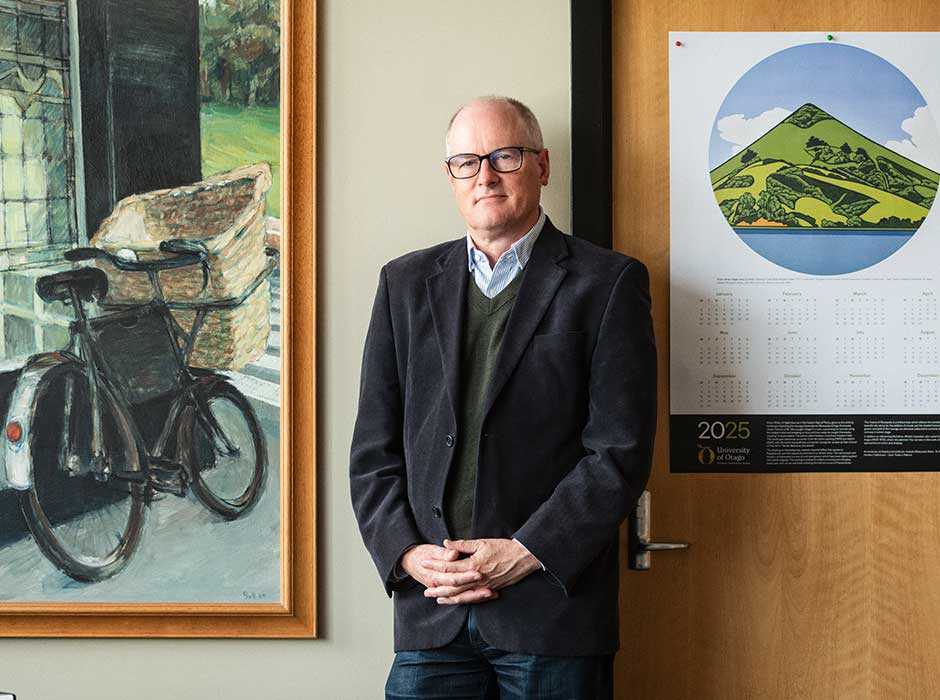
Professor Hugh Campbell: “As Arendt warned: when we lose the ability to carefully debate what is true and false, we become the perfect subjects for anti-democratic rule. We learn to hate more passionately and think less carefully.” Photo: Alan Dove.
OPINION - As funding for the Humanities faces increasing threats, Otago’s new Pro-Vice-Chancellor (Humanities) Professor Hugh Campbell warns their decline could leave society without the critical thinking and ethical insight needed to navigate today’s challenges.
For many older Humanities’ scholars, there is a particular niche on our bookshelf (usually slightly dusty) that might loosely be titled ‘Never Again!’ . It is the part of our book collection concerned with terrible and compelling issues of the past – things that have thankfully faded into lesser significance as society, politics and culture have moved on. Among these dusty tomes sits the work of Hannah Arendt, the world’s pre-eminent scholar of the emergence of a peculiarly modern form of state terror in the 20th century. Her celebrated masterwork, The Origins of Totalitarianism, was published in 1951 but slowly fell out of view at the end of the Cold War.
Over the past 10 years, Arendt has reappeared in Humanities courses around the world – including in Aotearoa New Zealand – as we are increasingly confronted by new authoritarian governments, attacks on universities and research, and the growing normalisation of the internet as the primary arena in which we debate and establish ‘truths’ in society.
These are not merely alarmist concerns. One Swedish think tank estimated that in 2023 democratic systems were in retreat, with 72 per cent of the world’s population now living under some form of autocratic rule. That study predated the election of the second Trump presidency, which appears to be placing pressure on the liberal democratic credentials of one major component of the remaining 28 per cent. These are precisely the moments when the dynamics of authoritarianism should be at the forefront of our minds.
Arendt’s journey to becoming one of the great scholars of authoritarianism was fraught with peril. As a German Jewish intellectual in the 1930s, she narrowly survived being sent to her death by the Nazi and Vichy French regimes on no fewer than three occasions. From behind enemy lines, she helped orchestrate a perilous escape for herself and numerous other Jewish refugees, travelling from France into Spain and then via Portugal to the United States (US).
Her escape from the Holocaust provided her with profound insights into the terrible powers of authoritarian states. Settled into the US after the war, she became a celebrated (and highly controversial) public intellectual – and a passionate advocate for critical and reflective thinking as a core element of enduring democratic systems.
The Origins of Totalitarianism addressed the unique way in which the modern, bureaucratically sophisticated states of Nazi Germany and the Soviet Union had enacted a new form of terror – totalitarianism – wherein the goal was not only to attack and destroy political enemies but to attack reality itself. Totalitarianism succeeded partly through the destruction of any agreed-upon sense of reality:
“The ideal subject of totalitarian rule is not the convinced Nazi or the convinced communist, but people for whom the distinction between fact and fiction … and the distinction between true and false … no longer exist.”
Arendt argued that what held the slide into authoritarian rule in check were critical societal sites of intellectual debate: an independent judiciary, trade unions, journalism and critical independent writing. But above all, it was the free and independent university. It was in universities that authoritarian tendencies met their match in institutional principles of free thinking, education grounded in critical debate, and the celebration of the values of free inquiry, careful scholarship and creative endeavour in the arts and sciences.
After almost half a century, Arendt’s famous analysis receded into the background. The Cold War ended. State investment in universities surged in the 1960s, ’70s and ’80s, and a strong political consensus emerged that universities – including Humanities subjects – were fundamental to the success of liberal democratic societies.
“Humanities’ scholars are the watchdogs of liberal democracy, barking out a warning on behalf of the dwindling 28 per cent who still live in a liberal democratic world.”
Two dramatically powerful forces have brought Arendt off the old dusty bookshelf and back into the curriculum. First, liberal democratic government is in retreat around the world. One characteristic of 21st century authoritarianism is a renewed attack on knowledge, expertise and ‘shared reality’. Governments in countries like Hungary, Russia, Turkey and India systematically erode sites of independent expertise: the courts, media and universities. Arendt’s warning signs from the mid-20th century are beginning to mount around us.
The second force is the internet – something Arendt could never have imagined, but which has become the primary source of ‘authoritative’ information for an increasing number of people. The internet is the stuff of Arendt’s nightmares: a medium allowing political forces to directly undermine key elements of the shared social reality built from reflective expertise. It is a shallow and unreflective forum of narrow debates, riven with confirmation bias, and openly manipulated both by corporate algorithms designed to increase profit and by the direct interventions of authoritarian state actors. It has become the indispensable tool of authoritarianism and has begun to progressively erode norms of political debate, including in Aotearoa New Zealand. As Arendt warned: when we lose the ability to carefully debate what is true and false, we become the perfect subjects for anti-democratic rule. We learn to hate more passionately and think less carefully.
It is not just the Humanities that are under threat. Urgent scientific issues – such as understanding and mitigating the effects of climate change or the value of immunisation – are being dramatically undermined online, draining the political will to address some of the most critical issues of the 21st century. The battle for the Humanities will, in part, determine whether orthodox scientific endeavour can continue to play a meaningful role in understanding and solving complex social challenges.
This is why we need the Humanities, and why at the emerging heart of malevolent political forces around the world, lie attacks on Humanities scholarship at universities and on research in general. Political attacks on the Humanities have even begun to surface in Aotearoa New Zealand with the selective repositioning of Marsden Funding and other attempts to defund the work of Humanities’ scholars.
This is the age of the internet and internet-driven politics – and the destination is dire. In response, we must maintain Arendt’s firewalls: the independent media, the legal system and, above all, the university. Humanities’ scholars are the watchdogs of liberal democracy, barking out a warning on behalf of the dwindling 28 per cent who still live in a liberal democratic world.
It is for all these reasons that many of us kept a copy of The Origins of Totalitarianism on our bookshelves: for the dreaded moment when it all began to happen again.
This story first appeared in issue 58 of the University of Otago Magazine. Check out the full edition here.
Studying Humanities
Humanities subjects are for students interested in people, how they think and how they act, and why they behave in certain ways. Not just individual behaviour, but groups and societies; learning from the past how people are likely to behave in the future.
Find out more